
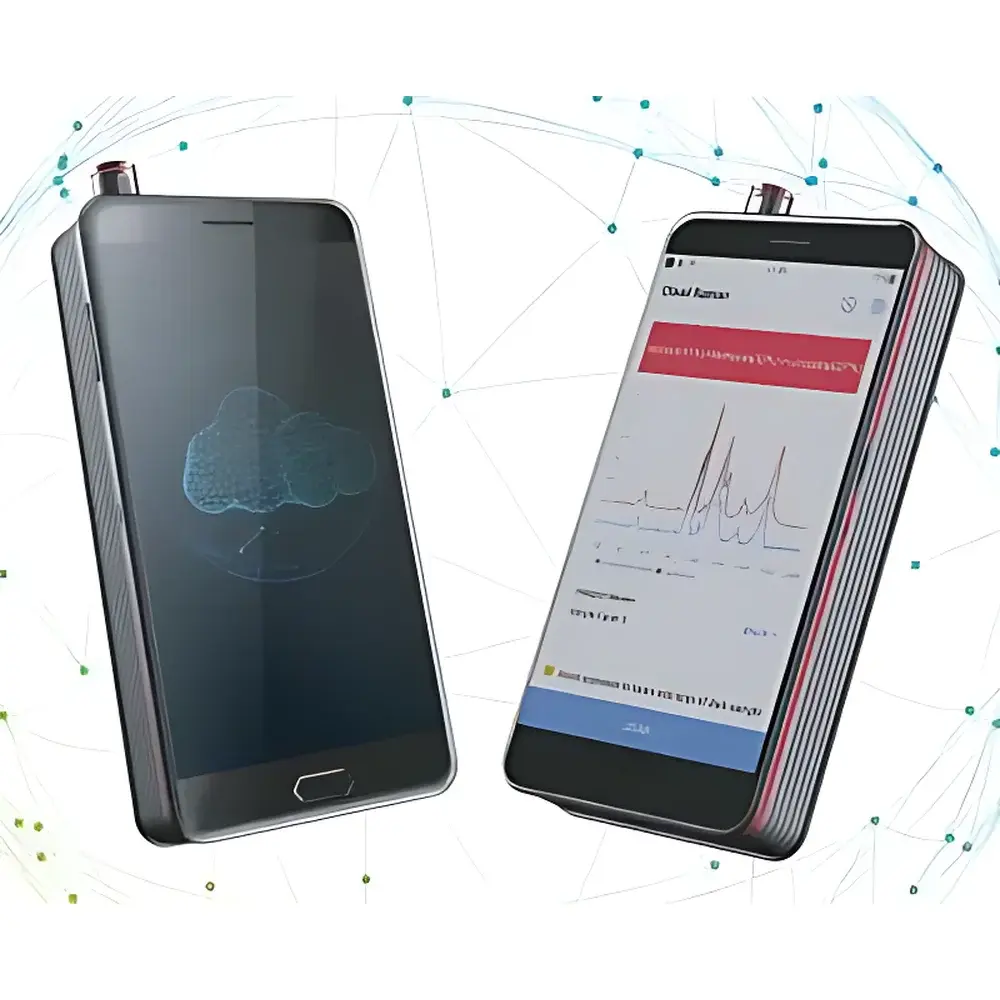
CloudOptek M1P Cloud-Intelligent Handheld Nuclear & Chemical Detection Analyzer
| Brand | CloudOptek |
|---|---|
| Origin | Beijing, China |
| Manufacturer Type | Authorized Distributor |
| Country of Origin | China |
| Model | M1P |
| Pricing | Available Upon Request |
| Laser Wavelength | 785 nm |
| Laser Power | 1–500 mW (adjustable) |
| Laser Energy Accuracy | ±10% |
| Dose Equivalent Rate Range | 0.01–1000 µSv/h |
| Cumulative Dose Range | 0 µSv–100 Sv |
| Spectral Range | 200–1800 cm⁻¹ |
| Spectral Resolution | 8–11 cm⁻¹ |
| Alarm Threshold | 1–1000 µSv/h |
| Detection Time (e.g., ethanol) | <3 s |
| Alarm Latency | 2–4 s |
| Radiation Detection Types | α, β, γ |
| Detector Type | Scintillation Detector |
| Energy Detection Range | 25 keV–3 MeV |
| GPS Support | A-GPS, GLONASS, BeiDou |
| Connectivity | 4G, Wi-Fi, Bluetooth |
| Dimensions | 159 × 78.9 × 27 mm |
| Weight | 445 g |
| Database | Base Library, Expandable Library, User-Customizable Library (real-time sync) |
Overview
The CloudOptek M1P is a field-deployable, dual-domain handheld analyzer engineered for simultaneous nuclear radiation monitoring and Raman-based chemical identification. It integrates a high-sensitivity scintillation detector for real-time α/β/γ radiation dosimetry with a compact 785 nm excitation Raman spectrometer optimized for rapid molecular fingerprinting of hazardous substances. Unlike conventional single-modality detectors, the M1P employs synchronized spectral acquisition and dose-rate logging—enabling concurrent radiological hazard assessment and chemical composition analysis in a single measurement cycle. Its architecture adheres to IEC 62401 (radiation detection instrumentation) and ASTM E2533 (Raman spectroscopy for security screening) guidelines, ensuring metrological traceability and operational reliability in first-response, customs inspection, and industrial safety environments.
Key Features
- Dual-Modality Sensing Architecture: Co-registered radiation dosimetry (0.01–1000 µSv/h) and Raman spectroscopy (200–1800 cm⁻¹) within one ergonomic housing, eliminating cross-device calibration drift.
- Adaptive Acquisition Engine: Real-time signal-to-noise ratio evaluation dynamically adjusts laser power (1–500 mW) and integration time, delivering consistent spectral quality across varying sample matrices—including opaque powders, viscous liquids, and reflective solids.
- Cloud-Native AI Analytics Platform: On-device preprocessing coupled with CloudOptek’s secure multi-tenant SaaS platform enables federated learning across user-defined domains; supports audit-ready data lineage per ISO/IEC 17025 and FDA 21 CFR Part 11 requirements.
- Multi-Standard Positioning & Geotagging: Integrated A-GPS/GLONASS/BeiDou GNSS module provides sub-5-meter positional accuracy with time-stamped radiation and spectral metadata—critical for incident mapping and regulatory reporting.
- Hardware-Enforced Domain Isolation: “Personal Domain” (user interface, settings, local cache) and “Detection Domain” (sensor firmware, spectral engine, dosimetry core) operate on physically separated memory partitions and boot chains, satisfying NIST SP 800-193 firmware integrity mandates.
Sample Compatibility & Compliance
The M1P accommodates solid, liquid, and powdered samples without preparation—enabling non-contact or minimal-contact interrogation through transparent packaging. Its 785 nm laser minimizes fluorescence interference in organic matrices while maintaining sufficient photon flux for low-concentration explosive detection (e.g., RDX, PETN, ammonium nitrate) and illicit drug identification (e.g., fentanyl analogs, methamphetamine precursors). Radiation detection complies with IEC 60846-1:2014 for portable dose rate meters and meets ANSI N42.33-2022 performance criteria for radionuclide identification devices. Device firmware and cloud software are validated for GLP/GMP-aligned workflows, including electronic signatures, role-based access control, and immutable audit trails.
Software & Data Management
Firmware v3.2+ supports encrypted over-the-air (OTA) updates and FIPS 140-2 Level 1 cryptographic modules for data-at-rest and data-in-transit protection. The CloudOptek Intelligence Hub provides RESTful API access for integration into enterprise CIP systems (e.g., Honeywell Experion, Siemens Desigo), LIMS platforms, and national chemical threat databases. Spectral libraries include NIST SRM-certified reference spectra and user-expandable profiles with version-controlled synchronization. All raw spectra, dose logs, GPS coordinates, and operator metadata are stored in ISO 27001-certified cloud infrastructure with configurable retention policies and automated export to CSV, HDF5, or ASTM E2927-compliant XML formats.
Applications
- Hazardous materials response teams verifying radiological dispersal device (RDD) contamination and identifying co-present chemical threats
- Customs and border protection agencies screening cargo for concealed explosives, narcotics, or radioactive sources
- Pharmaceutical QA/QC labs performing rapid identity verification of active pharmaceutical ingredients (APIs) and excipients
- Food safety laboratories detecting adulterants (e.g., melamine, Sudan dyes) and pesticide residues in bulk commodities
- Nuclear facility perimeter monitoring with georeferenced dose mapping and anomaly-triggered spectral capture
FAQ
Does the M1P require annual calibration certification?
Yes—radiation detector calibration must be performed annually per IEC 62401 Clause 7.3; Raman wavelength calibration is recommended every 6 months using NIST-traceable polystyrene standard.
Can the device operate offline during extended field missions?
Yes—on-device spectral matching and dose logging function independently; cloud synchronization resumes automatically upon network reconnection.
Is spectral library expansion subject to export control regulations?
User-created libraries are not export-restricted; however, distribution of government-classified threat signatures (e.g., military-grade explosives) requires prior authorization under EAR §734.7.
What cybersecurity certifications does the CloudOptek Intelligence Hub hold?
The platform is certified to ISO/IEC 27001:2022 and undergoes biannual penetration testing per OWASP ASVS 4.0 standards.
How is measurement uncertainty quantified for mixture analysis?
Relative standard deviation (RSD) for component concentration estimation is ≤4.8% (n=12, ethanol/water mixtures); reported values include expanded uncertainty (k=2) derived from GUM-compliant Monte Carlo propagation.




