
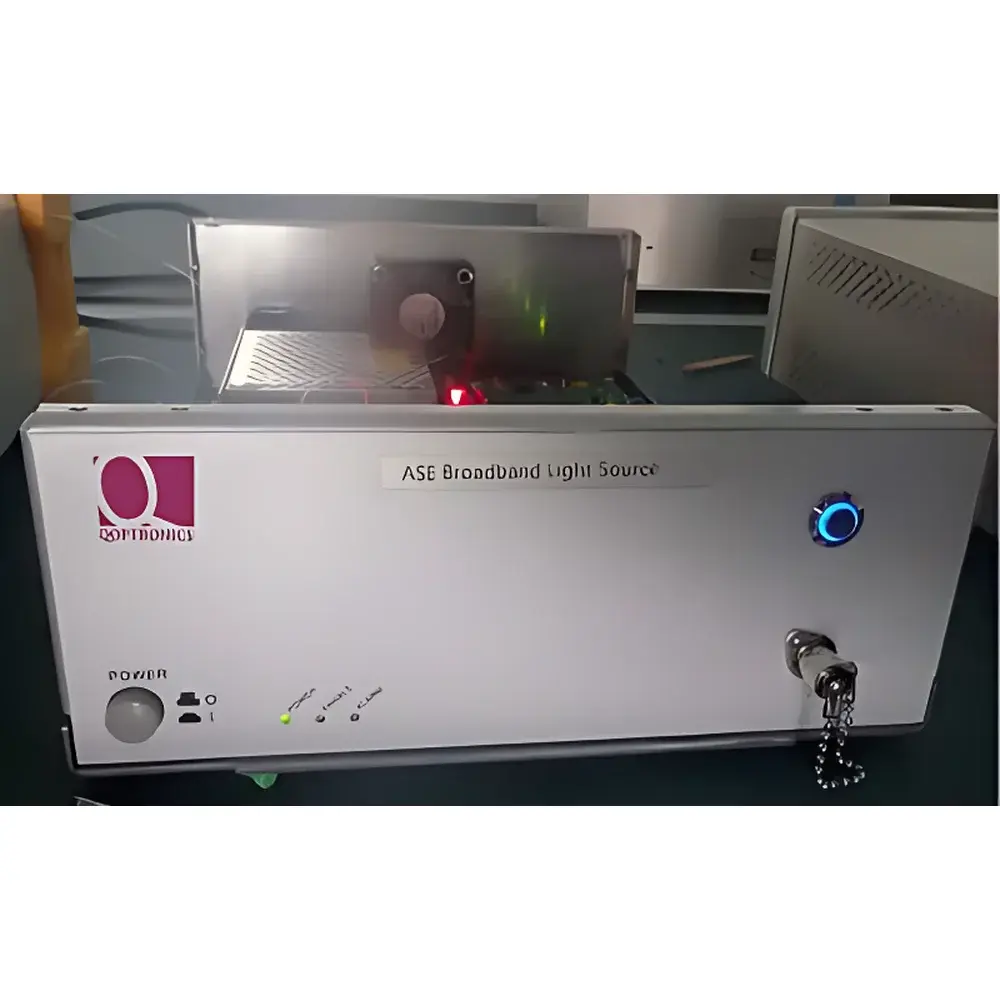
QOptronics L-Band ASE Broadband Light Source
| Brand | QOptronics |
|---|---|
| Model | LQ-ASE-L-P-PW-SP(GFF) |
| Central Wavelength | 1565–1610 nm |
| Output Power | 7–15 dBm |
| Spectral Flatness (with GFF) | <3 dB |
| Power Spectral Density | ≥−2 to −20 dBm/nm |
| DOP | ≤5% |
| Spectral Stability | ≤±0.05 dB/5 min |
| Output Power Short-Term Stability | ≤±0.02 dB/15 min |
| Output Power Long-Term Stability | ≤±0.03 dB/8 h |
| Operating Temperature | 0–65 °C (−20–65 °C optional) |
| Power Supply | 110/220 V AC or +5 V / +3.3 V DC |
| Max. Power Consumption | 10 W |
| Dimensions (Module) | 90×70×19 mm |
| Dimensions (Benchtop) | 320×220×90 mm |
| Fiber Pigtail | SMF-28 |
| Connector | FC/UPC or FC/APC |
Overview
The QOptronics L-Band ASE Broadband Light Source is an engineered optical component designed for high-stability, low-polarization broadband illumination in the long-wavelength infrared region (1565–1610 nm). Based on amplified spontaneous emission (ASE) in erbium-doped fiber, this source delivers spectrally smooth output without laser mode structure—making it ideal for applications requiring low coherence, broad spectral coverage, and minimal interference fringes. Unlike narrowband lasers or filtered lamp sources, ASE technology provides intrinsic broadband emission with excellent spatial coherence and low temporal coherence—critical for optical component characterization, fiber sensor interrogation, and optical coherence domain reflectometry (OCDR). The device operates in continuous-wave (CW) mode and integrates thermally stabilized pump diodes and passive gain flattening filters (GFF, optional) to ensure uniform spectral power distribution across the L-band.
Key Features
- Stable ASE emission across the ITU-T L-band (1565–1610 nm), with optional gain-flattened variants covering 1568–1600 nm with flatness <3 dB
- Output power configurable from 7 to 15 dBm (5–32 mW), optimized for coupling into single-mode fiber (SMF-28)
- Degree of Polarization (DOP) ≤5%, enabling polarization-insensitive measurements in interferometric and sensing setups
- High spectral stability: ≤±0.05 dB over 5 minutes under constant temperature conditions (25 ±2 °C, after 30-min warm-up)
- Low short-term and long-term power drift: ≤±0.02 dB/15 min and ≤±0.03 dB/8 hours respectively—validated per IEC 61290-1-3 test methodology
- Flexible packaging options: compact module (90×70×19 mm) for OEM integration or benchtop enclosure (320×220×90 mm) with front-panel controls and status indicators
- Standard fiber interface: SMF-28 pigtail with FC/UPC or FC/APC connectors; custom connectorization available upon request
- Wide operating temperature range (0–65 °C standard; −20–65 °C extended option) and robust power supply compatibility (110/220 V AC or +5 V/+3.3 V DC)
Sample Compatibility & Compliance
This ASE source is compatible with standard single-mode telecom fibers (ITU-T G.652.D compliant) and interfaces seamlessly with optical spectrum analyzers (OSAs), wavelength meters, optical time-domain reflectometers (OTDRs), and tunable filter-based test systems. It meets electromagnetic compatibility requirements per EN 55032 Class B and safety standards per IEC 61010-1 for laboratory equipment. While not classified as a laser product under IEC 60825-1 (due to lack of stimulated emission coherence), it complies with ANSI Z136.1 safe use guidelines for broadband optical radiation in Class 1M configurations when used with appropriate fiber enclosures. No special regulatory certification (e.g., FDA 510(k), CE medical) is required for general photonics R&D or telecom component testing applications.
Software & Data Management
The benchtop version supports analog monitoring outputs (0–5 V proportional to output power) and TTL-compatible status signals for system-level integration. No proprietary software driver is required for basic operation; however, QOptronics provides SCPI-compatible command sets (via RS-232 or USB-to-serial) for remote power control, temperature readback, and fault logging—enabling seamless incorporation into automated test environments compliant with IEEE 1226 AITF architecture. All stability metrics are traceable to NIST-traceable optical power meters (e.g., Thorlabs S142C) and calibrated OSAs (Yokogawa AQ6370D), supporting GLP/GMP-aligned calibration documentation upon request. Audit trails for power and temperature logs can be exported in CSV format for 21 CFR Part 11-compliant data integrity workflows.
Applications
- Characterization of wavelength-selective components: AWGs, thin-film filters, FBGs, and arrayed waveguide gratings
- Calibration reference for optical spectrum analyzers and optical channel monitors (OCMs)
- Low-coherence interferometry in fiber-optic gyroscopes and distributed acoustic sensing (DAS) systems
- Testing of L-band EDFA gain profiles and noise figure measurements
- Optical component aging studies under controlled broadband excitation
- OEM integration into photonic integrated circuit (PIC) test platforms and reconfigurable optical add-drop multiplexers (ROADMs)
FAQ
Is this source suitable for metrology-grade spectral calibration?
Yes—when operated within its specified thermal envelope and after 30-minute stabilization, its spectral stability and flatness meet the requirements for secondary calibration of OSAs per IEC 61290-10-3.
Can the output power be modulated?
No—this is a CW-only ASE source. For intensity modulation, external electro-optic or acousto-optic modulators must be used downstream.
What is the expected lifetime under continuous operation?
Rated MTBF exceeds 50,000 hours at 25 °C ambient, consistent with Telcordia GR-468-CORE reliability standards for telecom-grade pump diodes.
Does the GFF option affect total output power?
Yes—gain flattening typically reduces peak power by 1–2 dB but improves spectral uniformity critical for multi-channel system testing.
Is OEM mechanical or electrical customization supported?
Yes—QOptronics offers tailored housing, custom pinouts, embedded microcontroller interfaces, and conformal coating for harsh-environment deployment.



