
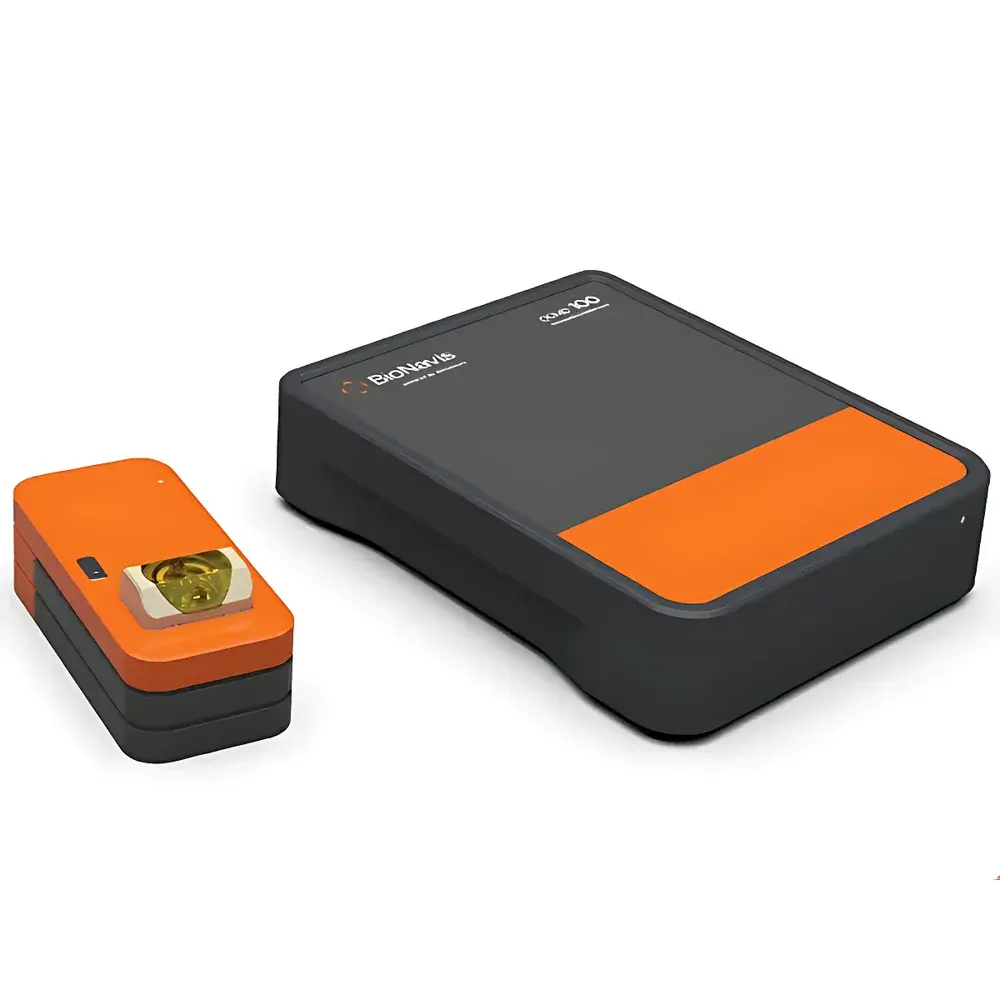
BioNavis QCMD 100 Quartz Crystal Microbalance with Dissipation Monitoring
| Brand | BioNavis |
|---|---|
| Origin | Finland |
| Model | QCMD 100 |
| Frequency Range | 4 MHz – 160 MHz |
Overview
The BioNavis QCMD 100 is a high-precision, single-channel Quartz Crystal Microbalance with Dissipation monitoring (QCM-D) system engineered for label-free, real-time analysis of interfacial mass changes and viscoelastic properties at solid–liquid or solid–gas interfaces. Based on the piezoelectric resonance principle, the instrument measures shifts in the resonant frequency (Δf) and energy dissipation (ΔD) of AT-cut quartz crystals upon mass adsorption, film formation, or structural rearrangement at the sensor surface. Unlike conventional QCM systems that assume rigid, thin-film behavior, QCMD 100 explicitly accounts for energy loss mechanisms—enabling quantitative differentiation between rigid mass uptake and soft, hydrated, or viscoelastic layer formation. This dual-parameter measurement capability makes it indispensable for characterizing dynamic molecular interactions, thin-film growth kinetics, and surface-bound processes across diverse scientific domains including biophysics, materials science, electrochemistry, and industrial corrosion research.
Key Features
- Simultaneous high-resolution measurement of frequency shift (Δf) and dissipation factor (ΔD) across 4–160 MHz fundamental and harmonic overtones
- Modular hardware architecture supporting optional integration of temperature control, flow cells, electrochemical modules, and optical coupling (e.g., for combined QCM-D + SPR)
- Calibrated sensor mounting system ensuring reproducible acoustic coupling and minimal mechanical drift
- Real-time data acquisition at up to 100 Hz sampling rate, enabling kinetic resolution of sub-second binding events
- Comprehensive sensor library including gold-coated, SiO₂, Al₂O₃, TiO₂, and custom functionalized surfaces (e.g., carboxyl, amine, streptavidin, Ni-NTA)
- Software-controlled liquid handling compatibility for automated multi-step assays and concentration series
Sample Compatibility & Compliance
The QCMD 100 accommodates aqueous, organic, and mixed-solvent environments, supporting measurements under static, continuous-flow, or stopped-flow conditions. It is compatible with standard 14 mm diameter QCM sensors and accepts custom sensor geometries upon request. The system complies with laboratory safety standards for low-voltage instrumentation (IEC 61010-1) and supports GLP/GMP-aligned workflows through audit-trail-enabled software logging. While not certified as medical device hardware, its data output meets requirements for regulatory submissions where QCM-D is cited in method validation (e.g., ISO 10993-18 for biomaterial surface characterization; ASTM F2519 for protein adsorption quantification). Sensor calibration protocols follow Sauerbrey and Voigt-based modeling conventions, with built-in tools for thickness, density, and shear modulus estimation per ISO/IEC 17025 traceable procedures.
Software & Data Management
The proprietary QSoft™ software provides intuitive experiment design, real-time visualization, and advanced modeling suites—including multi-layer viscoelastic inversion, affinity fitting (1:1 Langmuir, heterogeneous ligand models), and time-resolved hydration analysis. All raw and processed data are stored in vendor-neutral HDF5 format, ensuring long-term archival integrity and third-party interoperability (e.g., MATLAB, Python via h5py, OriginLab). Software supports 21 CFR Part 11-compliant user authentication, electronic signatures, and immutable audit trails for regulated environments. Export options include CSV, PNG, SVG, and structured JSON metadata for LIMS integration. Batch processing tools enable parallel analysis of >100 sensor datasets with consistent baseline correction and noise filtering parameters.
Applications
- Biomedical Materials: Quantitative assessment of protein adsorption, cell adhesion dynamics, hydrogel swelling, and antimicrobial coating efficacy under physiological buffer conditions
- Thin-Film Deposition & Coating Science: In situ monitoring of ALD, spin-coating, Langmuir–Blodgett transfer, and self-assembled monolayer formation—including thickness, density, and mechanical stability evaluation
- Electrochemical Interfaces: Mass–charge correlation during electrodeposition, SEI layer evolution in battery electrolytes, and corrosion initiation on pipeline steels in simulated downhole brines
- Biosensing & Diagnostics: Label-free detection of antigen–antibody affinity (KD determination), DNA hybridization kinetics, and aptamer–target binding under flow-through microfluidic configurations
- Enhanced Oil Recovery (EOR) Research: Wettability alteration studies via surfactant adsorption isotherms, asphaltene deposition kinetics, and clay–hydrocarbon interaction modeling
- Cleaning & Formulation Science: Real-time quantification of soil removal efficiency, detergent–surface binding stoichiometry, and anti-fouling polymer layer stability in food-grade stainless steel environments
FAQ
What is the difference between QCM and QCM-D?
QCM measures only frequency shift (Δf), assuming rigid, thin-film mass loading (Sauerbrey regime). QCM-D adds dissipation monitoring (ΔD), enabling discrimination between rigid and soft, hydrated, or viscoelastic layers—and thus providing structural insight beyond mass alone.
Can the QCMD 100 operate in air or only in liquid?
It supports both gaseous and liquid-phase operation, though optimal sensitivity for biological applications is achieved in aqueous media using temperature-stabilized flow cells.
Is sensor regeneration possible after an experiment?
Yes—most gold and oxide sensors tolerate mild chemical regeneration (e.g., piranha solution for organics, HCl for metal oxides) or electrochemical cleaning protocols, provided mechanical integrity and crystal orientation are preserved.
Does the system support harmonic overtone analysis?
Yes—simultaneous tracking of up to 13 overtones (n = 1–13) at 4–160 MHz enables robust viscoelastic modeling using multi-frequency Voigt-based inversion algorithms.
How is temperature controlled during measurement?
An optional Peltier-based thermal module maintains ±0.1 °C stability from 4 °C to 60 °C, with integrated fluidic heat exchange for rapid equilibration in flow-cell configurations.





