
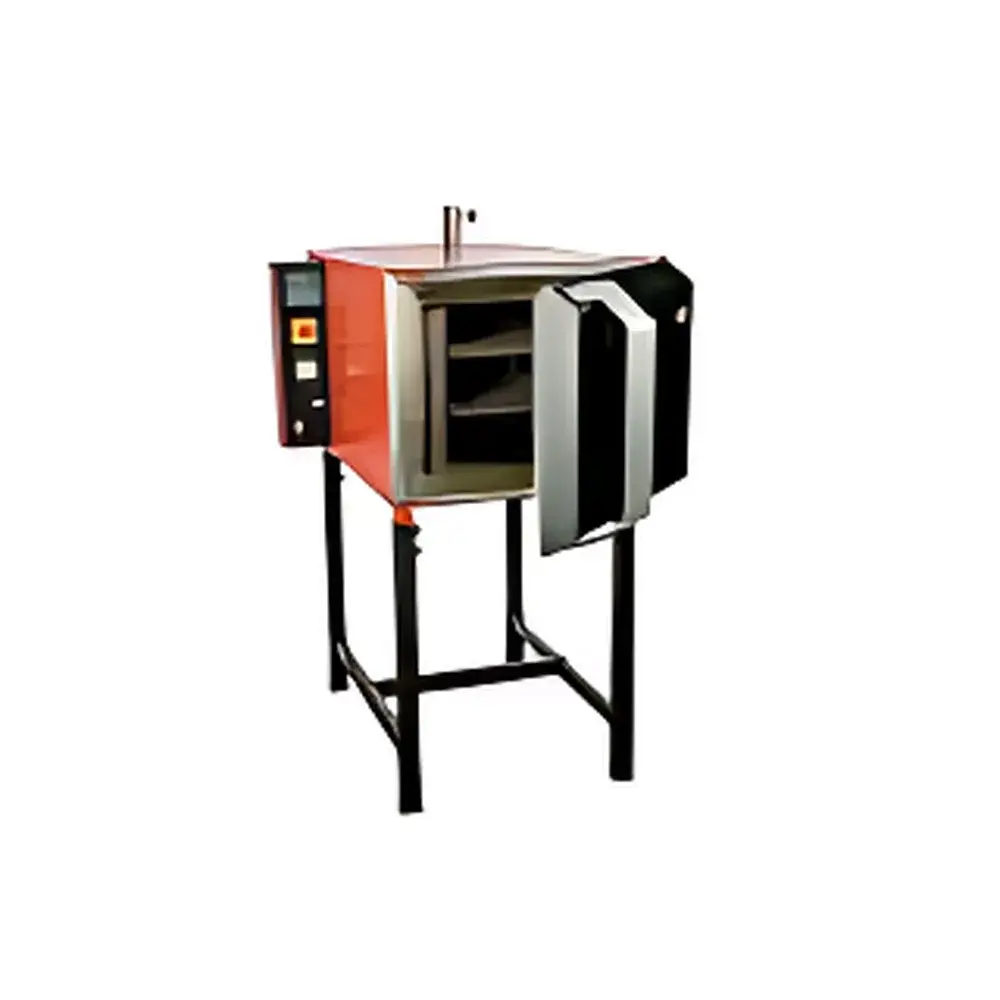
LAC PP Series Air-Circulating Box Furnace (850°C Max)
| Brand | LAC |
|---|---|
| Origin | Czech Republic |
| Model | PP 40/85 |
| Furnace Type | Benchtop/Industrial Box Furnace |
| Max Temperature | 850°C |
| Temperature Uniformity | ±2°C (per DIN 17052-1) |
| Heating Method | Resistive Wire (NiCr) |
| Internal Dimensions | 300 × 200 × 350 mm (W×H×D) |
| Volume | 21 L |
| Power Rating | 4 kW |
| Ramp Time to 850°C | ≤20 min |
| Insulation | Mineral Fiber (High-Density Ceramic Wool) |
| Controller | HT40AL Programmable Controller (30 programs, 15 segments each) |
| Thermocouple | K-Type |
| Safety Features | Door-Interlocked Terminal Switch, Overtemperature Cut-off |
| Construction | Low-Carbon Steel Outer Casing, AISI 304 Stainless Steel Chamber |
| Air Circulation | Horizontal Forced-Air System with Rear-Mounted Fan Assembly |
| Voltage | 230 V AC, 50/60 Hz |
| Weight | 130 kg |
Overview
The LAC PP Series Air-Circulating Box Furnace is a precision-engineered thermal processing system designed for laboratory and pilot-scale heat treatment applications requiring high temperature stability, exceptional uniformity, and repeatable process control. Operating on the principle of forced convection via horizontal airflow, this furnace achieves rapid thermal equilibration and minimizes axial and radial temperature gradients—critical for metallurgical processes such as tempering, annealing, normalizing, and preheating of ferrous and non-ferrous alloys. Certified to DIN 17052-1 for temperature uniformity classification, the PP 40/85 variant delivers ±2°C uniformity across its 21 L working volume at 850°C, verified under steady-state conditions per ISO 9001-compliant calibration protocols. Its robust architecture integrates a fully insulated AISI 304 stainless steel chamber, mineral fiber insulation with low thermal conductivity (<0.09 W/m·K at 600°C), and dual-side resistive heating elements ensuring symmetrical energy input and minimal thermal lag.
Key Features
- Forced-air circulation system with rear-mounted horizontal fan assembly, engineered to maintain laminar flow patterns and suppress thermal stratification
- AISI 304 stainless steel furnace chamber with high oxidation resistance up to 850°C and mechanical durability against repeated thermal cycling
- HT40AL programmable controller with real-time clock, supporting up to 30 independent thermal profiles—each comprising ≥15 programmable ramp/soak steps with slope control (°C/min) and event-triggered outputs
- Dual safety architecture: hardware-based terminal switch interrupting power upon door opening + independent overtemperature cut-off relay (setpoint adjustable)
- Mineral fiber insulation layer (≥120 mm thickness) optimized for low standby heat loss and fast recovery after door opening
- K-type thermocouple with cold-junction compensation, mounted in a thermally shielded well for long-term drift stability (<±0.5°C/year typical)
- Modular electrical cabinet located at rear for service accessibility, featuring semiconductor solid-state relays (no moving contacts) for silent, maintenance-free switching
Sample Compatibility & Compliance
The PP 40/85 accommodates standard crucibles (alumina, quartz, stainless steel), metal coupons (up to 100 mm × 50 mm × 25 mm), and small-component assemblies. Its open-atmosphere design supports ambient air, inert gas purging (via optional inlet port), or semi-sealed operation (with optional gasket upgrade). The furnace complies with IEC 61000-6-3 (EMC emission limits) and IEC 61000-6-2 (immunity), and meets CE marking requirements under the EU Machinery Directive 2006/42/EC and Low Voltage Directive 2014/35/EU. For regulated environments, it supports GLP/GMP-aligned validation: IQ/OQ documentation packages are available, and optional data logging modules comply with FDA 21 CFR Part 11 requirements when paired with validated software.
Software & Data Management
While the HT40AL controller operates autonomously, optional RS485/USB interface enables integration with LAC’s PC-based FurnaceControl Suite (v3.2+). This application provides real-time temperature graphing, profile upload/download, alarm history export (CSV), and audit-trail generation—including user ID, timestamp, parameter change log, and electronic signature support. All recorded data are time-stamped using NTP-synchronized clocks and stored with SHA-256 checksum integrity verification. Optional graphical chart recorders meet EN 14181 compliance for continuous emissions monitoring auxiliary use.
Applications
- Metallurgical heat treatment: stress relief of welded structures, spheroidization of tool steels, austempering of ductile iron
- Materials research: thermal aging studies of polymers and composites, catalyst calcination, ceramic sintering pre-burnout
- Quality control labs: ASTM E220 calibration verification of thermocouples, ISO 17025-compliant furnace qualification per EURAMET cg-18
- Electronics manufacturing: PCB pre-baking, solder paste drying, conformal coating curing
- Academic teaching: demonstration of TTT/CCT diagrams, phase transformation kinetics, and heat transfer modeling
FAQ
What standards does the temperature uniformity specification follow?
The ±2°C uniformity rating is determined per DIN 17052-1 (identical to ASTM E2203 Class 2), measured at nine points within the working zone after 30 minutes at setpoint.
Can the furnace be operated under inert atmosphere?
Yes—optional atmosphere inlet ports (ISO-KF 16 or 25) allow controlled N₂ or Ar purging; semi-sealed configuration achieves <1% O₂ residual with proper flow management.
Is validation support provided for GxP environments?
LAC supplies IQ/OQ templates, calibration certificates traceable to NIST, and optional 3rd-party FAT/SAT execution by accredited partners.
What maintenance intervals are recommended?
Thermocouple verification every 6 months; fan bearing inspection annually; insulation integrity check during major recalibration (every 2 years).
Does the controller support remote monitoring?
Via optional Ethernet module (PP-ETH-01), enabling Modbus TCP readout of PV, SP, status bits, and alarm flags into SCADA or LIMS platforms.



