
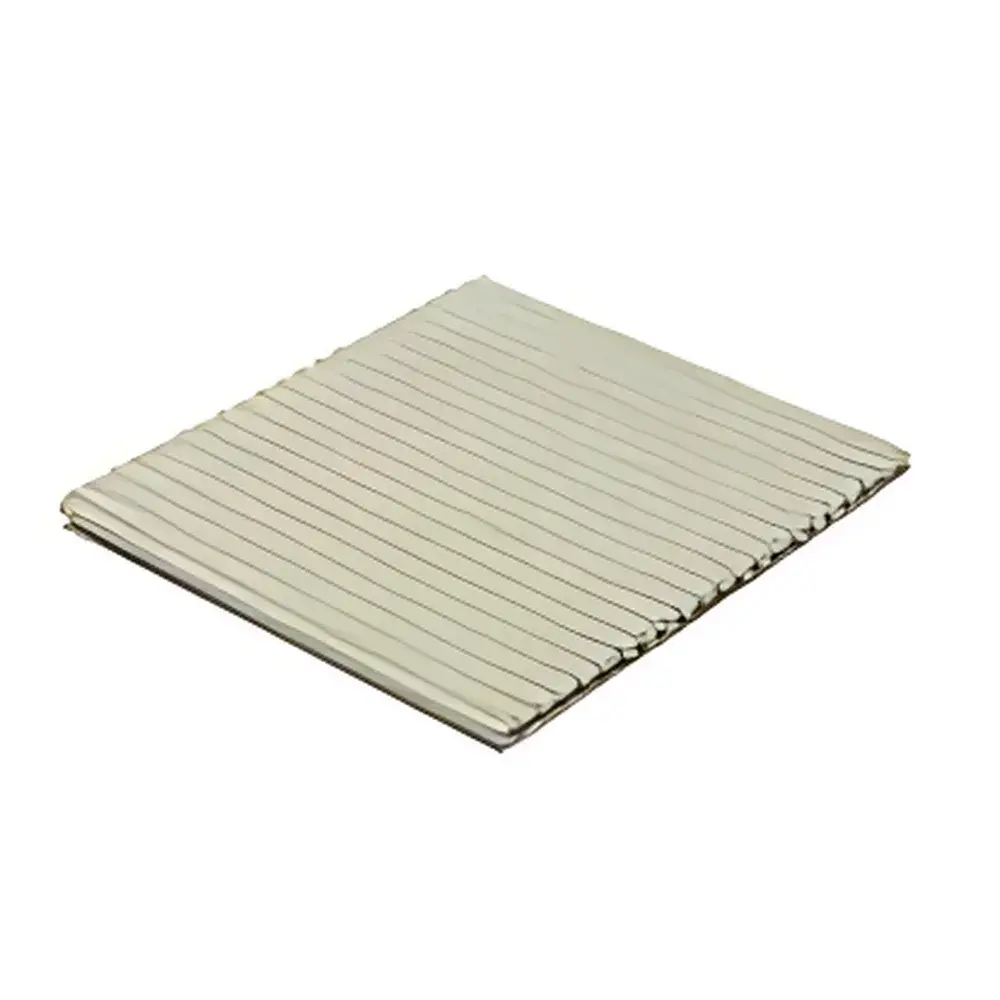
Nabertherm Corrugated Ceramic Hearth Plates for Muffle Furnaces
| Brand | Nabertherm |
|---|---|
| Origin | Germany |
| Product Type | Replacement Hearth & Collection Tray Set |
| Compatible Models | L, LT, LE, LV, LVT Series Muffle Furnaces |
| Part Numbers | 691601097, 691600507, 691600508, 691600509, 691601098, 691600506, 691600874, 691600875 |
| Material | High-Purity Alumina-Based Ceramic (Al₂O₃ ≥ 92%) |
| Thermal Stability | Up to 1300 °C Continuous |
| Surface Texture | Precision-Engineered Corrugated Profile |
| Thickness | 12 mm ±0.3 mm |
| Dimensional Tolerance | ±0.5 mm per 100 mm |
| Compliance | ISO 9001 Certified Manufacturing |
Overview
Nabertherm corrugated ceramic hearth plates are engineered replacement components designed specifically for laboratory and industrial muffle furnaces within the L, LT, LE, LV, and LVT series. These plates serve two critical functional roles: (1) protecting the furnace’s internal heating chamber floor from thermal stress, mechanical abrasion, and chemical exposure during repeated high-temperature cycles; and (2) acting as stable, inert support surfaces for crucibles, boats, and sample holders—thereby improving load uniformity and minimizing thermal distortion during annealing, ashing, calcination, or sintering processes. Constructed from high-purity alumina-based ceramic (Al₂O₃ ≥ 92%), each plate exhibits exceptional resistance to thermal shock, dimensional stability up to 1300 °C under continuous operation, and negligible reactivity with oxides, carbonates, and most inorganic salts. The precision-engineered corrugated surface geometry enhances structural rigidity while facilitating air circulation beneath samples—reducing localized hot spots and promoting more homogeneous heat transfer across the load zone.
Key Features
- High-temperature ceramic composition compliant with DIN EN 60672-3 (C130 class), rated for continuous service at 1300 °C and peak excursions to 1350 °C
- Corrugated profile optimized for mechanical load distribution—supports typical crucible weights up to 5 kg without deflection or microcracking
- Tight dimensional tolerances (±0.5 mm per 100 mm) ensure precise fitment across all compatible Nabertherm furnace models, eliminating lateral movement or misalignment during thermal cycling
- Non-porous, chemically inert surface resists oxidation, alkali attack, and metal infiltration—critical for ash content analysis (ASTM D3174, ISO 1171) and residue-free thermal treatment
- Manufactured under ISO 9001-certified quality management systems; full traceability of raw material batch and sintering parameters available upon request
- RoHS Directive 2011/65/EU and REACH Regulation (EC) No. 1907/2006 compliant—no restricted heavy metals or SVHC substances present
Sample Compatibility & Compliance
These hearth plates are validated for use with standard porcelain, alumina, quartz, and silicon carbide crucibles (diameters 25–100 mm), as well as flat-bottomed ceramic boats used in ASTM E1356 (DSC calibration), ISO 5660-1 (cone calorimetry), and USP heavy metals testing. Their inertness ensures no catalytic interference in gravimetric ash determination or loss-on-ignition (LOI) procedures. All part numbers correspond directly to Nabertherm’s official spare parts catalog and conform to the original equipment manufacturer’s dimensional and thermal specifications. Installation requires no modification to furnace hardware and maintains full compliance with IEC 61000-6-2 (immunity) and IEC 61000-6-4 (emission) standards for laboratory electrical equipment.
Software & Data Management
As passive hardware components, these ceramic hearth plates do not incorporate embedded electronics or require firmware updates. However, their use supports full auditability in regulated environments: each part number maps unambiguously to Nabertherm’s certified spare parts database, enabling integration into laboratory asset management systems (e.g., LabWare LIMS, Thermo Fisher SampleManager). When deployed in GLP- or GMP-compliant workflows—including those adhering to FDA 21 CFR Part 11 requirements—documentation of plate installation (including lot number, date, and furnace serial ID) is recommended for equipment qualification records (IQ/OQ/PQ) and thermal mapping validation reports.
Applications
- Gravimetric analysis of ash content in coal, biomass, foodstuffs, and pharmaceutical excipients (ASTM D2974, ISO 1171, USP )
- Calcination of catalyst precursors and metal oxide powders in materials science R&D
- Thermal decomposition studies under controlled atmosphere (air, N₂, O₂) in kinetics research
- Residue analysis following solvent extraction or acid digestion in environmental testing labs
- Preparation of reference standards for XRF and ICP-OES via high-temperature matrix removal
- Routine maintenance of Nabertherm muffle furnaces to extend chamber liner service life and maintain temperature uniformity per ASTM E220
FAQ
Are these plates suitable for use in reducing atmospheres?
Yes—alumina-based ceramics exhibit excellent stability in neutral and mildly reducing conditions (e.g., N₂ with ≤1% H₂). For strongly reducing environments (e.g., pure H₂ or CO), consult Nabertherm’s technical bulletin TB-072 for extended exposure limits.
Can I clean the plates with acidic solutions?
No. Avoid immersion in hydrofluoric acid (HF), phosphoric acid (>85%), or molten alkalis. Mild citric or acetic acid rinses (<5% v/v) are permissible for organic residue removal; always rinse thoroughly with deionized water and dry at 105 °C before reuse.
Do these plates require pre-firing before first use?
No pre-firing is necessary. They are fully sintered and stabilized during manufacturing. However, a slow ramp (≤5 °C/min) to 200 °C for 30 minutes is recommended to remove adsorbed moisture prior to high-temperature operation.
How often should hearth plates be replaced?
Replacement frequency depends on thermal cycling intensity and sample chemistry. Visual inspection for hairline cracks, warping >0.3 mm, or discoloration indicating phase transformation is advised every 200 operating hours above 1000 °C.



