
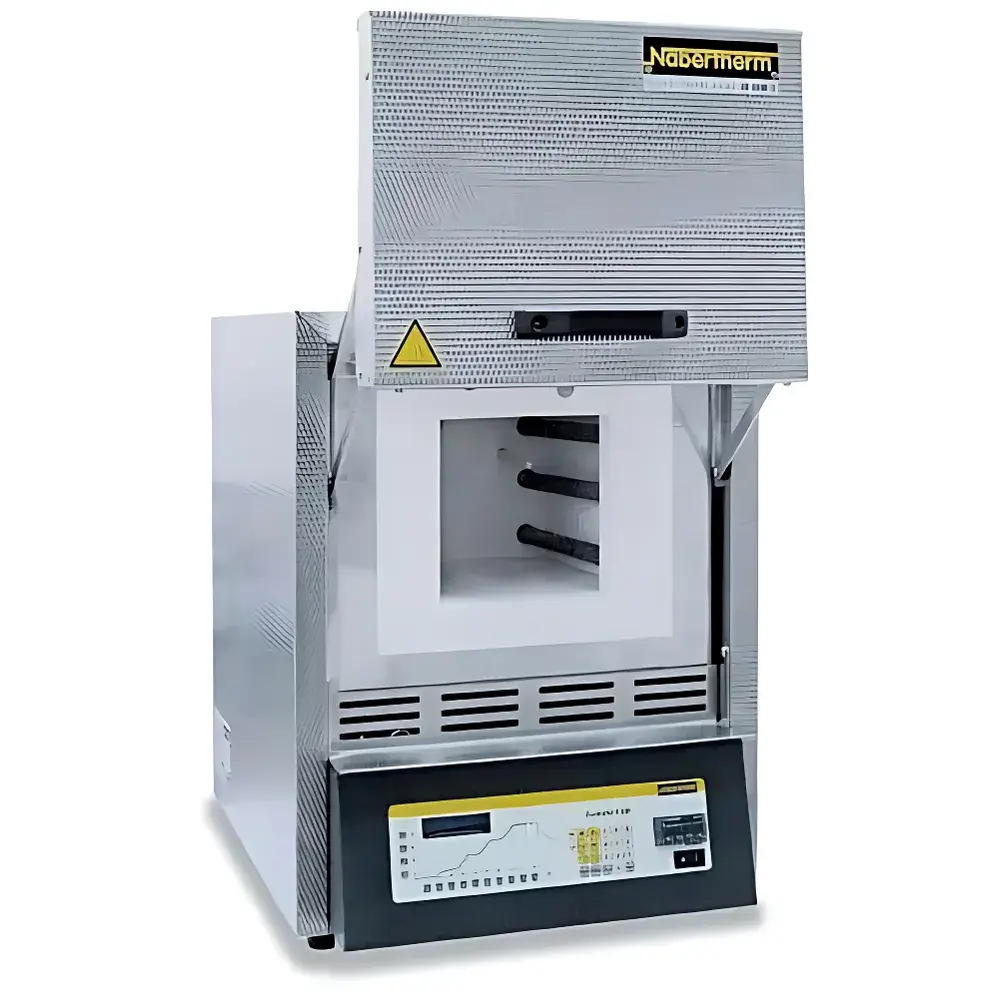
Nabertherm HTC Series High-Temperature Box Furnace with Silicon Carbide (SiC) Heating Elements
| Brand | Nabertherm |
|---|---|
| Origin | Germany |
| Model | HTC03/14–HTC08/16 |
| Type | Benchtop Box Muffle Furnace |
| Max Temperature | 1400 °C / 1500 °C / 1600 °C |
| Chamber Dimensions (W×D×H) | 120×210×120 mm or 170×290×170 mm |
| Chamber Volume | 3 L or 8 L |
| External Dimensions (W×D×H) | 400×535×530 mm or 450×620×570 mm |
| Power Supply | 3-phase, 9.0 kW or 13.0 kW |
| Weight | 30–40 kg |
| Heating Time to Max Temp | ≤40–60 min (dependent on model & setpoint) |
| Heating Element | Silicon Carbide (SiC) rods |
| Construction | Double-walled stainless steel housing with fiber insulation |
| Compliance | EN 60519-2 Class 2 thermal overtemperature protection |
Overview
The Nabertherm HTC Series is a precision-engineered high-temperature box muffle furnace designed for demanding laboratory and R&D applications requiring stable, repeatable thermal treatment up to 1600 °C. Utilizing silicon carbide (SiC) heating elements—known for exceptional thermal conductivity, oxidation resistance, and long service life—the HTC furnaces deliver rapid heat-up rates (as fast as 40 minutes to 1400 °C), excellent temperature uniformity across the working chamber, and high reproducibility in thermal processing cycles. The furnace operates on a robust double-walled stainless steel chassis with optimized ceramic fiber insulation, minimizing external surface temperatures while maximizing energy efficiency. Its modular design supports integration into automated workflows and complies with fundamental safety requirements defined in EN 60519-2 for industrial electroheating equipment.
Key Features
- High-performance SiC heating elements enabling rapid thermal ramping and extended operational lifetime under cyclic high-temperature conditions
- Three maximum temperature variants: 1400 °C (HTC03/14, HTC08/14), 1500 °C (HTC03/15, HTC08/15), and 1600 °C (HTC03/16, HTC08/16)
- Double-walled stainless steel housing with low-thermal-conductivity fiber insulation for enhanced safety and reduced ambient heat emission
- Modular door options: top-hinged (tilt-up) configuration for easy sample placement, or lift-type door to prevent operator contact with hot surfaces
- Adjustable air inlet (on door) and exhaust outlet (rear wall) for controlled atmosphere conditioning and volatile byproduct removal
- SSR-based power control system ensuring precise regulation of SiC rod output and minimizing electrical transients
- Integrated Class 2 overtemperature protection per EN 60519-2, with independent mechanical limit switch disconnecting power at pre-set safety thresholds
- Standardized mounting interfaces compatible with Nabertherm’s range of stackable crucible trays and refractory support blocks
Sample Compatibility & Compliance
The HTC series accommodates a wide range of inert and semi-reactive samples—including oxides, carbides, nitrides, metallic alloys, and ceramic precursors—within its alumina- or mullite-lined chambers. Chamber geometry (3 L or 8 L volume) and dimensional constraints ensure compatibility with standard ISO/ASTM-compliant crucibles (e.g., ASTM C633, ISO 14704). All models conform to CE marking requirements and meet essential health and safety provisions under the EU Machinery Directive 2006/42/EC. Electrical safety adheres to IEC 61000-6-3 (EMC emissions) and IEC 61000-6-2 (immunity). Optional documentation packages support GLP/GMP audit readiness, including factory calibration certificates traceable to DAkkS-accredited standards.
Software & Data Management
While the base HTC configuration features an analog/digital hybrid controller with manual setpoint programming, optional digital controllers (e.g., Nabertherm THERM 2000 series) provide full PID tuning, multi-segment ramp-soak profiles, real-time data logging, and RS485/Modbus RTU interface. When equipped with compliant firmware, these controllers support electronic record integrity per FDA 21 CFR Part 11 requirements—including user access levels, audit trail generation, and non-erasable event logs. Data export is supported via USB or Ethernet to CSV or XML formats for integration with LIMS or MES platforms.
Applications
- Sintering and densification of advanced ceramics (Al2O3, ZrO2, SiC, Si3N4)
- Heat treatment of refractory metals and superalloys (Mo, W, Ni-based systems)
- Thermal gravimetric analysis (TGA) sample preparation and pre-ashing
- Calcination of catalyst precursors and battery cathode materials (e.g., LiCoO2, NMC)
- Residue ashing in environmental and food testing per AOAC 942.05 and EPA Method 3010A
- Research-scale crystal growth and solid-state reaction kinetics studies
FAQ
What is the typical service life of the SiC heating elements under continuous operation at 1500 °C?
Under proper operating conditions—including gradual ramp rates, avoidance of thermal shock, and periodic visual inspection—SiC rods typically exceed 2,000 hours of cumulative use at 1500 °C.
Can the HTC furnace be operated under inert or reducing atmospheres?
Yes, when fitted with appropriate gas-tight seals and purge fittings (optional accessory), the furnace supports N2, Ar, and forming gas (5% H2/95% N2) environments; however, prolonged use under strong reducing conditions may accelerate SiC degradation and requires validation per application.
Is remote monitoring or control available?
Remote operation is supported via optional digital controllers with Ethernet or Wi-Fi modules, enabling secure web-based access, alarm notifications, and integration with building management systems (BMS).
Does the furnace include factory calibration documentation?
Each unit ships with a test certificate verifying thermal uniformity (±5 °C at 1400 °C, ±8 °C at 1600 °C per DIN 17052-1) and overtemperature cutoff functionality; DAkkS-accredited calibration reports are available upon request.
What maintenance is required for long-term reliability?
Recommended quarterly checks include inspection of door gasket integrity, verification of airflow port alignment, cleaning of SSR heatsinks, and validation of thermocouple continuity; no routine lubrication or consumable replacement is needed beyond element replacement at end-of-life.



