
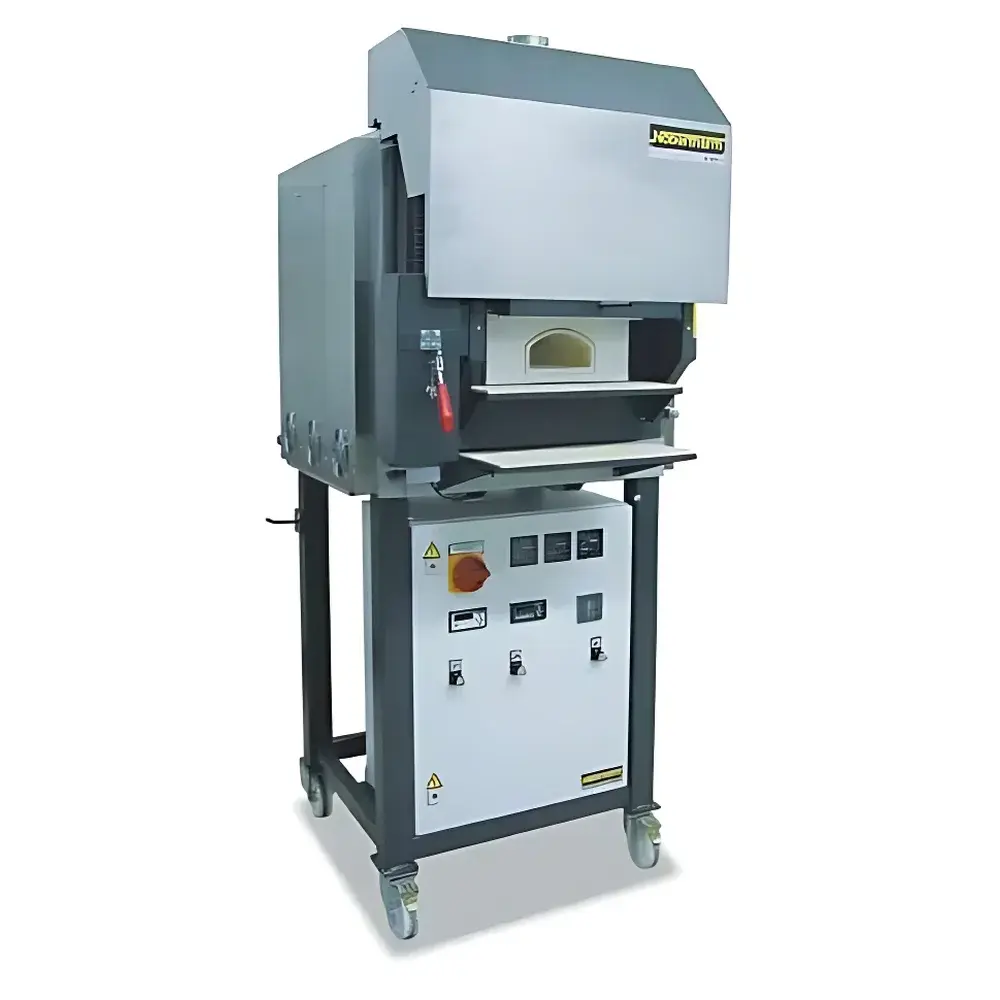
Nabertherm N 110/HS and S 73/HS High-Performance Ashing Furnaces for Precious Metal Cupellation
| Brand | Nabertherm |
|---|---|
| Origin | Germany |
| Model | N 110/HS, S 73/HS |
| Max Temperature | 1300 °C (N 110/HS), 1200 °C (S 73/HS) |
| Internal Dimensions (W×D×H, mm) | 260×340×95 (N 110/HS), 530×380×360 (S 73/HS) |
| Chamber Volume | 8 L (N 110/HS), 73 L (S 73/HS) |
| External Dimensions (W×D×H, mm) | 760×790×1435 (N 110/HS), 1050×1530×900 (S 73/HS) |
| Power Rating | 22 kW (N 110/HS), 26 kW (S 73/HS) |
| Electrical Supply | 3-phase |
| Weight | 510 kg (N 110/HS), 890 kg (S 73/HS) |
| Chamber Lining | Replaceable Ceramic Muffle |
| Heating Configuration | Four-sided heating |
| Door Type | Manual lift door (optional motorized lift available) |
| Cooling | Dual-wall housing with integrated cooling fan |
Overview
The Nabertherm N 110/HS and S 73/HS ashing furnaces are purpose-engineered for cupellation—a high-temperature metallurgical assay technique used to separate precious metals (e.g., gold and silver) from base metal impurities such as lead, copper, and bismuth. Operating on the principle of controlled oxidative volatilization, these furnaces maintain precise, uniform temperature profiles up to 1300 °C (N 110/HS) or 1200 °C (S 73/HS) within a fully enclosed ceramic muffle chamber. The muffle isolates heating elements and insulation from corrosive fumes generated during lead oxide (litharge) formation, thereby extending component service life and ensuring long-term thermal stability. Designed in accordance with DIN EN 60519-1 safety standards for industrial electroheating equipment, these furnaces integrate robust thermal architecture with laboratory-grade reproducibility—critical for ISO/IEC 17025-accredited assay laboratories performing fire assay according to ASTM E1335, ISO 11426, and GB/T 17475.
Key Features
- Four-sided heating configuration ensures radial temperature homogeneity across the muffle cavity—essential for consistent cupel oxidation kinetics and accurate precious metal recovery.
- Replaceable ceramic muffle liner (alumina-silica composition) provides chemical inertness against litharge condensate and sulfur-bearing vapors; minimizes cross-contamination between sequential assays.
- Dual-wall steel housing with forced-air cooling fan maintains external surface temperatures below 60 °C under full-load operation—compliant with occupational safety requirements per EN 61000-6-4 (EMC) and EN 61000-3-12 (harmonic current emissions).
- Front-access service door enables unobstructed maintenance of rear-mounted heating elements and insulation without disassembling the furnace frame.
- Integrated stainless-steel exhaust chimney mounted above the door opening connects directly to centralized lab ventilation systems (recommended duct velocity ≥1.5 m/s for optimal fume capture).
- Front-mounted ceramic plate staging area allows pre-heated cupels to be positioned adjacent to the muffle entrance—reducing thermal shock and improving workflow ergonomics.
- Tool rack mounted on the furnace top provides secure storage for tongs, cupel trays, and ashing crucibles—maintaining ISO 15190-compliant lab organization protocols.
Sample Compatibility & Compliance
These furnaces accommodate standard cupel sizes (e.g., 30 mm × 30 mm × 12 mm) and support batch processing of up to 24 cupels (N 110/HS) or 96 cupels (S 73/HS) per cycle. The ceramic muffle’s low thermal mass enables rapid ramp rates (up to 15 °C/min) while retaining ±2 °C temperature uniformity (measured at 1100 °C per DIN 17025 Annex C). All models comply with GLP documentation requirements when paired with optional Nabertherm THERMOCOMFORT controllers featuring audit-trail-enabled data logging (21 CFR Part 11–compatible firmware available). Furnace operation aligns with USP thermal validation guidelines and supports IQ/OQ/PQ protocol execution for regulated QC environments.
Software & Data Management
When equipped with the Nabertherm THERMOCOMFORT controller (standard or optional), the furnace supports programmable multi-step heating profiles—including pre-heat, cupellation, and slow-cool segments—with real-time temperature recording at 1-second intervals. Data export is supported via USB or Ethernet to CSV or XML formats. Optional software modules enable automated report generation compliant with ISO/IEC 17025 clause 7.8.2 (result reporting), including traceable calibration certificate references and operator ID tagging. Remote monitoring via Modbus TCP or OPC UA is available for integration into LIMS or MES platforms.
Applications
- Fire assay of gold and silver ores, concentrates, and doré bars in mining and refining QA/QC labs.
- Reference material certification (e.g., CRM production per ISO Guide 35) requiring gravimetric precision ≤±0.02 mg.
- Research-scale cupellation studies investigating flux chemistry, cupel porosity effects, and oxidation kinetics under controlled pO₂ conditions.
- Regulatory compliance testing for jewelry hallmarking authorities (e.g., UK Assay Offices, Swiss Hallmarking Bureau) adhering to ISO 11426:2021.
- High-temperature ashing of lead-rich samples prior to ICP-OES or AAS analysis—eliminating matrix interference without introducing platinum-group contamination.
FAQ
What distinguishes the HS-series muffle design from standard Nabertherm muffle furnaces?
The HS (High Stability) series incorporates an extended ceramic muffle with reinforced flange geometry and optimized gas flow channels—specifically engineered to resist thermal spalling and litharge-induced microcracking during repeated cupellation cycles.
Can the furnace be validated for GMP environments?
Yes—when configured with THERMOCOMFORT controller + validation package (IQ/OQ templates, sensor calibration certificates, and 21 CFR Part 11 audit trail module), it meets FDA and EMA expectations for thermal process validation in pharmaceutical or precious metal reference labs.
Is exhaust gas treatment required downstream of the chimney connection?
While not mandated by DIN 12925-1, we recommend coupling the exhaust outlet to an alkali scrubber or HEPA-filtered fume hood to capture residual PbO particulates and SO₂—particularly where local air emission limits apply (e.g., EU Directive 2010/75/EU).
What maintenance intervals are recommended for the ceramic muffle?
Under typical assay throughput (≤10 cycles/day), visual inspection every 200 cycles and replacement every 1,000–1,500 cycles is advised; muffle integrity should be verified using ultrasonic thickness measurement prior to reuse.
Are custom muffle geometries available for non-standard cupel configurations?
Yes—Nabertherm offers OEM muffle fabrication services for specialized dimensions or refractory compositions (e.g., high-purity alumina for ultra-low background applications); lead time: 8–12 weeks.



