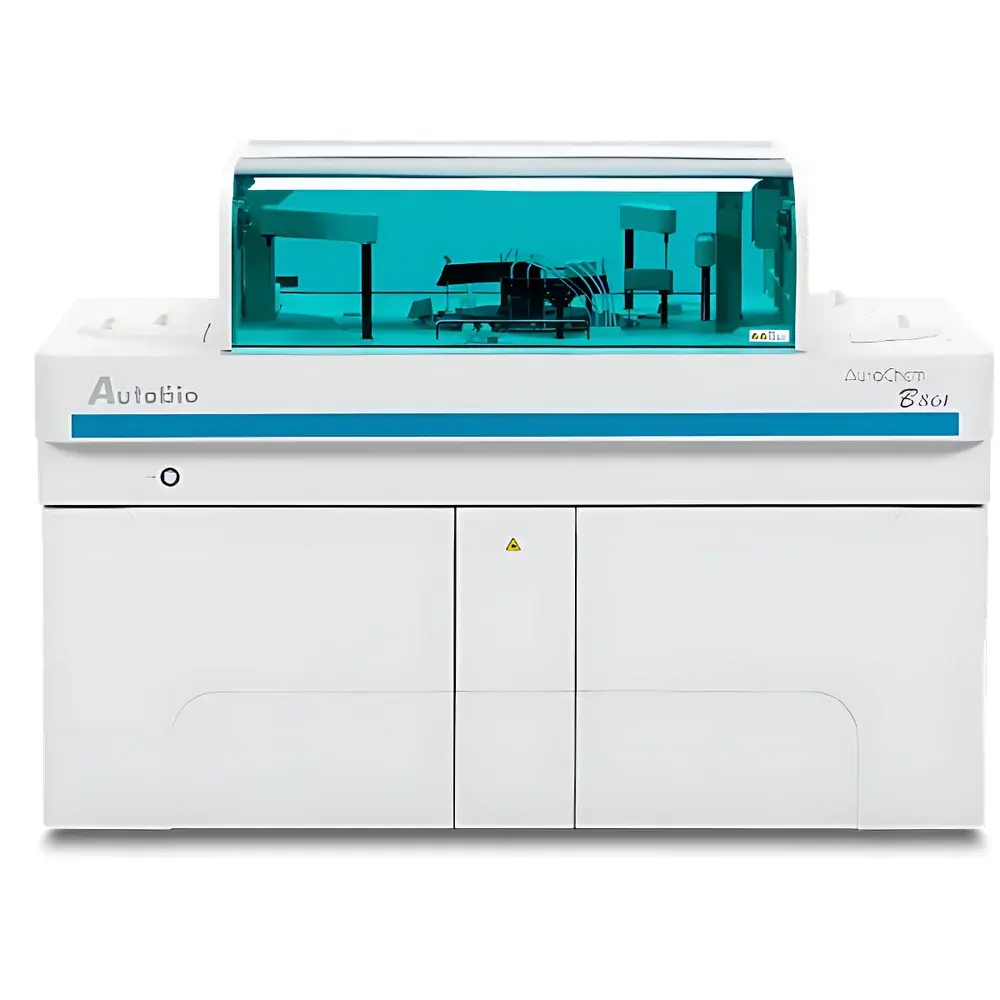
Autobio AutoChem B861 Fully Automated Clinical Chemistry Analyzer
| Brand | Autobio |
|---|---|
| Origin | Henan, China |
| Manufacturer Type | Authorized Distributor |
| Country of Manufacture | China |
| Model | AutoChem B861 |
| Price Range | USD 150–15,000,000 (FOB) |
| Detection Principle | Post-Dispensing Spectrophotometry with 16-Wavelength Optical System |
| Sample Throughput | Up to 800 tests/hour (typical configuration) |
| HbA1c Capability | Whole Blood Direct Measurement |
| Mechanical Durability | >5,000,000 cycles validated under continuous-load fatigue testing |
| Key Components | Imported precision optical modules, high-accuracy peristaltic pumps, and temperature-stabilized reaction cuvettes |
Overview
The Autobio AutoChem B861 Fully Automated Clinical Chemistry Analyzer is an in vitro diagnostic (IVD) platform engineered for high-volume clinical laboratories requiring consistent analytical performance, regulatory traceability, and long-term operational reliability. It operates on the principle of post-dispensing spectrophotometric measurement—where reagent and sample are mixed in a thermally controlled quartz or disposable cuvette, followed by absorbance detection across 16 discrete wavelengths (340–800 nm). This optical architecture enables simultaneous multi-wavelength kinetic and endpoint assays without mechanical grating movement, minimizing photometric drift and improving inter-run reproducibility. Designed to meet ISO 15189 and CLIA-equivalent quality system requirements, the AutoChem B861 supports routine quantification of enzymes (e.g., ALT, AST, ALP), metabolites (e.g., glucose, creatinine, uric acid), proteins (e.g., albumin, total protein), lipids (e.g., cholesterol, triglycerides), and glycated hemoglobin (HbA1c) directly from whole blood—eliminating pre-processing steps and reducing turnaround time.
Key Features
- 16-channel fixed-wavelength optical system with dual-beam compensation, delivering <±1.5% photometric accuracy at 340 nm (per CLSI EP6-A2 verification protocol)
- Whole-blood HbA1c assay capability using standardized boronate affinity separation and enzymatic quantification—validated against IFCC reference methods (RMG-HbA1c)
- Modular fluidics architecture incorporating imported peristaltic pumps, ceramic syringes, and low-dead-volume valves; all critical wear components rated for ≥5,000,000 actuation cycles under accelerated fatigue testing
- Temperature-controlled reaction block maintaining 37.0 ± 0.1 °C across all 120 cuvette positions, with real-time thermal mapping and auto-compensation algorithms
- Integrated barcode scanning for primary tube identification, reagent lot tracking, and QC material registration—enabling full audit trail per FDA 21 CFR Part 11 Annex 11 requirements
- Self-diagnostic subsystem monitoring optical intensity, pipetting precision, wash efficiency, and carryover (<0.5 ppm for high-concentration analytes)
Sample Compatibility & Compliance
The AutoChem B861 accepts standard 13 × 75 mm, 13 × 100 mm, and microtubes (0.5–2.0 mL) with optional rack adapters for pediatric or emergency-use tubes. Serum, plasma (EDTA/K₂EDTA/Li-heparin), and anticoagulated whole blood are supported without centrifugation for HbA1c. All reagents and calibrators are CE-IVDR Class B certified and compatible with Autobio’s portfolio of over 80 FDA-cleared and NMPA-registered IVD assays. The system complies with ISO 17511 (metrological traceability), ISO 15197 (glucose monitoring), and EN ISO 15189:2022 for medical laboratories. Instrument validation documentation includes IQ/OQ/PQ protocols aligned with GxP environments and GLP/GMP-aligned audit readiness.
Software & Data Management
The analyzer runs on Autobio’s LIMS-integrated ChemLab OS v4.2—a Windows-based, 64-bit application supporting HL7 v2.5.1 and ASTM E1384 messaging. Software features include dynamic calibration curve interpolation (4PL, linear, log-log), delta-check logic with configurable thresholds, reflex testing rules, and automated QC flagging per Westgard multirules. Audit logs record user actions, parameter changes, calibration events, and error recovery sequences with timestamped digital signatures. Data export supports CSV, PDF, and XML formats compliant with local health information exchange (HIE) frameworks. Remote diagnostics via encrypted TLS 1.2 tunnel enable proactive service intervention without compromising data sovereignty.
Applications
The AutoChem B861 serves core clinical chemistry workflows in hospital central labs, reference laboratories, and regional diagnostic centers. Primary use cases include metabolic panel screening (CMP/SMAC), liver/kidney function assessment, lipid profile analysis, therapeutic drug monitoring (e.g., phenytoin, lithium), and diabetes management via HbA1c and fructosamine. Its robustness supports 24/7 operation in high-throughput settings—particularly where specimen volume exceeds 300 samples/day and assay menu breadth exceeds 60 tests. The platform also integrates into decentralized networks for satellite lab consolidation, enabling centralized reagent inventory control and harmonized result reporting across multi-site health systems.
FAQ
Does the AutoChem B861 support bidirectional LIS connectivity?
Yes—it supports both HL7 ADT/ORU and ASTM two-way communication with major laboratory information systems including Cerner, Epic, Sunquest, and Meditech.
What is the minimum sample volume required for HbA1c measurement?
15 µL of whole blood is sufficient for direct HbA1c quantification without preprocessing.
Is the system compatible with third-party reagents?
Only Autobio-branded reagents and calibrators are validated for use; off-label reagent usage voids regulatory compliance and instrument warranty.
How often does the optical system require recalibration?
Photometric calibration is performed automatically during startup and every 24 hours during idle periods; manual recalibration is recommended after lamp replacement or major maintenance.
Can the AutoChem B861 be integrated into a total laboratory automation (TLA) line?
Yes—via standardized pneumatic tube interface (PTS) and robotic arm docking protocols compliant with CLSI GP42-A4 specifications.
Related Products