
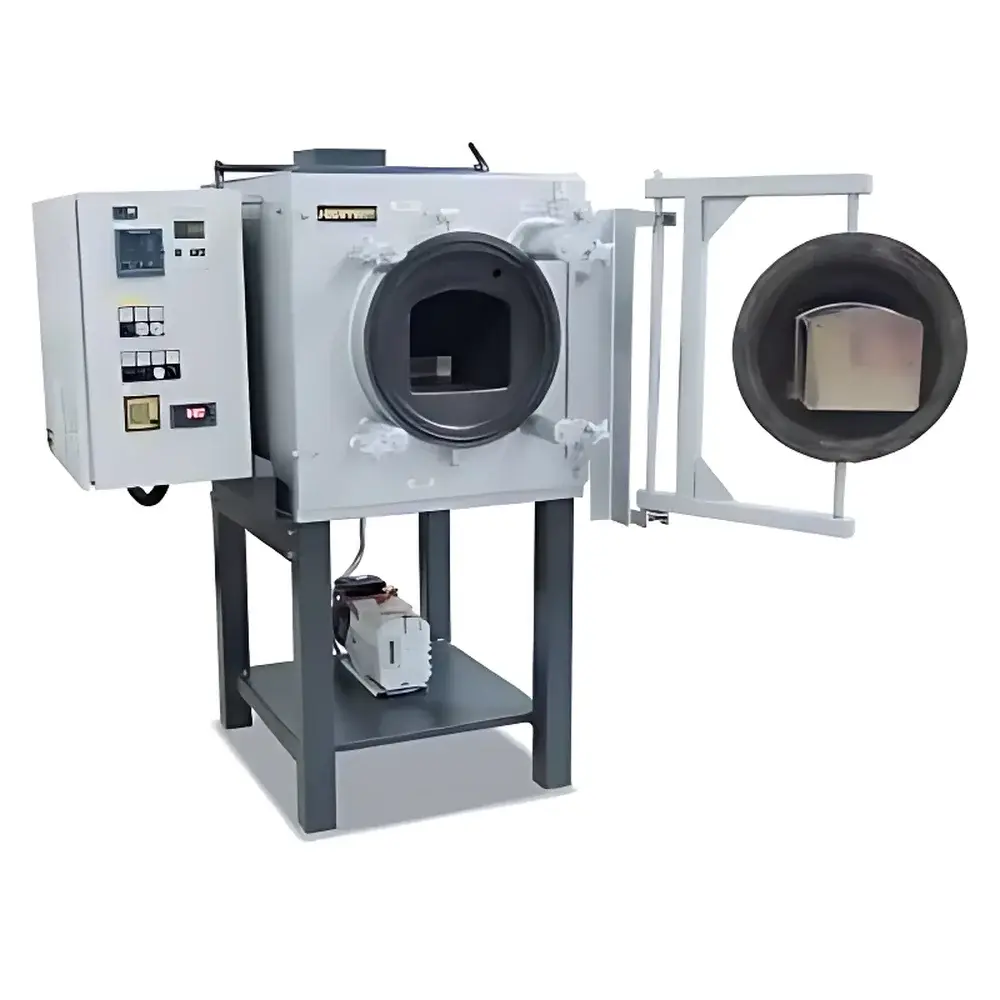
Nabertherm N21/M–N321/MA Series High-Temperature Vacuum & Protective Atmosphere Sealed-Crucible Furnaces with External Indirect Heating
| Brand | Nabertherm |
|---|---|
| Origin | Germany |
| Model | N21/M, N41/M, N81/M, N161/M, N321/M, N41/MA, N81/MA, N161/MA, N321/MA |
| Max Temperature | 1100 °C (N-series) / 900 °C (MA-series) |
| Internal Dimensions (W×D×H) | 220×300×150 mm to 700×1050×240 mm |
| Chamber Volume | 10–180 L |
| External Dimensions (W×D×H) | 830×950×760 mm to 1550×2220×1050 mm |
| Power Supply | 3-phase, 10–47 kW |
| Weight | 290–1580 kg |
| Temperature Uniformity | ΔT ≤ 30 K (standard, >800 °C, per DIN 17052) |
| Optional Uniformity | ΔT ≤ 10 K (with multi-zone control and/or gas circulation) |
| Cooling System | Water-cooled door seal with open-loop cooling circuit |
| Atmosphere Compatibility | Inert gases (N₂, Ar, 95/5 N₂/H₂), vacuum (via optional pump), H₂ (with certified safety package) |
| Control Architecture | Cascade temperature regulation (internal + external thermocouples), PLC-integrated gas management (optional), compliance-ready for GLP/GMP environments |
Overview
The Nabertherm N21/M–N321/MA series comprises high-precision, externally heated sealed-crucible furnaces engineered for thermal processing under strictly controlled atmospheric conditions. Unlike conventional muffle furnaces, these systems feature a hermetically sealed inner crucible—constructed from high-purity alumina or quartz—mounted within an insulated outer chamber. Heat is applied indirectly via resistive heating elements positioned exclusively around the crucible’s exterior surface, eliminating direct radiant exposure and ensuring uniform thermal transfer through conduction and controlled convection. This architecture enables reproducible, contamination-free heat treatment in inert, reducing, or vacuum environments—critical for sintering, annealing, calcination, binder burnout, and low-oxygen pyrolysis protocols. The furnace chamber operates up to 1100 °C (N-series) or 900 °C (MA-series), with temperature uniformity validated per DIN 17052:1985 (ΔT ≤ 30 K at ≥800 °C in standard configuration). For applications demanding tighter spatial consistency—such as semiconductor precursor annealing or battery cathode material synthesis—optional multi-zone heating and forced gas circulation extend uniformity to ΔT ≤ 10 K across defined operational ranges.
Key Features
- Hermetic stainless-steel sealed crucible with integrated water-cooled door flange and graphite or ceramic gasket system, rated for leak rates <1×10⁻⁶ mbar·L/s (helium test)
- Externally mounted heating elements with zone-specific power modulation—no internal wiring or insulation degradation inside the process atmosphere
- Open-loop water cooling circuit for door seal integrity, preventing thermal drift during extended high-temperature holds
- Standard manual gas supply manifold with dual-stage shut-off valve, precision needle valve, and calibrated rotameter (0–20 L/min range)
- Cascade temperature control architecture: independent Pt100 sensors inside and outside the crucible feed a dual-input PID algorithm, minimizing thermal lag and overshoot
- Optional vacuum cold-pull capability via ISO-KF 40 or 63 interface; compatible with two-stage rotary vane or turbomolecular pumps (not included)
- Structural refractory lining with low thermal mass ceramic fiber modules—reducing energy consumption and enabling rapid ramp rates (up to 10 K/min, depending on model and load)
- CE-marked enclosure with IP54-rated electrical cabinet, integrated overtemperature cut-off (TÜV-certified Class 2 safety device), and emergency stop per EN 60204-1
Sample Compatibility & Compliance
These furnaces accommodate diverse sample geometries—from powder-filled alumina boats and graphite crucibles to wafer stacks and ceramic green bodies—within standardized crucible dimensions. The sealed environment prevents oxidation of reactive metals (e.g., Ti, Mg, rare-earth alloys), inhibits carbon deposition during hydrocarbon-rich atmospheres, and eliminates cross-contamination between sequential runs. All models comply with DIN 17052 for temperature uniformity validation and meet essential requirements of the EU Machinery Directive 2006/42/EC and Electromagnetic Compatibility Directive 2014/30/EU. Optional configurations support FDA 21 CFR Part 11–compliant electronic recordkeeping when paired with Nabertherm’s THERMOCOM® software and audit-trail-enabled controllers. Hydrogen operation requires the certified H₂-Safe package (EN ISO 10156, EN 13445-3), including flame arrestors, hydrogen-specific leak detection, purge interlocks, and SIL2-rated PLC safety logic.
Software & Data Management
Furnace operation is managed via Nabertherm’s THERMOCOM® control platform, supporting both standalone touchscreen interfaces (TFT display with touch-sensitive keys) and Ethernet-connected PC integration. The system records time-stamped temperature profiles, gas flow rates (when MFCs are installed), pressure traces (with vacuum option), and alarm events with full timestamping and user attribution. Data export adheres to ASTM E2500-13 guidelines for raw data integrity: CSV files include metadata headers (instrument ID, calibration status, operator ID, environmental conditions). Optional firmware upgrades enable GLP-compliant electronic signatures, role-based access control, and automated report generation aligned with ISO/IEC 17025 laboratory accreditation requirements.
Applications
- Controlled-atmosphere sintering of advanced ceramics (SiC, AlN, ZrO₂) and metal matrix composites
- Low-oxygen annealing of thin-film photovoltaic precursors (CIGS, CZTS) and OLED encapsulation layers
- Thermal debinding and catalytic pyrolysis of polymer-bonded metal injection molding (MIM) components
- High-purity calcination of battery cathode materials (NMC, LFP) without transition-metal reduction
- Hydrogen-reduction of tungsten oxide to ultrafine W powder under ISO Class 5 cleanroom-compatible conditions
- Accelerated aging studies of nuclear fuel cladding alloys under simulated LOCA (Loss-of-Coolant Accident) atmospheres
FAQ
Can this furnace operate under vacuum without modification?
Yes—vacuum operation is supported via optional ISO-KF port and external pump connection; however, base pressure and pumping speed depend on selected vacuum hardware.
What safety certifications apply to hydrogen operation?
Hydrogen-compatible models require the factory-installed H₂-Safe package, certified to EN ISO 10156 (gas compatibility), EN 13445-3 (unfired pressure vessels), and IEC 61508 SIL2 for safety instrumented functions.
Is temperature uniformity validated at all setpoints—or only at maximum temperature?
Uniformity is verified per DIN 17052 across three representative setpoints (e.g., 300 °C, 700 °C, 1000 °C); reports are provided with each unit shipment.
How is calibration traceability maintained for temperature sensors?
All Pt100 sensors are supplied with individual DAkkS-accredited calibration certificates (traceable to PTB), valid for 12 months; recalibration intervals follow ISO/IEC 17025 Annex A.3 guidance.
Does the cascade control system support third-party SCADA integration?
Yes—Modbus TCP and OPC UA interfaces are available as factory options, enabling bidirectional communication with LabVIEW, Ignition, or DeltaV DCS platforms.



