
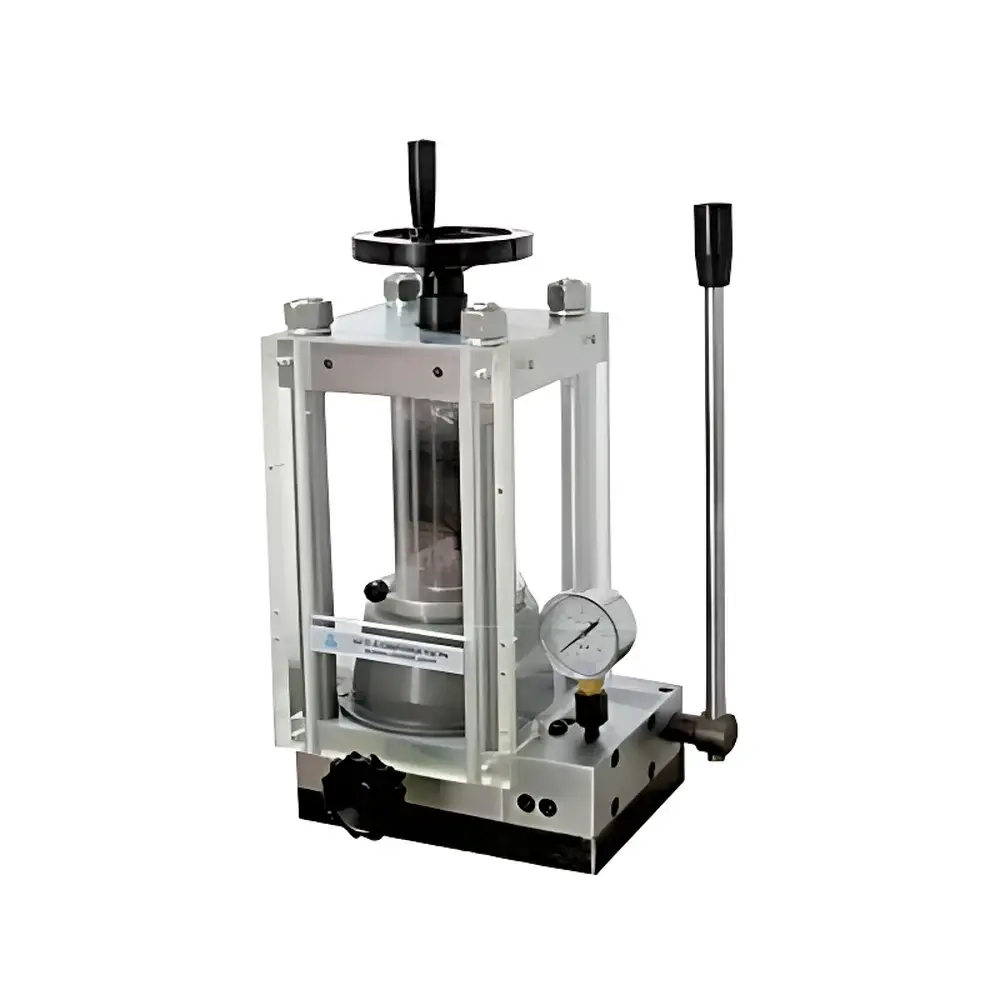
Hefei Kejing YLJ-24T Manual Hydraulic Pellet Press
| Brand | Hefei Kejing |
|---|---|
| Model | YLJ-24T |
| Maximum Pressure | 24 Ton (235 kN) |
| Max Gauge Pressure | 40 MPa |
| Cylinder Stroke | 0–25 mm |
| Pressure Stability | ≤1 MPa / 10 min |
| Working Chamber | 105 × 105 × 150 mm (Height Customizable) |
| Overall Dimensions | 280 × 200 × 520 mm |
| Net Weight | 36 kg |
| Standard Accessories | Hex Key Wrench, Fixed Wrench, Hand Lever, Cotter Pin, O-Ring Seal |
| Optional Accessories | Cold-Press Dies, Heated Dies |
Overview
The Hefei Kejing YLJ-24T Manual Hydraulic Pellet Press is a precision-engineered laboratory press designed for reproducible, high-force compaction of powdered samples into uniform pellets—primarily for spectroscopic analysis (e.g., FTIR, XRF, XRD), elemental calibration standards, and ceramic pre-forming. It operates on a manually actuated, single-acting hydraulic principle: user-applied torque to the hand lever drives oil displacement via a high-efficiency gear pump, generating controlled pressure in the main cylinder. Unlike pneumatic or motor-driven systems, this manual architecture eliminates dependency on external power sources or compressed air, ensuring operational reliability in resource-constrained labs and field-deployable environments. The press delivers up to 24 metric tons (235 kN) of compressive force with a maximum gauge pressure of 40 MPa—sufficient to densify refractory oxides, metal powders, and polymer composites under ambient conditions. Its mechanical design emphasizes long-term force retention: pressure decay is limited to ≤1 MPa over 10 minutes at maximum load, enabling stable dwell periods critical for consistent green density and interparticle bonding.
Key Features
- Rapid-advance hydraulic system with dual-stage pumping: fast initial stroke (0–20 mm) followed by fine-pressure control (20–25 mm), reducing average cycle time by >5× compared to conventional manual presses.
- Zero-leakage hydraulic circuit: proprietary seal geometry and surface-finished cylinder bore prevent fluid migration under sustained load—verified per ISO 10770-1 test protocols for hydraulic component leakage classification.
- Front-mounted, vertically hinged protective panel: fully removable for unobstructed die access; engineered from 3-mm cold-rolled steel with reinforced hinge mounts to withstand repeated impact during routine operation.
- Modular working chamber: internal dimensions of 105 × 105 × 150 mm (W × D × H); height is factory-customizable upon order to accommodate extended dies or multi-layer stacking fixtures.
- Integrated mechanical safety: self-locking valve mechanism prevents unintended pressure release during dwell; all hydraulic components conform to GB/T 7935–2005 (Chinese national standard equivalent to ISO 4413).
Sample Compatibility & Compliance
The YLJ-24T supports a broad spectrum of dry, free-flowing, and semi-cohesive powders—including alkali halides (KBr, NaCl), metal oxides (Al₂O₃, SiO₂), catalyst precursors, pharmaceutical excipients, and geological reference materials. Its force range enables both low-pressure tabletting (e.g., 1–5 Ton for KBr IR pellets) and high-density compaction (e.g., 15–24 Ton for XRF fusion beads). All structural components comply with RoHS Directive 2011/65/EU for hazardous substance restriction. While not certified to ISO/IEC 17025, the press meets functional requirements outlined in ASTM E290–22 (Standard Test Methods for Bend Testing of Metallic Flat Materials) for mechanical stability during static loading. Calibration certificates for pressure transducers (optional add-on) are traceable to NIM (National Institute of Metrology, China) standards.
Software & Data Management
As a purely manual, non-electronic instrument, the YLJ-24T does not incorporate embedded controllers, digital displays, or data logging capabilities. Force application is monitored exclusively via analog Bourdon-tube pressure gauge (0–40 MPa scale, Class 1.6 accuracy per EN 837-1). Users record process parameters—including applied torque, dwell duration, and final pellet thickness—manually in lab notebooks or LIMS-compatible spreadsheets. For laboratories requiring audit-ready documentation, integration with third-party USB pressure transducers (e.g., Honeywell ASDX series) and LabVIEW-based acquisition modules is supported via standard 1/8″ NPT port on the pressure manifold. Such configurations satisfy FDA 21 CFR Part 11 requirements when paired with electronic signature-enabled software and secure audit trails.
Applications
- FTIR sample preparation: production of transparent KBr pellets (typically 8–12 Ton, 1–2 min dwell) with optical homogeneity suitable for quantitative spectral analysis.
- X-ray fluorescence (XRF) calibration: compaction of certified reference materials (CRMs) into 32-mm diameter discs at 20–24 Ton to minimize particle segregation and matrix effects.
- Materials science research: green-body fabrication for sintering studies, including ZnO varistors, Li-ion battery cathode precursors, and porous metal filters.
- Geochemical analysis: consolidation of soil, sediment, or rock powder into homogeneous briquettes for handheld XRF screening under field conditions.
- Pharmaceutical QA/QC: mechanical testing of excipient compressibility using standardized punch-and-die sets compliant with USP <1062>.
FAQ
What is the maximum recommended operating pressure for routine use?
For optimal seal longevity and repeatable performance, we recommend limiting continuous operation to ≤35 MPa (≈21.5 Ton), reserving 40 MPa (24 Ton) for short-duration, high-density applications only.
Can the press be used with heated dies?
Yes—optional heated die kits (up to 300 °C) are available with integrated thermocouple ports and PID temperature controllers; mounting interfaces comply with DIN 55102-2 flange standards.
Is recalibration required after extended use?
The analog pressure gauge should be verified annually against a certified deadweight tester; no recalibration of the hydraulic circuit itself is needed unless seals are replaced.
What maintenance intervals are advised?
Hydraulic oil (ISO VG 46 mineral oil) must be replaced every 12 months or after 500 operating cycles; O-rings and piston wipers should be inspected quarterly and replaced if surface cracking or extrusion is observed.
Does the press meet GLP compliance requirements?
When operated with documented procedures, calibrated gauges, and maintained logbooks, the YLJ-24T satisfies core GLP principles for equipment qualification (OECD GLP Principles, Section 5.2.2); full validation packages (IQ/OQ/PQ) are available upon request.
Related Products



