
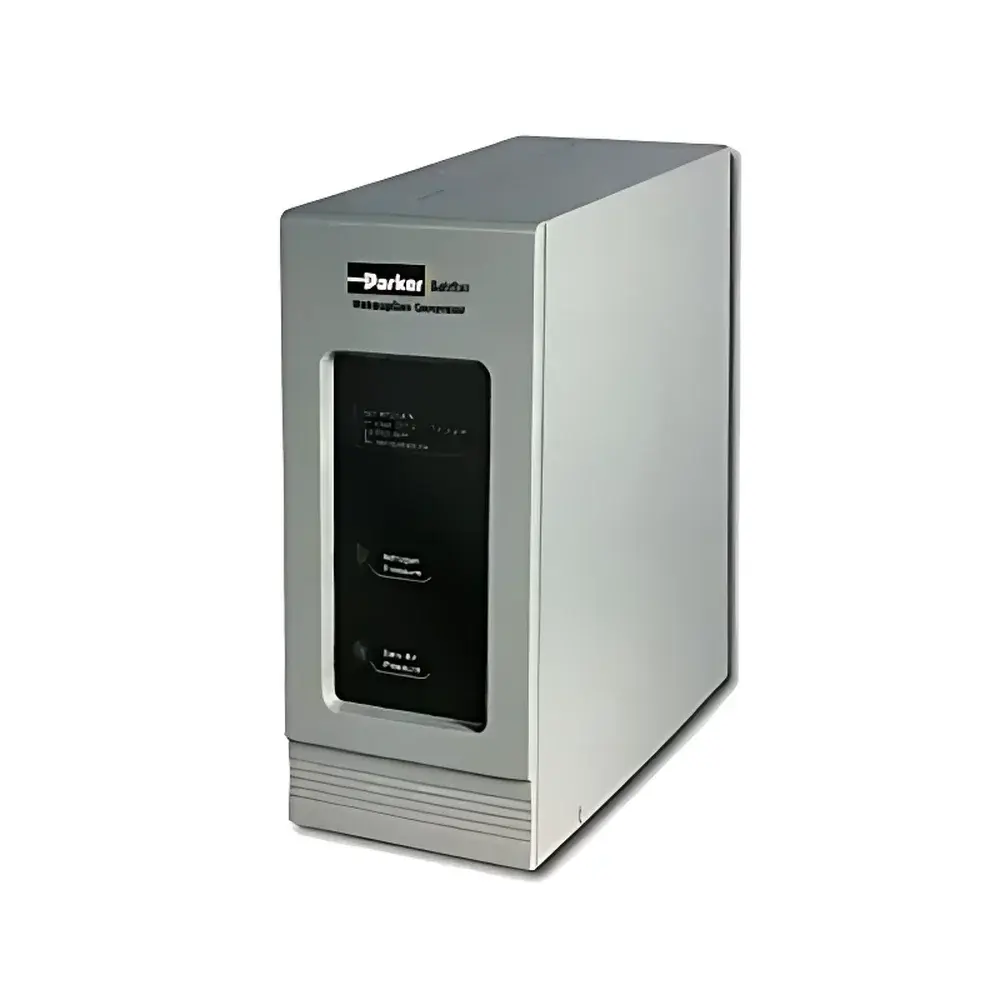
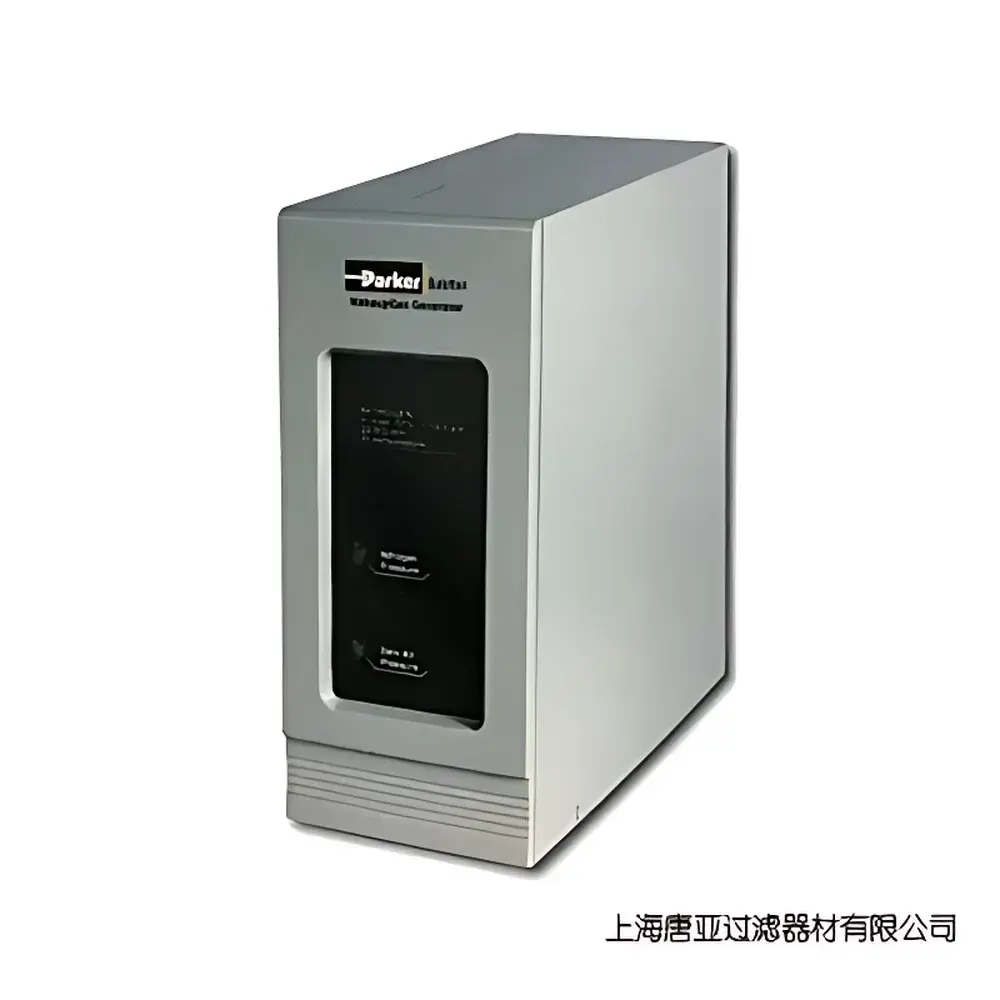
Parker MGG-400 FID Makeup Gas Generator
| Brand | Parker |
|---|---|
| Origin | USA |
| Model | MGG-400 |
| Gas Purity | <0.05 ppm THC (as methane) |
| Output Capacity | Sufficient for 5–6 FID detectors |
| Regulatory Compliance | Designed for GLP/GMP-aligned laboratories |
| Noise Level | <45 dB(A) |
| Power Supply | 100–240 VAC, 50/60 Hz |
| Dimensions | 43.2 × 48.3 × 27.9 cm (W×D×H) |
| Weight | 22.7 kg |
Overview
The Parker MGG-400 FID Makeup Gas Generator is an engineered solution for gas chromatography laboratories requiring high-purity, on-demand nitrogen as makeup gas for Flame Ionization Detectors (FIDs). Unlike traditional cylinder-based supply systems, the MGG-400 employs membrane separation technology coupled with catalytic purification to generate nitrogen from compressed air—delivering consistent, ultra-low hydrocarbon content (<0.05 ppm THC, measured as methane) essential for optimal FID performance. This generator is specifically calibrated to meet the stringent requirements of analytical GC workflows where baseline stability, peak symmetry, and detector sensitivity are directly influenced by makeup gas quality. Its design supports continuous operation across multiple FID channels (up to six), making it suitable for high-throughput QC labs, pharmaceutical stability testing suites, and environmental analysis facilities operating under ISO/IEC 17025 or FDA 21 CFR Part 11-compliant data integrity frameworks.
Key Features
- Stable nitrogen output at ≥99.5% purity with verified total hydrocarbon (THC) contamination <0.05 ppm (as methane), validated per ASTM D6245 and ISO 8573-1 Class 1 particulate/oil specification
- Dual-stage filtration architecture: coalescing pre-filter + catalytic dehydrogenation stage + carbon polishing bed ensures removal of moisture, oil aerosols, and volatile organic compounds
- Integrated pressure regulation and flow control (0–100 mL/min per outlet, adjustable via front-panel digital interface) for precise matching to individual FID requirements
- Self-diagnostic system with real-time monitoring of inlet pressure, dew point, filter life, and catalyst status—alerts displayed via LED indicators and optional RS-232/USB logging
- Compact benchtop footprint (43.2 × 48.3 × 27.9 cm) with vibration-dampened mounting and acoustic shielding, achieving operational noise levels below 45 dB(A)
- No consumables beyond standard compressed air supply (dew point ≤ −40°C, oil-free, particle-filtered to ISO 8573-1 Class 2); no periodic catalyst replacement required within first 10,000 hours of operation
Sample Compatibility & Compliance
The MGG-400 is compatible with all major GC platforms utilizing FID detection—including Agilent, Thermo Fisher Scientific, Shimadzu, PerkinElmer, and Waters systems—as confirmed by OEM technical integration documentation. It meets critical regulatory expectations for analytical gas supply in regulated environments: nitrogen purity specifications align with USP <691>, EP 2.5.27, and ICH Q2(R2) method validation guidelines concerning reagent-grade gases. The generator’s firmware supports audit-trail-enabled operation when integrated with LIMS or chromatography data systems (CDS), satisfying FDA 21 CFR Part 11 requirements for electronic records and signatures. All internal wetted materials comply with USP Class VI biocompatibility standards, and electrical safety conforms to UL 61010-1 and CE EN 61010-1.
Software & Data Management
While the MGG-400 operates autonomously without mandatory software, its optional Parker SmartLink™ interface enables remote status monitoring, event logging, and predictive maintenance scheduling via Ethernet or USB connection. Logged parameters include cumulative runtime, filter saturation index, inlet pressure deviation history, and last calibration timestamp. Data export formats (CSV, XML) support integration into laboratory-wide asset management platforms. For GxP environments, configuration changes require dual-authentication access, and all operator actions are time-stamped and user-identified—ensuring full traceability during internal or external audits.
Applications
- Routine quantification of hydrocarbons in petrochemical feedstocks and finished fuels (ASTM D1319, D5186)
- Residual solvent analysis in pharmaceutical APIs per ICH Q3C guidelines
- Volatile organic compound (VOC) profiling in environmental water and soil extracts (EPA Method 8260D)
- Fatty acid methyl ester (FAME) analysis in biodiesel certification (ASTM D6751)
- Quality control of polymer additives and plasticizers using multi-FID parallel detection configurations
FAQ
What compressed air quality is required for reliable MGG-400 operation?
A minimum inlet air specification of ISO 8573-1 Class 2:2:2 (≤0.1 µm particles, ≤0.1 mg/m³ oil, dew point ≤ −40°C) is recommended; Parker offers compatible air dryers and coalescing filters as system accessories.
Can the MGG-400 replace helium as carrier gas in GC-FID?
No—the MGG-400 is designed exclusively for makeup gas application. Carrier gas substitution requires separate optimization and is not supported by this model.
How often does the system require preventive maintenance?
Annual inspection of inlet filters and verification of outlet purity (via optional THC analyzer) is advised; full service interval is 2 years or 8,000 operating hours—whichever occurs first.
Is the MGG-400 compatible with hydrogen flame-gas supply systems?
Yes—its nitrogen output is fully compatible with standard hydrogen generators (e.g., Parker HGD series) for complete FID fuel gas independence.
Does Parker provide installation qualification (IQ) and operational qualification (OQ) documentation?
Yes—Parker supplies a vendor-executed IQ/OQ protocol package compliant with ASTM E2500 and Annex 15 of the EU GMP Guide, including test scripts, acceptance criteria, and execution records.
Related Products



