
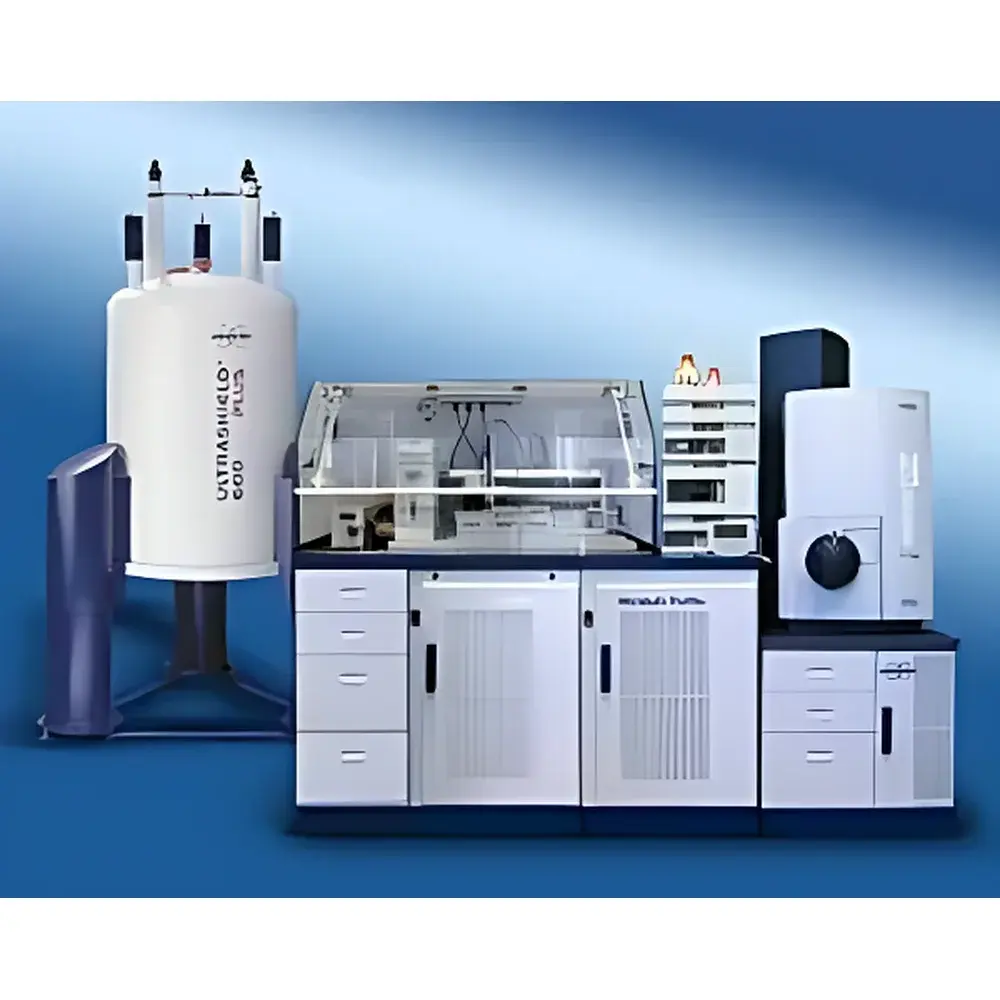
Bruker Metabolic Profiler™ Integrated NMR-MS Platform
| Brand | Bruker |
|---|---|
| Origin | Germany |
| Manufacturer Type | Authorized Distributor |
| Origin Category | Imported |
| Model | Metabolic Profiler™ |
| Instrument Type | High-Field Nuclear Magnetic Resonance Spectrometer |
| Sample Format | Solid-Liquid Dual-Mode Compatibility |
| Sensitivity | Not Specified |
| Resolution | Not Specified |
Overview
The Bruker Metabolic Profiler™ is a fully integrated, high-field nuclear magnetic resonance (NMR) and mass spectrometry (MS) platform engineered for comprehensive metabolomics research. It unifies Avance™ NMR spectrometers—capable of high-resolution 1D/2D NMR analysis—with ESI-coupled ultra-high-resolution time-of-flight (UHR-TOF) mass spectrometers (maXis™ or micrOTOF™ series) in a single, synchronized analytical workflow. This hybrid architecture leverages the complementary strengths of both techniques: NMR provides quantitative, non-destructive structural elucidation with inherent reproducibility and minimal sample preparation bias, while UHR-TOF MS delivers accurate mass measurement, elemental composition assignment, and high sensitivity for low-abundance metabolites. The system is designed to address core challenges in modern metabolomics—including spectral complexity, dynamic range limitations, annotation ambiguity, and biological context integration—by enabling concurrent acquisition, cross-platform data alignment, and statistically robust multivariate interpretation.
Key Features
- Seamless hardware integration between Bruker Avance™ NMR spectrometers (≥400 MHz, configurable up to 1 GHz) and ESI-UHR-TOF mass spectrometers (maXis™ or micrOTOF™ platforms), including shared sample handling and synchronized acquisition triggers.
- Automated sample preparation module supporting standardized extraction protocols for biofluids (serum, urine, CSF), tissues, and microbial cultures—compatible with both liquid-state NMR and direct-infusion or LC-MS workflows.
- SampleTrack™ Laboratory Information Management System (LIMS) for end-to-end traceability: automated sample logging, barcode-driven tracking, metadata capture (collection time, storage conditions, prep method), and audit-compliant data archiving.
- Dedicated software suite including TopSpin™ (NMR processing), DataAnalysis™ (MS data processing), and MetaboScape™ (integrated NMR-MS statistical analysis), supporting PCA, PLS-DA, OPLS-DA, pathway mapping, and covariance network generation.
- FDA 21 CFR Part 11–compliant electronic signature support, role-based access control, and full audit trail functionality across all software modules for GLP/GMP-aligned laboratories.
Sample Compatibility & Compliance
The Metabolic Profiler™ accommodates diverse biological matrices under both solid- and liquid-state NMR configurations—enabling analysis of intact tissue extracts (e.g., perchloric acid or methanol-chloroform extracts), biofluid supernatants, and lyophilized cell pellets. It supports standard NMR tube formats (5 mm, Shigemi) and microflow MS interfaces. All components comply with IEC 61010-1 (electrical safety), ISO/IEC 17025:2017 (testing and calibration laboratories), and relevant ASTM standards for metabolite quantification (e.g., ASTM E3089–21 for NMR-based assay validation). Method development workflows are compatible with NIH Common Fund-supported metabolomics standards and the Metabolomics Standards Initiative (MSI) reporting guidelines.
Software & Data Management
Data acquisition, processing, and interpretation occur within a unified software environment built on Bruker’s Unified Software Architecture (USA). Raw NMR and MS datasets are automatically registered, time-stamped, and linked via unique sample IDs. MetaboScape™ enables joint peak picking, feature alignment across platforms, isotopic pattern matching, and confidence-level annotation (Level 1–4 per MSI). All processed results—including spectra, statistical models, and pathway enrichment reports—are stored in a secure, searchable database with version-controlled project history. Export options include mzML, NMReDATA, and ISA-Tab formats for submission to public repositories such as MetaboLights or HMDB.
Applications
- Biomarker discovery in clinical cohorts (e.g., oncology, neurodegenerative disease, diabetes) through longitudinal profiling of serum, plasma, and cerebrospinal fluid.
- Pharmacometabolomics studies assessing drug-induced metabolic perturbations and inter-individual variability in response to therapeutics.
- Microbial metabolomics for strain characterization, fermentation monitoring, and secondary metabolite identification in bioprocess development.
- Toxicometabolomics investigations linking xenobiotic exposure to endogenous pathway disruption using in vitro hepatocyte models or in vivo rodent studies.
- Plant metabolomics for phytochemical profiling, stress response phenotyping, and quality control of botanical extracts under ISO 22000 or ICH Q5C frameworks.
FAQ
What NMR field strengths are supported by the Metabolic Profiler™ platform?
The system is configured around Bruker Avance™ consoles rated for 400 MHz, 600 MHz, or 800 MHz superconducting magnets, with optional upgrade paths to 1 GHz systems based on laboratory infrastructure and application requirements.
Is LC-NMR capability included in the standard configuration?
LC-NMR is available as an optional module via coupling to Bruker’s LC-Solvent Suppression system and flow-probe technology; it requires additional hardware integration and method validation.
How does the platform ensure data interoperability with third-party bioinformatics tools?
All primary and processed data adhere to open, community-accepted formats (mzML, nmrML, ISA-Tab), enabling direct import into R/Bioconductor packages (XCMS, metaX), Python-based workflows (PyMassSpec, nmrglue), and commercial platforms like SIMCA or MATLAB.
Can the system be validated for regulated environments (e.g., pharmaceutical QC)?
Yes—the entire workflow, from instrument qualification (IQ/OQ/PQ) to software validation (including 21 CFR Part 11 compliance), follows Bruker’s GxP Validation Services framework and aligns with USP , ISO/IEC 17025, and ICH M10 guidelines.





