
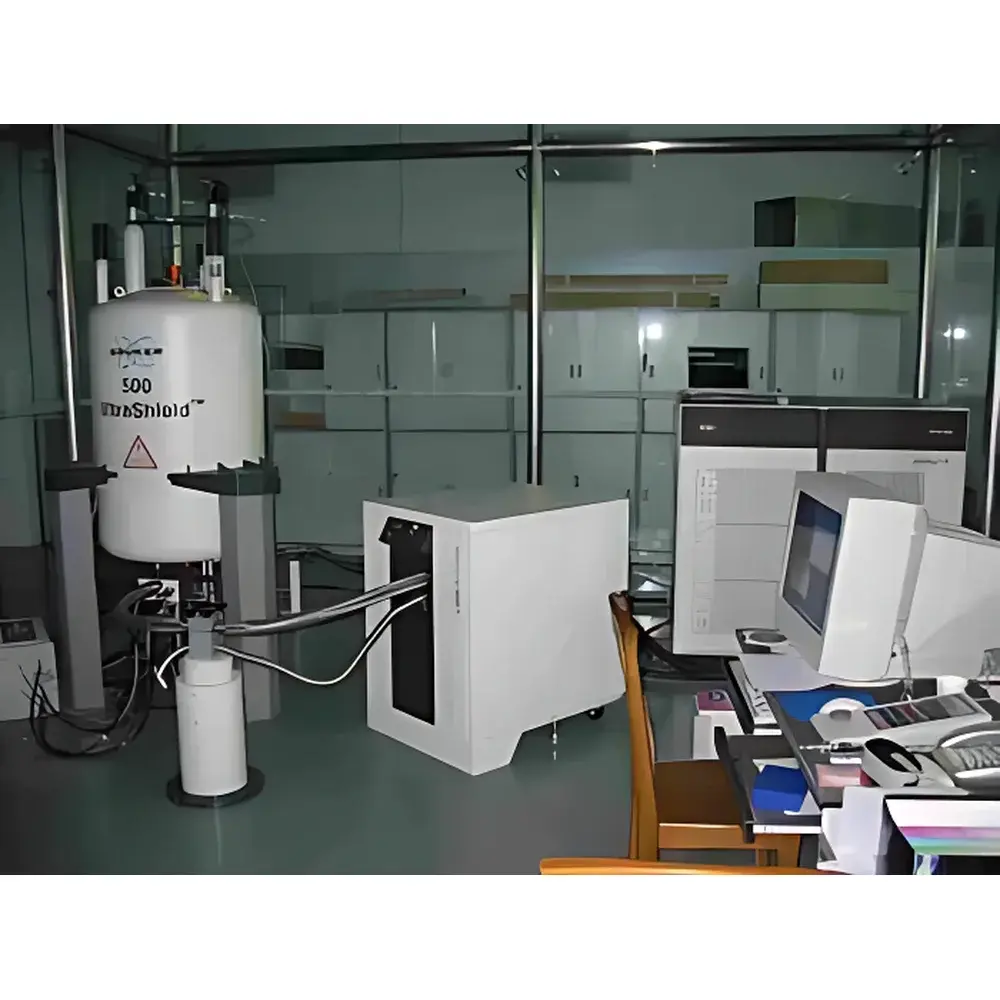
Bruker CryoProbe for High-Field NMR Spectrometers
| Brand | Bruker |
|---|---|
| Model | CryoProbe |
| Origin | Imported |
| Cooling Principle | Closed-cycle helium refrigeration (Gifford-McMahon cryocooler) |
| Operating Temperature | ~20 K (probe coil), ~25 K (preamp) |
| Signal-to-Noise (S/N) Gain | Up to 4× vs. room-temperature probes |
| Compatible Systems | Bruker AVANCE III/IV NMR platforms |
| Probe Configurations | Dual-tuned (e.g., ¹H/¹³C), triple-resonance (e.g., ¹H/¹³C/¹⁵N), with ²H lock and Z-gradient capability |
| Compliance | Designed for GLP/GMP-compliant labs |
Overview
The Bruker CryoProbe is a cryogenically cooled radiofrequency (RF) probe system engineered for high-field nuclear magnetic resonance (NMR) spectrometers. It operates on the principle of cryogenic signal amplification: by cooling the RF coil and low-noise preamplifier to ~20–25 K using a closed-cycle Gifford-McMahon helium cryocooler, thermal noise is substantially reduced—enabling up to a fourfold improvement in signal-to-noise ratio (S/N) compared to conventional room-temperature probes. This gain is physically rooted in the reduction of Johnson-Nyquist noise in the detection circuitry, directly translating into either a 16-fold reduction in experiment time (for equivalent S/N) or the ability to analyze samples at one-quarter the concentration. The CryoProbe is not a standalone instrument but an integrated hardware module designed exclusively for Bruker AVANCE III and AVANCE IV NMR platforms, requiring no liquid helium refills after initial commissioning.
Key Features
- Cryogenic RF detection architecture with integrated 2H lock channel and Z-axis gradient coils for solvent suppression and coherence selection
- Dual- and triple-resonance configurations supporting standard biomolecular and small-molecule NMR experiments (e.g., HSQC, HMQC, NOESY, TOCSY)
- Optimized RF homogeneity and short pulse dead times (< 1 µs typical), enabling precise broadband excitation and robust decoupling
- Linear power response across dynamic range—critical for quantitative pulse calibration and amplitude-modulated experiments
- Enhanced water suppression performance due to improved coil Q-factor and reduced dielectric losses, particularly beneficial for aqueous biological samples with moderate ionic strength
- Plug-and-play integration with Bruker’s standard CryoPlatform, including automated start-up sequence, real-time temperature monitoring, and fail-safe shutdown protocols
Sample Compatibility & Compliance
The CryoProbe accommodates standard 5 mm NMR tubes and is validated for use with a broad spectrum of sample types—including proteins, nucleic acids, metabolites, and synthetic organic compounds—in both aqueous and organic solvents. Its design accommodates samples with ionic strengths up to 300 mM NaCl without measurable degradation in S/N or line shape fidelity. From a regulatory standpoint, the CryoProbe—when operated within a Bruker AVANCE system running TopSpin 4.x or later—is compatible with GLP and GMP environments. Full electronic audit trail functionality, user access control, and 21 CFR Part 11–compliant electronic signatures are supported through TopSpin’s validated software framework. System-level documentation (IQ/OQ/PQ protocols) is available upon request for pharmaceutical and contract research laboratory deployment.
Software & Data Management
CryoProbe operation is fully embedded within Bruker’s TopSpin software environment. All cryogenic status parameters—including cold head temperature, helium pressure, compressor runtime, and cooldown progress—are displayed in real time and logged automatically. Experimental parameter sets (.acqus files) store probe-specific metadata (e.g., cryo-status flag, calibrated power levels, gradient calibration constants), ensuring full traceability. Data acquisition workflows support automated batch processing, spectral referencing, and integration with CMC-se (Chenomx) or Mnova for quantitation. Raw FID data retain full phase and amplitude integrity, preserving compatibility with advanced processing techniques such as non-uniform sampling (NUS), maximum entropy reconstruction, and deep-learning–based denoising algorithms.
Applications
The CryoProbe delivers measurable performance advantages in applications where sensitivity, resolution, or throughput is limiting. These include: structural elucidation of low-concentration natural products; ligand-observed binding assays (e.g., STD, WaterLOGSY); dynamic nuclear polarization (DNP)-adjacent experiments requiring ultra-low-noise baselines; high-throughput screening of fragment libraries; and metabolomics profiling of limited-volume clinical biofluids (e.g., CSF, microdialysate). In biomolecular NMR, it enables backbone assignment of 20–30 kDa proteins at sub-millimolar concentrations and accelerates 3D/4D NOESY acquisition cycles by >75% relative to ambient probes.
FAQ
Does the CryoProbe require liquid helium refills during routine operation?
No. After initial helium charge, the system operates in a fully closed-cycle mode. Helium is compressed, expanded, and recirculated via the Gifford-McMahon cryocooler—no consumables are required under normal conditions.
Can the CryoProbe be retrofitted onto older AVANCE II systems?
No. CryoProbe integration requires AVANCE III or newer electronics architecture, including dedicated cryo-control I/O, updated gradient drivers, and TopSpin 3.5+ firmware support.
Is the CryoPlatform compatible with non-Bruker NMR spectrometers?
No. Mechanical, electrical, and communication interfaces are proprietary to Bruker’s AVANCE platform and not interoperable with other vendors’ consoles.
What is the typical cooldown time from ambient to operating temperature?
Approximately 12–14 hours for full thermal stabilization; partial readiness (for basic ¹H acquisition) is achieved within 6 hours.
How is safety ensured during long-term unattended operation?
The CryoController continuously monitors helium pressure, cold head temperature, compressor oil level, and coolant flow. Any anomaly triggers automatic ramp-down and system halt, with event logs timestamped to millisecond resolution.




