
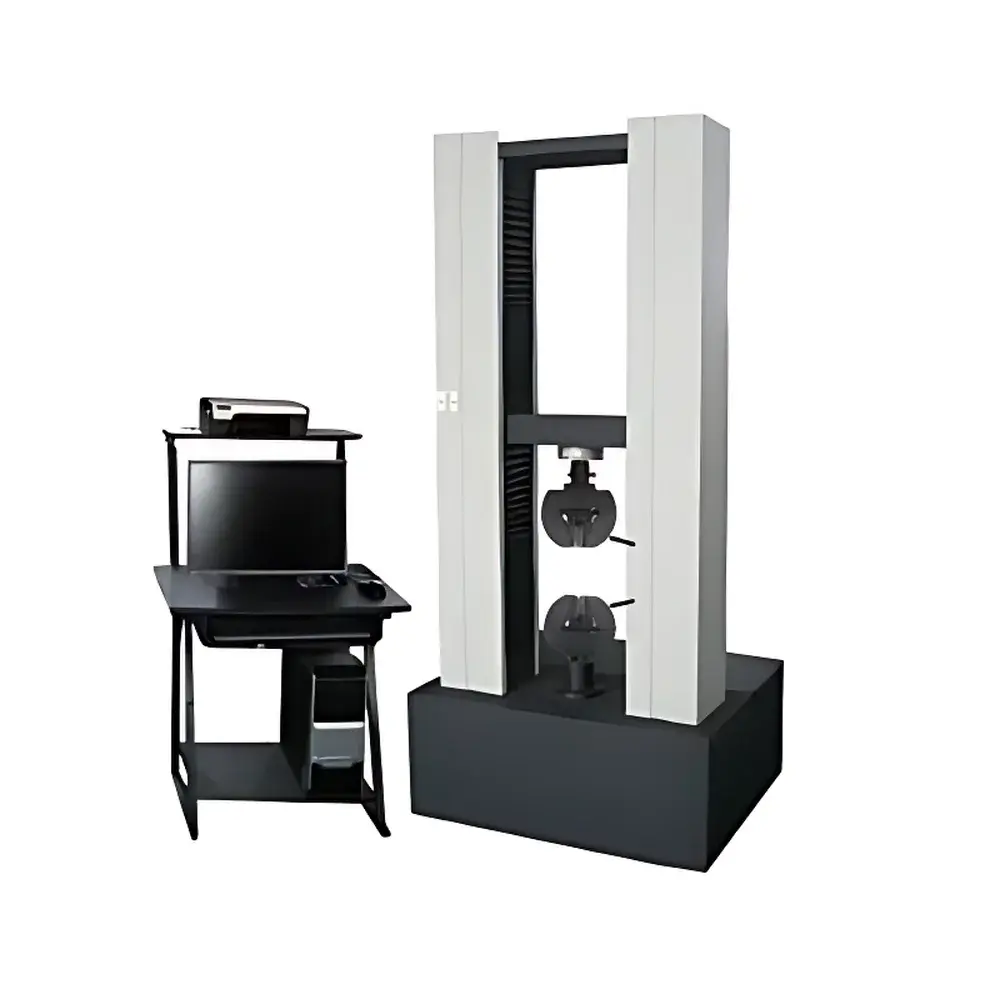
TianYuan TY-8000 300 kN Variable-Frequency Controlled Universal Testing Machine
| Brand | TianYuan |
|---|---|
| Origin | Jiangsu, China |
| Manufacturer Type | Direct Manufacturer |
| Model | TY-8000 |
| Load Cell Capacity | 300 kN |
| Force Resolution | 1/100,000 |
| Force Accuracy | ≤0.5% FS |
| Force Amplification | 7-range auto-switching |
| Displacement Resolution | 1/1000 |
| Displacement Accuracy | ≤1% FS |
| Metallic Extensometer Resolution | 1/1000 |
| Metallic Extensometer Accuracy | ≤0.5% FS |
| Large-Deformation Extensometer Accuracy | ±1 mm |
| Test Speed Range | 5–150 mm/min (customizable) |
| Crosshead Travel | 900 mm (customizable) |
| Test Width | 480 mm (excl. grips, customizable) |
| Power Supply | 3-phase 380 V, 50 Hz |
| Rated Power | ~7.5 kW |
| Dimensions (L×W×H) | ~1090 × 840 × 2100 mm |
| Weight | ~1400 kg |
Overview
The TianYuan TY-8000 300 kN Variable-Frequency Controlled Universal Testing Machine is a high-capacity electromechanical testing system engineered for precision mechanical property characterization of metallic and non-metallic materials under static and quasi-static loading conditions. Based on servo-controlled variable-frequency drive (VFD) actuation, the system delivers stable, low-noise motion control across its full speed range—enabling compliant, repeatable execution of tensile, compression, flexural, shear, tear, peel, and puncture tests per international standards. Its modular load frame architecture supports interchangeable fixtures and extensometers, while the integrated force measurement subsystem—featuring a 300 kN load cell with 1/100,000 internal resolution and ≤0.5% full-scale accuracy—ensures traceable force quantification in accordance with ISO 7500-1 Class 1 and ASTM E4 calibration requirements.
Key Features
- Variable-frequency drive (VFD) motor control for smooth, low-vibration crosshead movement across 5–150 mm/min; optional custom speed profiles available for specialized protocols
- Seven-range automatic force amplification switching ensures optimal signal-to-noise ratio across the entire 300 kN dynamic range
- Dual-resolution displacement sensing: standard encoder-based measurement (1/1000 resolution, ≤1% FS accuracy) plus optional high-precision metallic extensometer (1/1000 resolution, ≤0.5% FS accuracy)
- Modular test space configuration: 900 mm vertical travel and 480 mm test width (excluding grips), both configurable to accommodate large specimens or multi-specimen fixtures
- Rugged welded steel frame with reinforced base and column structure, designed to minimize deflection and maintain alignment under maximum load
- Comprehensive safety architecture including emergency stop circuitry, overload protection, software-defined travel limits, and mechanical end-stop buffers
Sample Compatibility & Compliance
The TY-8000 accommodates standardized test specimens per ASTM D638, D790, D3039, ISO 527, ISO 178, ISO 6892-1, GB/T 228.1, GB/T 528, GB/T 529, and JIS K 6251. It supports flat, round, and irregular geometries via adjustable wedge-action, pneumatic, or hydraulic grips—compatible with specimen thicknesses up to 50 mm and widths up to 480 mm. The system meets electromagnetic compatibility (EMC) requirements per IEC 61326-1 and electrical safety standards per IEC 61000-6-2/6-4. All force and displacement data acquisition complies with ISO 17025 documentation practices for accredited laboratories.
Software & Data Management
Controlled via Windows-based proprietary software (compatible with Windows 10/11 and legacy Windows 7 environments), the TY-8000 platform enables real-time visualization of up to five synchronized curves—including Load vs. Displacement, Load vs. Time, Displacement vs. Time, Stress vs. Strain, and Load vs. Extension. Raw data is saved in ASCII CSV format with timestamped metadata, supporting third-party analysis tools (MATLAB, Python pandas, OriginLab). The software includes audit-trail functionality compliant with FDA 21 CFR Part 11 requirements when configured with user authentication, electronic signatures, and immutable log archiving. Test reports—generated in PDF or Excel—include specimen ID, operator name, environmental conditions (optional sensor integration), statistical summaries (mean, SD, CV%), and annotated curve overlays for comparative analysis.
Applications
- Mechanical validation of structural alloys, composites, and polymer laminates in aerospace and automotive R&D labs
- Quality assurance of fasteners, weldments, and castings per ISO 898-1 and ASTM F606
- Characterization of elastomeric materials (rubber, TPEs) including modulus, elongation at break, and hysteresis loop analysis
- Compression testing of foams, ceramics, and biomedical scaffolds per ASTM D3574 and ISO 844
- Educational use in university materials science laboratories for hands-on instruction in stress-strain theory and fracture mechanics fundamentals
- Contract testing services requiring GLP-compliant documentation and ISO/IEC 17025 traceability
FAQ
What standards does the TY-8000 support for calibration and verification?
The system adheres to ISO 7500-1 (static calibration), ISO 5893 (dynamic verification), and ASTM E4 for force verification; displacement calibration follows ISO 9513 guidelines.
Can the TY-8000 be integrated with external environmental chambers or digital image correlation (DIC) systems?
Yes—the machine features analog and digital I/O ports (±10 V, TTL, RS-232/485) for synchronization with climate chambers (−70 °C to +300 °C), high-speed cameras, and DIC controllers.
Is remote operation and monitoring supported?
Remote desktop access and secure web-based status dashboards are available via optional network interface module with TLS 1.2 encryption and role-based access control.
What maintenance intervals are recommended for long-term accuracy retention?
Biannual verification of load cell linearity and extensometer calibration is advised; annual mechanical inspection of guide rails, belt tension, and grip jaw alignment is required per the manufacturer’s maintenance schedule.
Does the software support multi-language UI and report generation?
English and Chinese language interfaces are standard; additional languages (German, French, Japanese) are available as licensed add-ons with localized report templates.



