
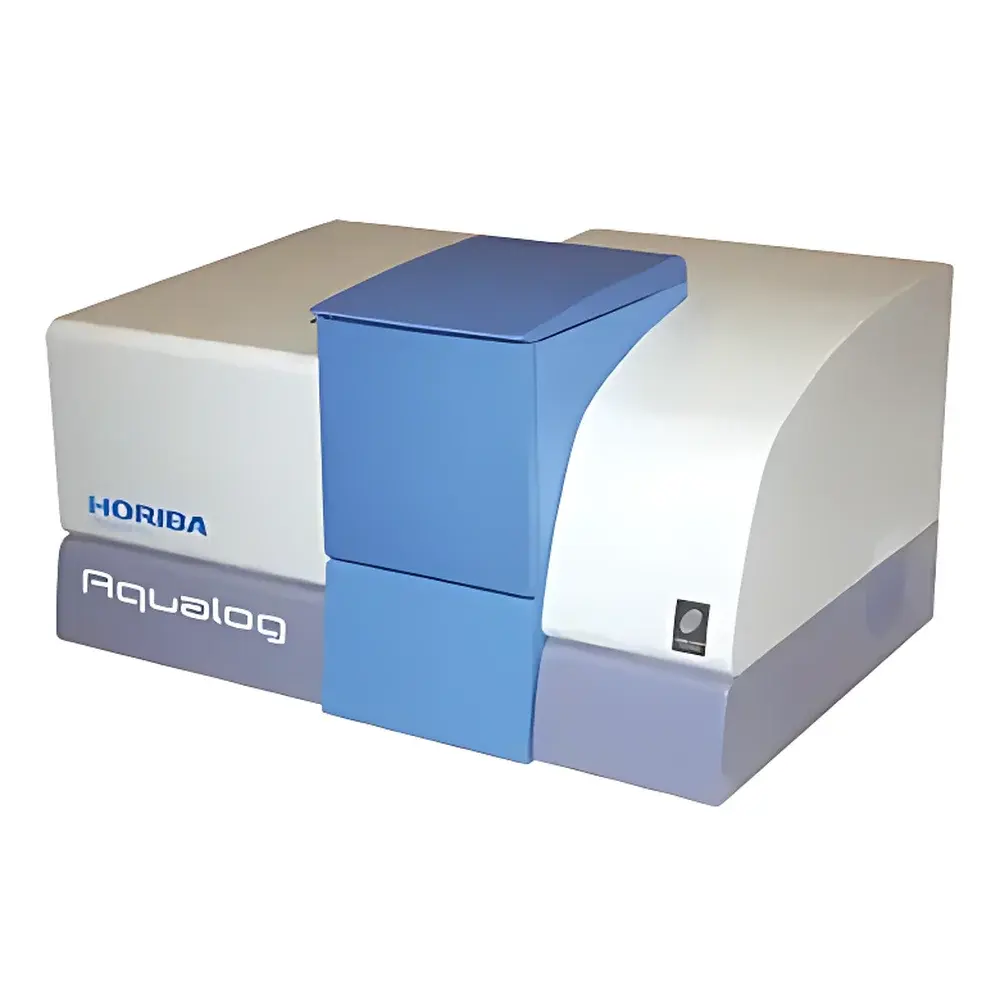
HORIBA Aqualog® Synchronous Absorption and Three-Dimensional Fluorescence Spectrometer
| Brand | HORIBA |
|---|---|
| Origin | USA |
| Manufacturer Type | Original Equipment Manufacturer (OEM) |
| Import Status | Imported |
| Model | Aqualog® |
| Dispersion Element | Grating |
| Slit Width (Spectral Bandpass) | 5 nm |
| Optical Resolution | 0.58 nm |
| Sensitivity | 20,000:1 (SNR, RMS, water Raman at 350 nm excitation, 30 s integration) |
| Wavelength Accuracy | ±1.0 nm |
Overview
The HORIBA Aqualog® Synchronous Absorption and Three-Dimensional Fluorescence Spectrometer is an engineered solution for comprehensive characterization of Colored Dissolved Organic Matter (CDOM) in aquatic systems. Unlike conventional sequential measurement approaches, the Aqualog® employs synchronized dual-beam optical architecture to acquire absorption spectra and excitation-emission matrices (EEMs) simultaneously—within a single instrument cycle and without mechanical reconfiguration. This capability is grounded in coupled photometric and fluorometric detection principles: absorption is measured via a calibrated silicon photodiode reference path, while fluorescence EEMs are captured using a thermoelectrically cooled CCD detector with high quantum efficiency in the UV–Vis range. The system’s core design addresses fundamental challenges in environmental optical sensing—including inner-filter effect correction, Raman and Rayleigh scatter removal, and spectral bandpass matching between absorption and fluorescence channels—enabling quantitative, reproducible CDOM component identification and tracking across diverse water matrices (e.g., freshwater, estuarine, marine, wastewater effluents).
Key Features
- Simultaneous acquisition of absorbance and full excitation-emission matrix (EEM) spectra—eliminating temporal drift and sample degradation artifacts associated with sequential scanning
- Dual-grating excitation monochromator delivering exceptional stray-light suppression (< 10⁻⁶), critical for low-concentration CDOM analysis in oligotrophic waters
- 150 W ozone-free xenon lamp with stable output over 2,000 hours, ensuring long-term photometric consistency across calibration cycles
- Matched spectral bandwidths (5 nm) for absorption and fluorescence channels—enabling direct, mathematically rigorous correction of inner-filter effects using Beer–Lambert-derived attenuation factors
- TE-cooled back-illuminated CCD detector (−20 °C operating temperature) with 20,000:1 water Raman SNR (350 nm excitation, 30 s integration)
- Automated wavelength accuracy verification and performance validation suite compliant with NIST-traceable protocols, supporting GLP/GMP-aligned laboratory documentation
- Integrated sample auto-sampler with programmable 2-position or 4-position magnetic stirring and temperature-controlled sample holders (±0.1 °C stability)
Sample Compatibility & Compliance
The Aqualog® accommodates liquid samples in standard 1 cm quartz cuvettes, flow-through cells (including HPLC-compatible configurations), fiber-optic coupled probes, and solid-phase substrates via optional accessories. Its optical path design supports both low-absorbance natural waters (e.g., open ocean) and highly colored humic-rich samples (e.g., peatland runoff) through dynamic range optimization and real-time signal normalization. All firmware and data handling routines comply with FDA 21 CFR Part 11 requirements for electronic records and signatures when operated with validated software configurations. Instrument performance verification adheres to ASTM D5907–22 (Standard Test Method for Total Organic Carbon in Water) and ISO 10694:2022 (Water quality — Determination of organic carbon content), providing traceable alignment with regulatory and research-grade reporting frameworks.
Software & Data Management
The Aqualog® is controlled by dedicated software fully integrated with OriginLab™, enabling automated post-acquisition processing including: (1) NIST-traceable quinine sulfate calibration referencing; (2) iterative inner-filter effect correction using concurrent absorbance data; (3) Rayleigh and Raman scatter line masking and interpolation; (4) EEM normalization to Raman unit (RU) or internal standard; and (5) export of corrected, aligned matrices directly into MATLAB®, R, or Python environments for multivariate modeling. Audit trails record all parameter changes, calibration events, and data transformations—supporting ISO/IEC 17025-compliant quality assurance workflows. Raw and processed datasets are stored in HDF5 format, preserving metadata integrity (wavelength grids, integration times, temperature logs, detector gain settings) for long-term archival and inter-laboratory comparison.
Applications
- Quantitative source apportionment of CDOM using PARAFAC modeling—distinguishing terrestrial vs. microbial, autochthonous vs. allochthonous fluorescent components
- Real-time monitoring of dissolved organic carbon (DOC) dynamics during wastewater treatment, reservoir management, and drinking water disinfection by-product (DBP) precursor tracking
- Climate-driven shifts in aquatic carbon cycling—correlating EEM signatures with δ¹³C-DOC, lignin phenols, and molecular weight distributions
- Validation of satellite-derived CDOM algorithms through field-deployable benchtop reference measurements
- Method development for EPA Method 415.3 and ISO 20675:2020 compliance in routine water quality laboratories
FAQ
How does the Aqualog® correct for inner-filter effects without manual intervention?
The system uses co-acquired absorbance spectra to compute wavelength-specific attenuation coefficients, applying them pixel-wise to raw EEMs in real time—no user-defined thresholds or iterative fitting required.
Can the Aqualog® be used for non-aqueous samples?
Yes—when equipped with solid-sample holders or fiber-optic probes, it supports qualitative and semi-quantitative fluorescence profiling of soils, sediments, biofilms, and polymer films under controlled humidity and temperature conditions.
Is PARAFAC modeling performed within the instrument software?
No—PARAFAC is executed externally in MATLAB, R, or Python; however, the Aqualog® software exports rigorously corrected, NIST-aligned EEMs with full metadata, ensuring compatibility with standard decomposition toolkits (e.g., drEEM, DOMFluor).
What validation protocols accompany the instrument?
Each unit ships with NIST-traceable wavelength accuracy verification kits, water Raman SNR test reports, stray-light certification documents, and a complete GLP-compliant performance qualification (PQ) protocol for laboratory implementation.
Does the system support remote operation and networked data archiving?
Yes—via TCP/IP-enabled instrument control and configurable export to LIMS or cloud-based repositories (e.g., AWS S3, NAS) using secure FTP/SFTP protocols, meeting institutional data governance policies.




