
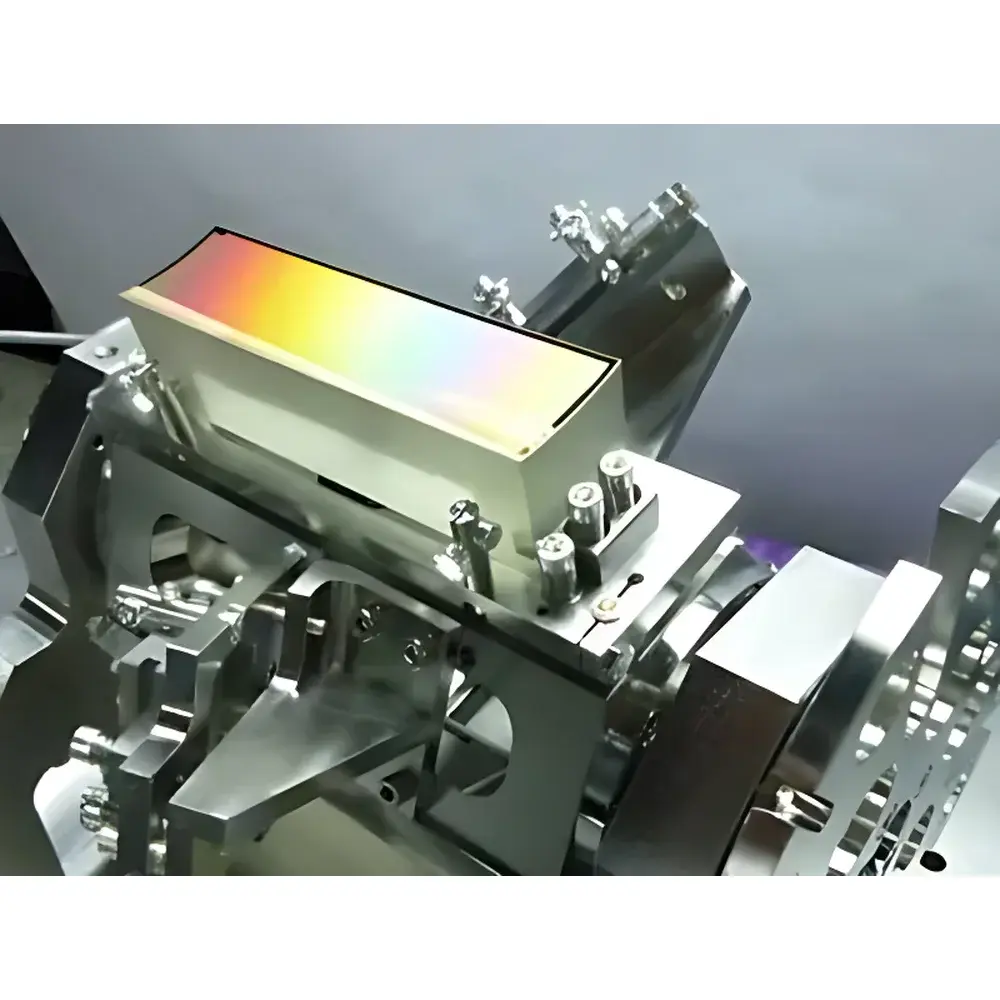
HORIBA Jobin Yvon Synchrotron-Optimized Grating
| Key | Brand: HORIBA |
|---|---|
| Origin | France |
| Manufacturer Type | Original Equipment Manufacturer (OEM) |
| Origin Category | Imported |
| Model | Synchrotron-Optimized Grating |
| Pricing | Upon Request |
Overview
The HORIBA Jobin Yvon Synchrotron-Optimized Grating is a precision optical component engineered for use in high-flux, ultra-high-vacuum (UHV) synchrotron radiation beamlines. Designed and fabricated using advanced ion-beam etching (IBE) and holographic interference lithography techniques, these gratings operate on the principle of wavelength-selective diffraction—enabling precise spectral separation across soft X-ray, vacuum ultraviolet (VUV), and extreme ultraviolet (EUV) regimes. Unlike conventional spectroscopic gratings, synchrotron-optimized variants are subject to stringent thermal, mechanical, and radiation stability requirements due to exposure to intense, broadband photon fluxes (10⁹–10¹² photons/s/mm²) and heat loads exceeding several hundred watts per square centimeter. HORIBA Jobin Yvon’s decades-long collaboration with major synchrotron facilities—including ESRF, DESY, APS, SPring-8, and NSLS-II—has informed rigorous design protocols aligned with beamline commissioning timelines, vacuum compatibility (≤10⁻⁹ mbar), and long-term radiative stability under continuous operation.
Key Features
- High diffraction efficiency (>75% at design wavelength, optimized via rigorous electromagnetic modeling)
- Exceptional damage threshold (>10 J/cm² at 10 Hz, 10 ns pulse; >5 kW/cm² CW for VUV/EUV operation)
- Large-format substrates up to 40 mm × 200 mm, supporting full-beam coverage without tiling artifacts
- Customizable optical surface geometry: plane, spherical, or toroidal (including aspheric departure ≤λ/10 RMS over aperture)
- Variable Line Spacing (VLS) and Variable Groove Depth (VGD) patterning for aberration correction and focal plane linearization
- Ion-etched multilayer groove profiles with sub-nanometer sidewall roughness (<0.3 nm RMS) to minimize stray light and higher-order scattering
- UHV-compatible mounting interfaces and outgassing-compliant coatings (per ASTM E595)
Sample Compatibility & Compliance
These gratings are compatible with all standard synchrotron monochromator architectures—including SX700-type, varied-line-spacing (VLS) Rowland-circle, and off-plane Eagle configurations. Substrate materials include single-crystal silicon (Czochralski-grown, orientation) and fused silica (Suprasil® 3001), both certified for low birefringence and thermal expansion coefficient matching (CTE ≤ 0.5 ppm/K from 20–100 °C). Coating options—Au, Pt, Cd, Mo, SiC, and MgF₂—are selected based on reflectance optimization per spectral range (e.g., Au for >50 eV, SiC for 40–100 eV, MgF₂ for 10–20 eV). All gratings comply with ISO 10110-7 (surface figure tolerance), ISO 14644-1 Class 5 cleanroom assembly, and meet requirements for GLP/GMP-aligned beamline qualification documentation packages.
Software & Data Management
HORIBA provides proprietary grating design simulation tools—GRATE-PRO v5.2 and GRT-SIM—supporting vectorial diffraction modeling (RCWA), thermal deformation prediction (ANSYS-coupled), and alignment sensitivity analysis. Each delivered grating includes a traceable metrology report (via autocollimator interferometry and micro-focus X-ray topography), with full digital twin data (STL + ZMX files) supplied for integration into ray-tracing platforms such as SHADOW, SRW, or XOP. Firmware-embedded calibration identifiers support automated inventory tracking within facility-wide asset management systems compliant with ISO/IEC 17025 and FDA 21 CFR Part 11 audit trails.
Applications
- Soft X-ray absorption spectroscopy (XAS) at beamlines dedicated to catalysis, battery materials, and quantum matter studies
- VUV photoemission spectroscopy (ARPES) requiring high-resolution dispersion (ΔE/E < 1×10⁻⁴) and angular fidelity
- Time-resolved pump-probe experiments utilizing high-repetition-rate undulator sources
- Coherent diffractive imaging (CDI) and ptychography where wavefront preservation and minimal phase error are critical
- Calibration reference standards for EUV lithography metrology and space-based solar observatories (e.g., Solar Orbiter/SPICE)
FAQ
What vacuum levels are supported for long-term operation?
All gratings are UHV-rated to ≤10⁻⁹ mbar and undergo bake-out validation at 150 °C for 48 hours prior to shipment.
Can HORIBA support custom groove density gradients beyond standard VLS profiles?
Yes—nonlinear, segmented, and multi-zone VLS/VGD patterns are routinely implemented using maskless e-beam lithography and reactive ion etching.
Is thermal deformation modeling included in the quotation package?
Thermal-optical performance simulations under specified heat load profiles are provided as part of the engineering review stage.
Do you supply mounting kinematics and alignment fiducials?
Precision Invar or titanium mounts with kinematic flexures and laser-scribed alignment marks are available as optional integrated subsystems.
How is coating adhesion validated for high-heat-load applications?
Adhesion is verified per ASTM D3359 (cross-hatch test) and thermal cycling (−40 °C to +120 °C, 100 cycles) with post-test reflectance retention ≥98% of baseline.





