
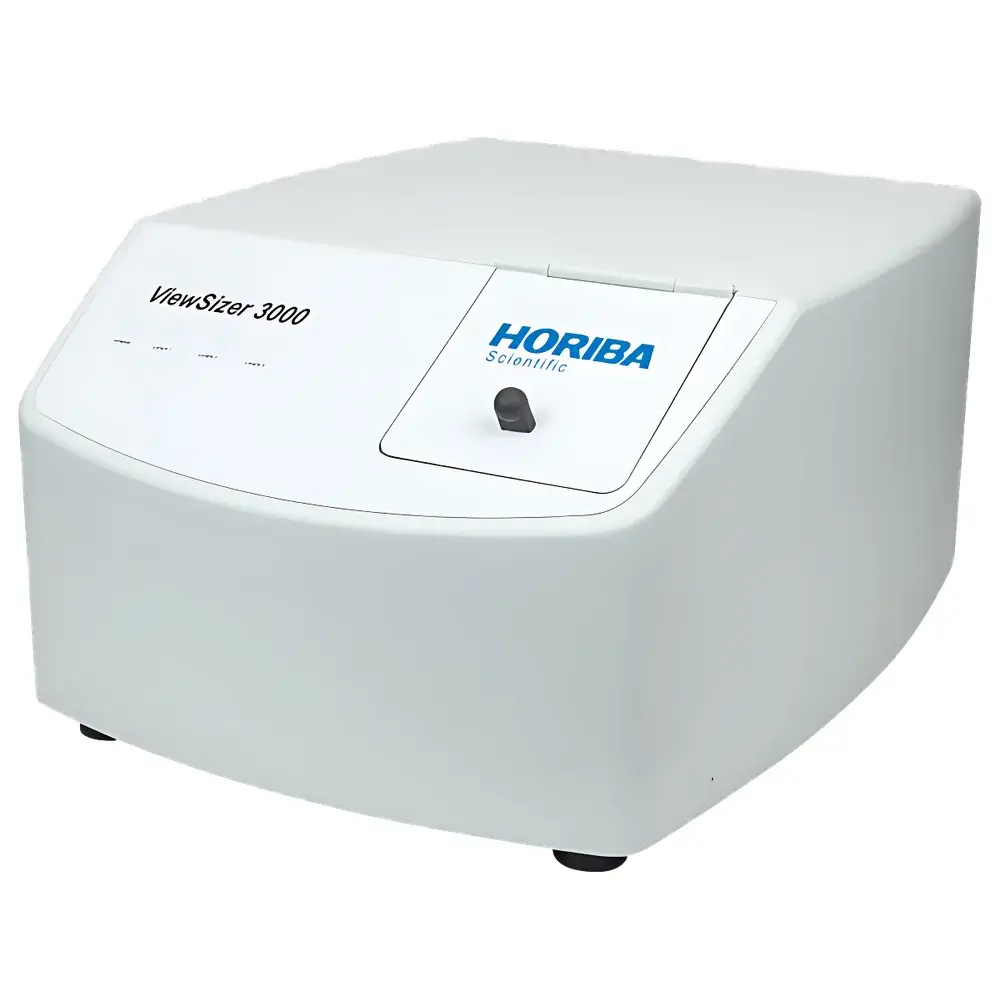
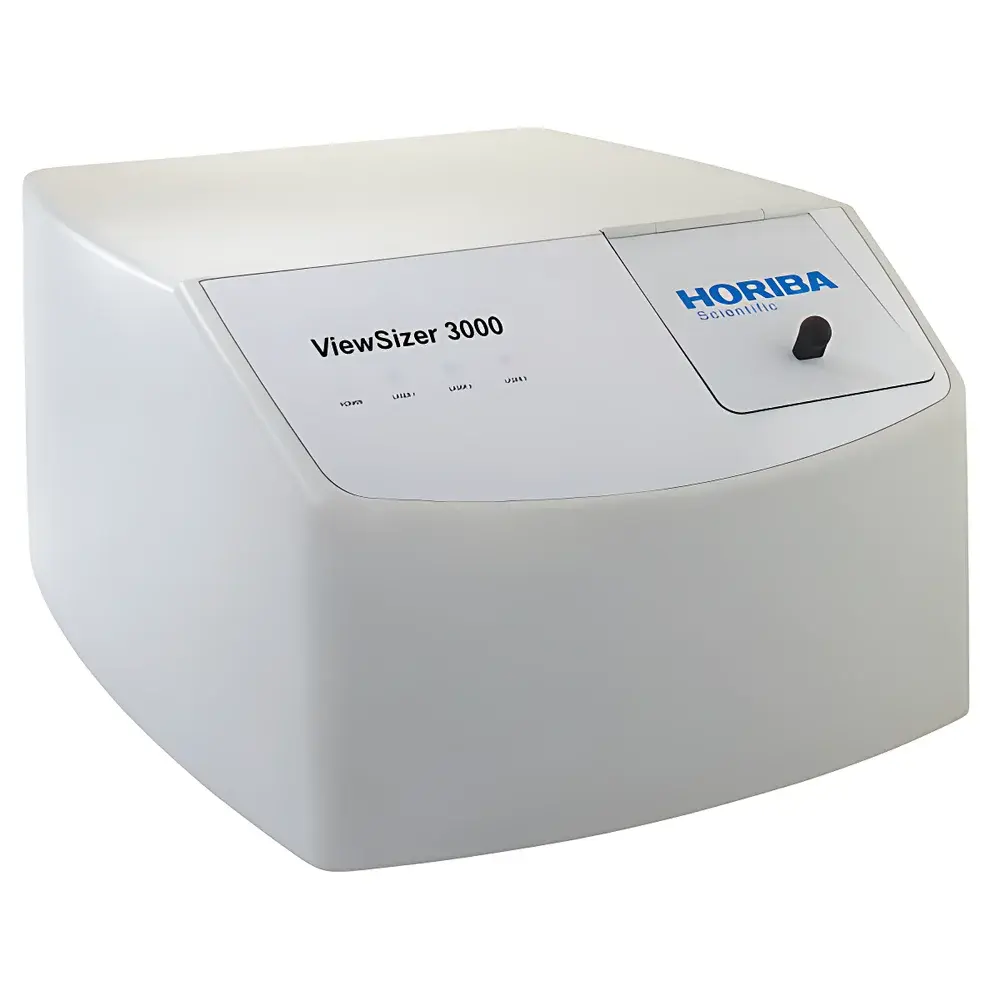
HORIBA ViewSizer 3000 Nanoparticle Tracking Analyzer
| Brand | HORIBA |
|---|---|
| Origin | USA |
| Manufacturer Type | Manufacturer |
| Origin Category | Imported |
| Model | ViewSizer 3000 |
| Pricing | Upon Request |
| Dispersion Method | Wet Dispersion |
| Measurement Range | 10 nm – 15 µm |
| Repeatability | Not Specified |
| Measurement Time | 6 min |
Overview
The HORIBA ViewSizer 3000 is a high-performance Nanoparticle Tracking Analysis (NTA) instrument engineered for simultaneous, quantitative visualization, sizing, and concentration determination of nanoparticles in liquid suspension. Unlike ensemble-averaging techniques such as dynamic light scattering (DLS), the ViewSizer 3000 employs single-particle tracking based on Brownian motion analysis. Each nanoparticle is individually resolved via scattered light under controlled illumination, and its mean-squared displacement over time is calculated from video capture. Particle hydrodynamic diameter is derived using the Stokes–Einstein equation, while absolute number concentration is computed from the imaged volume—defined by optical depth, field-of-view area, and camera pixel calibration—ensuring traceable, volumetric quantification without reliance on calibration standards. The system’s vertical observation geometry minimizes sedimentation artifacts and enables real-time monitoring of time-dependent phenomena including protein aggregation, crystal nucleation, dissolution kinetics, and colloidal stability.
Key Features
- Triple-wavelength illumination system (405 nm blue, 532 nm green, 640 nm red) enabling optimal contrast selection across diverse particle compositions and refractive indices
- Vertical optical configuration supporting kinetic studies of settling-sensitive systems (e.g., therapeutic proteins, liposomes, exosomes)
- Integrated intermittent stirring mechanism ensuring homogeneous sampling and improved measurement reproducibility
- Optimized sample cell design with low-volume capacity (≤ 400 µL), rapid cleaning protocol, and minimal carryover risk
- Real-time particle-by-particle trajectory reconstruction with automated drift correction and intensity-based particle discrimination
- Fluorescence-compatible detection channel allowing multi-component resolution in heterogeneous mixtures (e.g., labeled vs. unlabeled vesicles, polymer-coated vs. bare nanoparticles)
Sample Compatibility & Compliance
The ViewSizer 3000 accommodates aqueous and organic suspensions with viscosities up to 10 cP and particle concentrations ranging from 10⁶ to 10⁹ particles/mL. It supports ISO 22412:2017-compliant NTA methodology and is routinely applied in environments governed by ICH Q5A(R2), USP , and FDA guidance on nanomaterial characterization. While not inherently 21 CFR Part 11-compliant out-of-the-box, the software architecture supports audit trail configuration, electronic signature integration, and data integrity controls required for GLP and GMP-regulated laboratories upon validation. Sample preparation follows standard wet dispersion protocols compatible with sonication, filtration (0.22 µm), and pH/ionic strength adjustment per material-specific SOPs.
Software & Data Management
Acquisition and analysis are executed through HORIBA’s proprietary ViewSizer Software v3.x, designed for intuitive workflow navigation and regulatory-ready documentation. The interface provides synchronized video playback with overlayed particle trajectories, real-time histogram updates, and batch processing for comparative kinetic series. Export formats include CSV (for size distribution, concentration, and intensity-weighted metrics), PDF reports with embedded metadata (instrument ID, operator, timestamp, environmental conditions), and HDF5 for advanced statistical modeling. All raw video files, processed datasets, and analysis parameters are stored with immutable timestamps and user-defined project tags. Optional plugins enable correlation with complementary techniques (e.g., DLS, TEM image analysis, SEC-MALS) via standardized data exchange schemas.
Applications
- Quantitative characterization of extracellular vesicles (exosomes, microvesicles) for biopharmaceutical development and biomarker research
- In-process monitoring of nanoparticle synthesis (e.g., PLGA, lipid nanoparticles) including nucleation, growth, and aggregation phases
- Stability assessment of protein therapeutics under thermal or mechanical stress conditions
- Crystallization kinetics in pharmaceutical formulations and functional food matrices
- Dissolution profiling of poorly water-soluble active pharmaceutical ingredients (APIs) in nanosuspensions
- Multi-modal particle identification in complex biological fluids (e.g., serum, synovial fluid) using fluorescence spectral deconvolution
FAQ
What is the minimum detectable particle size under standard operating conditions?
The lower detection limit is 10 nm for particles with refractive index contrast ≥ 0.02 relative to the dispersant, assuming optimal illumination wavelength selection and signal-to-noise ratio > 5:1.
Can the ViewSizer 3000 measure polydisperse samples containing both sub-100 nm and micron-sized particles in a single run?
Yes—the triple-laser system and adaptive exposure control allow simultaneous visualization across the full 10 nm – 15 µm range without manual reconfiguration.
Is temperature control integrated into the instrument?
No; external Peltier-controlled sample stages or thermostatted cuvettes are recommended for temperature-dependent studies.
How is measurement volume calibrated and validated?
Calibration is performed using traceable spherical polystyrene standards (NIST SRM 1963) and verified via geometric optical path length calculation combined with camera sensor metrology.
Does the software support automated pass/fail criteria for release testing?
Yes—customizable acceptance thresholds can be defined per parameter (e.g., D10 ≤ 80 nm, concentration ±15% of target), with automated flagging and report generation.



