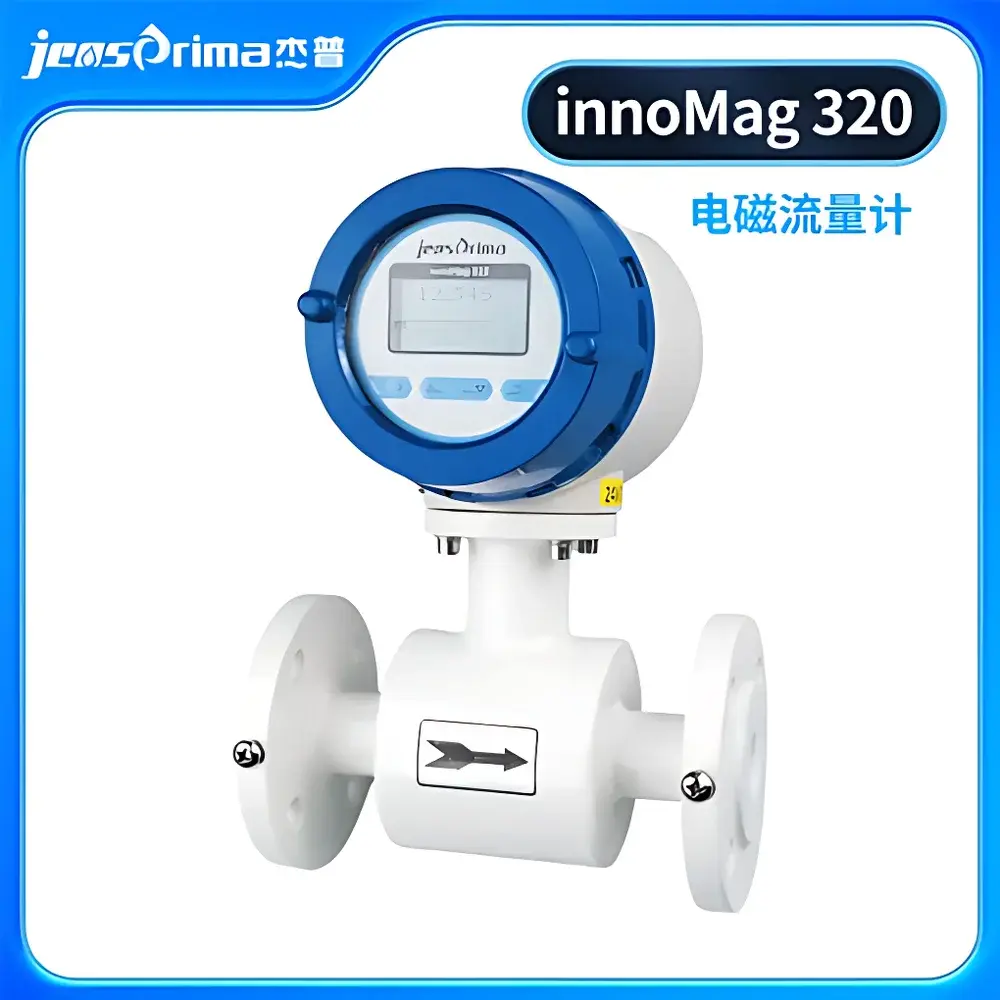
JENSPRIMA InnoMag 320 Electromagnetic Flow Meter
| Brand | JENSPRIMA |
|---|---|
| Origin | Shanghai, China |
| Manufacturer Type | Authorized Distributor |
| Product Origin | Domestic (China) |
| Model | InnoMag 320 |
| Pricing | Available Upon Request |
| Construction Type | Integral (S-type) or Remote (L-type) |
| Nominal Diameter Range | DN10–DN2000 |
| Flow Range | 0.2–30,000 m³/h |
| Accuracy | ±0.5% of reading |
| Repeatability | ±0.1% of reading |
| Display | Backlit LCD |
| Installation | Flanged (custom clamp-on option available) |
| Minimum Conductivity | ≥10 µS/cm |
| Electrode Materials | 316 Stainless Steel, Hastelloy C, Tantalum, Titanium |
| Lining Materials | PTFE (DN10–DN1000), Rubber (DN50–DN2000) |
| Housing Materials | Controller – Aluminum |
| Temperature Limits | PTFE Lining – –40 to +150 °C |
| Ambient Operating Temperature | –20 to +70 °C |
| Output Signals | 4–20 mA (max. 750 Ω), Pulse Output, Frequency Output |
| Communication Protocols | MODBUS RTU (standard), HART (optional) |
| Power Supply | 85–260 VAC or 24 VDC |
Overview
The JENSPRIMA InnoMag 320 Electromagnetic Flow Meter is an industrial-grade online flow measurement instrument engineered for continuous, non-intrusive volumetric flow monitoring of conductive liquids in demanding process environments. Based on Faraday’s Law of Electromagnetic Induction, the InnoMag 320 generates a magnetic field perpendicular to the flow direction and measures the induced voltage across two electrodes mounted in the pipe wall. This voltage is directly proportional to the average fluid velocity—enabling highly stable and linear flow output independent of pressure, temperature, density, viscosity, or flow profile variations. Designed for long-term reliability in wastewater treatment plants, metallurgical facilities, chemical processing units, and mining operations, the InnoMag 320 delivers consistent metrological performance under fluctuating hydraulic conditions and moderate particulate loading.
Key Features
- True bidirectional flow measurement with polarity-sensitive signal processing—essential for recirculation loops and batch transfer validation.
- Zero-pressure-loss design eliminates energy penalties and avoids mechanical wear associated with orifice plates or turbine meters.
- High repeatability (±0.1% of reading) ensures robust data integrity for mass balance calculations and regulatory reporting.
- Modular construction: Integral (S-type) configuration for compact installations; remote (L-type) sensor-controller separation for high-temperature or hazardous area deployments.
- Wide nominal bore range (DN10–DN2000) supports applications from laboratory-scale dosing lines to municipal water trunk mains.
- Electrode and liner material selection—including Hastelloy C, tantalum, titanium, PTFE, and natural rubber—enables chemical compatibility mapping per ISO 15197 and ASTM D1129 guidelines.
- Robust electromagnetic interference (EMI) shielding and galvanic isolation meet IEC 61326-1 requirements for industrial electromagnetic compatibility.
Sample Compatibility & Compliance
The InnoMag 320 is validated for use with aqueous solutions, slurries, acids, alkalis, and pulp suspensions exhibiting minimum electrical conductivity of 10 µS/cm—a threshold aligned with EN 14154-1 for electromagnetic water meters. Its PTFE-lined variants comply with FDA 21 CFR 177.1550 for incidental food contact, while rubber-lined configurations support ISO 22899-1 standards for abrasive slurry handling. The device conforms to CE marking directives (2014/30/EU EMC, 2014/31/EU Measuring Instruments Directive) and carries IP67-rated enclosures (sensor) and IP65 (controller). Optional ATEX/IECEx certification kits are available for Zone 1/21 hazardous locations. Calibration traceability follows ISO/IEC 17025-accredited procedures, with optional factory calibration certificates issued per ISO 10012.
Software & Data Management
The InnoMag 320 integrates seamlessly into plant-wide SCADA and DCS architectures via its standard MODBUS RTU interface over RS-485. Optional HART 7 protocol support enables parameter configuration, diagnostics, and loop verification using handheld communicators or asset management systems compliant with FDT/DTM and EDDL specifications. Local backlit LCD provides real-time instantaneous flow (m³/h), totalized volume (m³), net/absolute direction indication, and diagnostic status codes—including electrode contamination alerts, empty-pipe detection, and grounding fault warnings. All operational events and configuration changes are timestamped and stored internally for audit trail generation—supporting GLP/GMP-aligned data governance frameworks and facilitating 21 CFR Part 11-compliant electronic record retention when interfaced with validated historian platforms.
Applications
- Municipal and industrial wastewater influent/effluent monitoring, including activated sludge return and digester feed control.
- Continuous caustic soda, sulfuric acid, and chlorine solution dosing in chemical manufacturing and electroplating lines.
- Slurry transport metering in iron ore beneficiation, coal washing, and phosphate mining operations.
- Cooling water circulation and condensate return tracking in power generation and steel rolling mills.
- Batch reconciliation and custody transfer verification in beverage and pharmaceutical utilities where conductivity remains stable.
FAQ
What is the minimum fluid conductivity required for reliable operation?
The InnoMag 320 requires a minimum conductivity of 10 µS/cm. Below this threshold, signal-to-noise ratio degrades significantly, compromising measurement stability.
Can the InnoMag 320 measure flow in partially filled pipes?
No—it is designed exclusively for full-pipe applications. Partially filled or open-channel flows require ultrasonic Doppler or area-velocity sensors.
Is the device suitable for sanitary applications in food or pharma?
Yes, when equipped with FDA-compliant PTFE lining and 316L stainless steel wetted parts, and installed with hygienic tri-clamp or DIN 11851 connections (custom order).
How does the InnoMag 320 handle air entrainment or gas bubbles?
Air pockets exceeding ~5% volume fraction may cause signal dropout or erratic readings. Installation at downward-sloping pipe sections or use of degassing valves upstream is recommended.
Does the flow meter require periodic recalibration?
While electromagnetic principles offer inherent long-term stability, annual verification against a master meter or portable ultrasonic reference is recommended per ISO 9001 and ISO/IEC 17025 quality system requirements.