
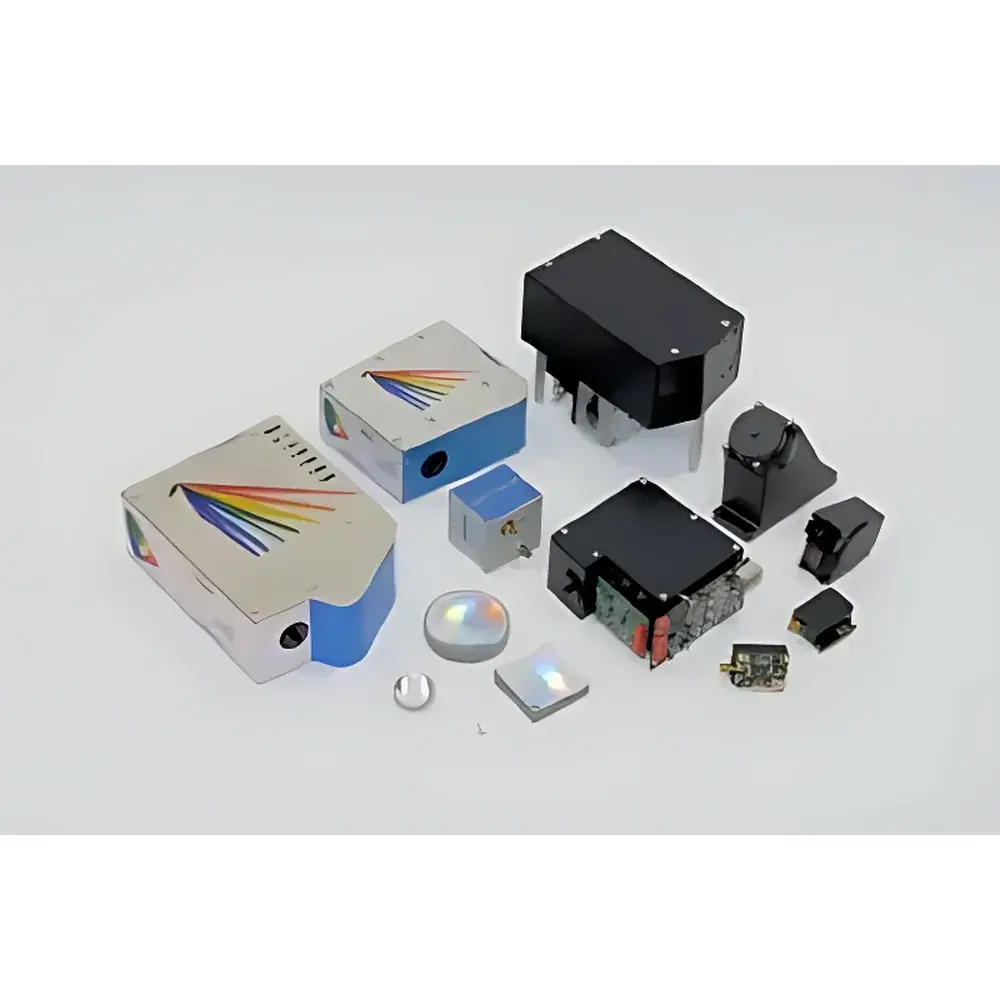
HORIBA OEM Customizable Fiber Optic Spectrometer
| Brand | HORIBA |
|---|---|
| Origin | France |
| Manufacturer Type | Original Equipment Manufacturer (OEM) |
| Product Category | Imported |
| Model | OEM Customizable Spectrometer |
| Price | Upon Request |
| Spectral Range | 190–2100 nm |
| Optical Resolution | 10–1 nm (FWHM, configurable per design) |
| Focal Length | 20–140 mm |
| Detector Options | Single-channel PMT, Linear/2D CCD, CMOS, InGaAs, NMOS, PDA arrays |
| Optical Design | Monolithic Czerny–Turner or Crossed-beam configuration with Aberration-Corrected (Type-4) holographic grating |
| Compliance | Designed for integration into ISO/IEC 17025-accredited analytical systems, compatible with FDA 21 CFR Part 11–ready software environments |
Overview
The HORIBA OEM Customizable Fiber Optic Spectrometer is a purpose-engineered optical sensing platform designed exclusively for integration into third-party analytical instrumentation. Built upon decades of R&D in high-performance spectroscopic metrology at HORIBA Jobin Yvon’s Grenoble facility, this spectrometer leverages monolithic optical architecture and aberration-corrected holographic grating technology to deliver reproducible spectral fidelity across the deep UV to short-wave NIR range (190–2100 nm). Unlike off-the-shelf benchtop units, it operates as a core subsystem—optimized for mechanical, thermal, and electronic co-design with host instruments such as portable Raman analyzers, HPLC-UV/Vis detectors, multi-parameter environmental monitors, and clinical fluorescence platforms. Its measurement principle relies on wavelength-dispersive detection via fixed or scanning grating optics, with signal acquisition governed by detector quantum efficiency, pixel well depth, and readout noise characteristics—all tunable during OEM specification.
Key Features
- Monolithic optical bench construction ensures long-term mechanical stability and minimal thermal drift (<0.05 nm/°C typical), critical for field-deployable and GMP-compliant instrumentation.
- Type-4 aberration-corrected holographic gratings provide flat-field imaging across the full spectral range, enabling uniform spatial resolution and photometric linearity without software-based correction.
- Configurable focal length (20 mm to 140 mm) allows trade-off optimization between throughput (étendue), resolution, and system footprint—supporting both compact handheld designs and high-resolution laboratory-grade integrations.
- Detector agnosticism: supports PMT, linear/area CCD, scientific CMOS, extended-range InGaAs (up to 2100 nm), NMOS, and photodiode array (PDA) sensors—each with matched slit coupling, thermoelectric cooling options, and analog/digital interface standards (LVDS, USB3, Camera Link).
- OEM-dedicated firmware architecture enables seamless communication via UART, SPI, or I²C; full register-level control of integration time, gain, offset, and dark current compensation is provided through documented low-level APIs.
Sample Compatibility & Compliance
This spectrometer module is not intended for direct end-user operation but serves as a certified subassembly within final analytical devices. It complies with RoHS 2011/65/EU and REACH Annex XVII requirements. Optical performance specifications are validated per ISO 14644-1 Class 5 cleanroom assembly protocols and undergo 100% spectral calibration traceable to NIST SRM 2036 (deuterium lamp) and SRM 2035 (tungsten halogen). When integrated into medical or pharmaceutical instrumentation, the module supports system-level validation under ISO 13485 and FDA 21 CFR Part 11 when paired with audit-trail-enabled host software. It meets electromagnetic compatibility per EN 61326-1:2013 for industrial environments.
Software & Data Management
HORIBA provides a comprehensive OEM Software Development Kit (SDK), including C/C++, Python, and LabVIEW drivers, along with spectral calibration files (.cal, .spc) and dark reference templates. All firmware supports non-volatile storage of multiple calibration sets—enabling multi-detector or multi-grating configurations within a single hardware platform. Raw data output is delivered in IEEE 754-compliant 16-bit or 32-bit floating-point format, preserving dynamic range for post-acquisition chemometric processing (e.g., PCA, PLS regression). Time-stamped frame metadata (exposure, temperature, grating position) is embedded in each spectrum packet to support GLP/GMP-compliant data integrity workflows.
Applications
- Integrated liquid chromatography detectors requiring real-time UV-Vis-NIR spectral deconvolution.
- Portable Raman spectrometers for in-field pharmaceutical raw material identification (ICH Q5A, USP ).
- Multi-parameter water quality analyzers measuring nitrate, organic carbon, and turbidity via absorption fingerprinting (ISO 7027, ASTM D6508).
- LED and laser diode spectral characterization systems used in photobiomodulation device manufacturing.
- Fluorescence lifetime and intensity monitoring in microplate readers for HTS assay development (CLSI EP17-A2).
- Gas-phase absorption spectroscopy modules for stack emission monitoring (EPA Method 10, EN 15267).
FAQ
Can HORIBA provide spectral calibration certificates traceable to NIST standards?
Yes—each unit ships with a unique calibration report referencing NIST-traceable sources and uncertainty budgets per ISO/IEC 17025 requirements.
Is mechanical housing customization available (e.g., mounting flanges, thermal interface design)?
Yes—custom machined housings, EMI-shielded enclosures, and conductive anodized finishes are offered under NDA.
What is the typical lead time for volume OEM orders?
Standard lead time is 14–18 weeks from PO release for quantities ≥50 units; expedited builds are available under contractual agreement.
Do you support co-development of application-specific firmware?
Yes—HORIBA’s Embedded Systems Group offers joint firmware development with customer-defined real-time processing pipelines (e.g., peak-finding, ratio-metric normalization, baseline correction).
Are optical interfaces limited to SMA905 fiber coupling?
No—options include FC/PC, ST, bare-fiber pigtails, free-space input slits, and custom collimator lenses matched to customer optical trains.
Related Products




