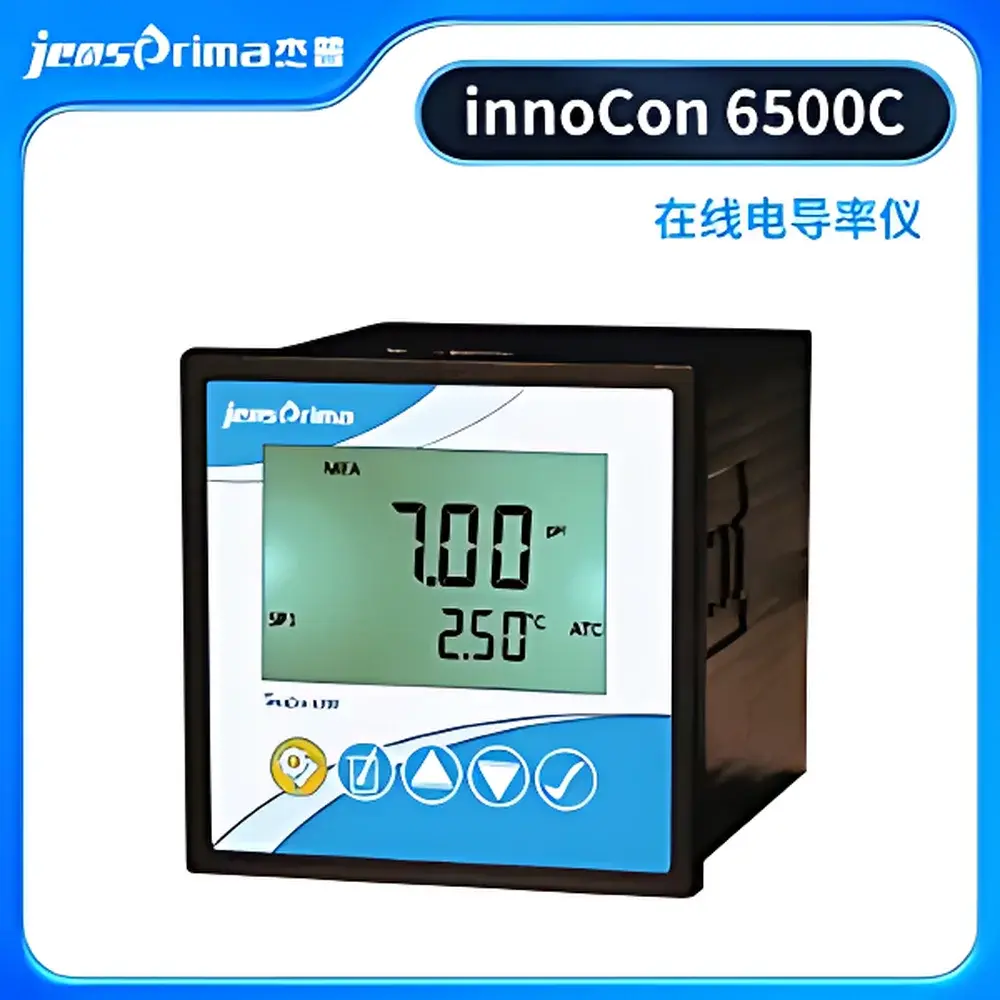
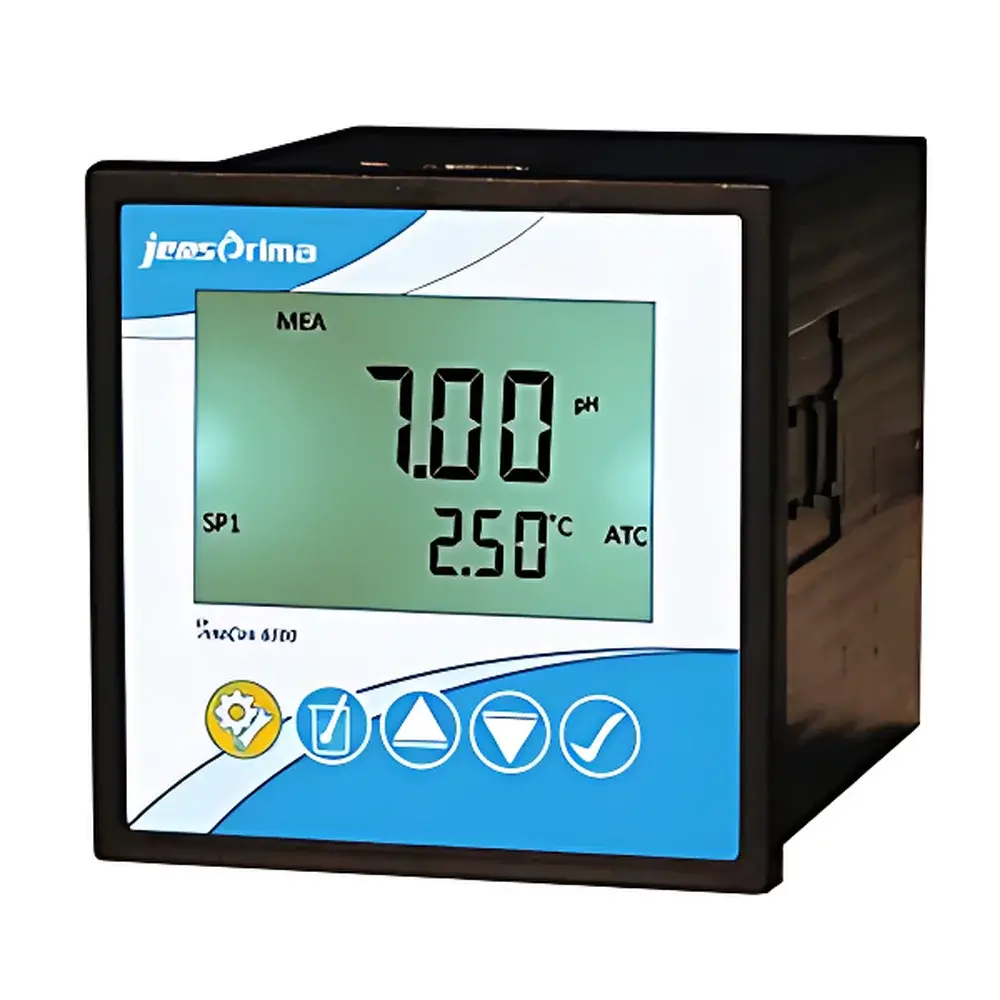
JENSPRIMA innoCon 6500C Online Conductivity Analyzer
| Brand | JENSPRIMA |
|---|---|
| Origin | Shanghai, China |
| Model | innoCon 6500C |
| Conductivity Range | 0.00–20.00 / 200.0 / 2000 µS/cm, 0.00–20.00 / 200.0 / 2000 mS/cm |
| Resistivity Range | 0.00–20.00 MΩ·cm |
| TDS Range | 0.00 ppm–200.0 ppt |
| Resolution | 0.01/0.1/1 µS/cm, 0.1/1 mS/cm, 0.01 MΩ·cm, 0.01/0.1/1 ppm, 0.1 ppt |
| Accuracy | ±1% FS |
| Temperature Sensor | Pt1000 |
| Temp. Compensation | Automatic (with ±10.0 °C offset adjustment) or Manual |
| Operating Temp. | −10.0 to +60.0 °C |
| Humidity | 10–90% RH (non-condensing) |
| Display | Backlit LCD (44×65 mm), yellow backlight |
| Power Supply | 90–260 VAC, 50/60 Hz |
| Outputs | Two isolated 4–20 mA analog outputs (configurable, max. 600 Ω load) |
| Relay Outputs | Two independent SPST relays (Hi/Lo alarm, hysteresis adjustable |
| Enclosure Rating | IP54 |
| Mounting | Panel mount (cutout: 92×92 mm) |
| Dimensions | 96×96×130 mm |
| Weight | 0.45 kg |
Overview
The JENSPRIMA innoCon 6500C Online Conductivity Analyzer is a DIN-standard panel-mounted process instrument engineered for continuous, high-stability measurement of electrical conductivity, resistivity, and total dissolved solids (TDS) in aqueous industrial streams. It operates on the principle of two-electrode or four-electrode conductometric measurement—depending on the connected innoSens 320 sensor—and applies real-time temperature compensation using an integrated Pt1000 platinum resistance thermometer. The analyzer features dual-range auto-ranging capability across six decades (from ultra-pure water at 0.01 µS/cm up to aggressive brine solutions exceeding 2000 mS/cm), with built-in compensation curves optimized for ultrapure and purified water applications per ASTM D1125 and ISO 7888 standards. Its robust architecture supports deployment in chemical processing, pharmaceutical water systems (PW, WFI), boiler feedwater monitoring, desalination pre-treatment, and semiconductor rinse-loop control—environments where long-term drift stability, immunity to electromagnetic interference, and compliance-ready data integrity are critical.
Key Features
- DIN 43700-compliant housing (96×96 mm front face, 130 mm depth) with flame-retardant plastic enclosure rated IP54 for dust resistance and limited water ingress protection
- Wide-input universal power supply (90–260 VAC, 50/60 Hz), eliminating need for external transformers in global installations
- Backlit yellow LCD display (44×65 mm active area) showing simultaneous conductivity/resistivity/TDS value, measured temperature, relay status, and system diagnostics
- Configurable dual 4–20 mA analog outputs—each independently assignable to any measured parameter (e.g., conductivity + temperature) with scalable full-scale ranges and galvanic isolation
- Two programmable SPST relays with user-defined high/low setpoints, adjustable hysteresis, and fail-safe logic—certified for 5 A switching capacity at 250 VAC or 30 VDC
- Automatic calibration support via recognized standard solutions (e.g., KCl 0.01 mol/L, 0.1 mol/L); manual calibration mode also available with slope and offset adjustment
- Password-protected configuration interface (four-digit PIN) restricting access to setup menus, calibration, and relay programming—supporting role-based operational security
- One-touch factory reset function for rapid recovery after misconfiguration without requiring service tools or firmware reload
Sample Compatibility & Compliance
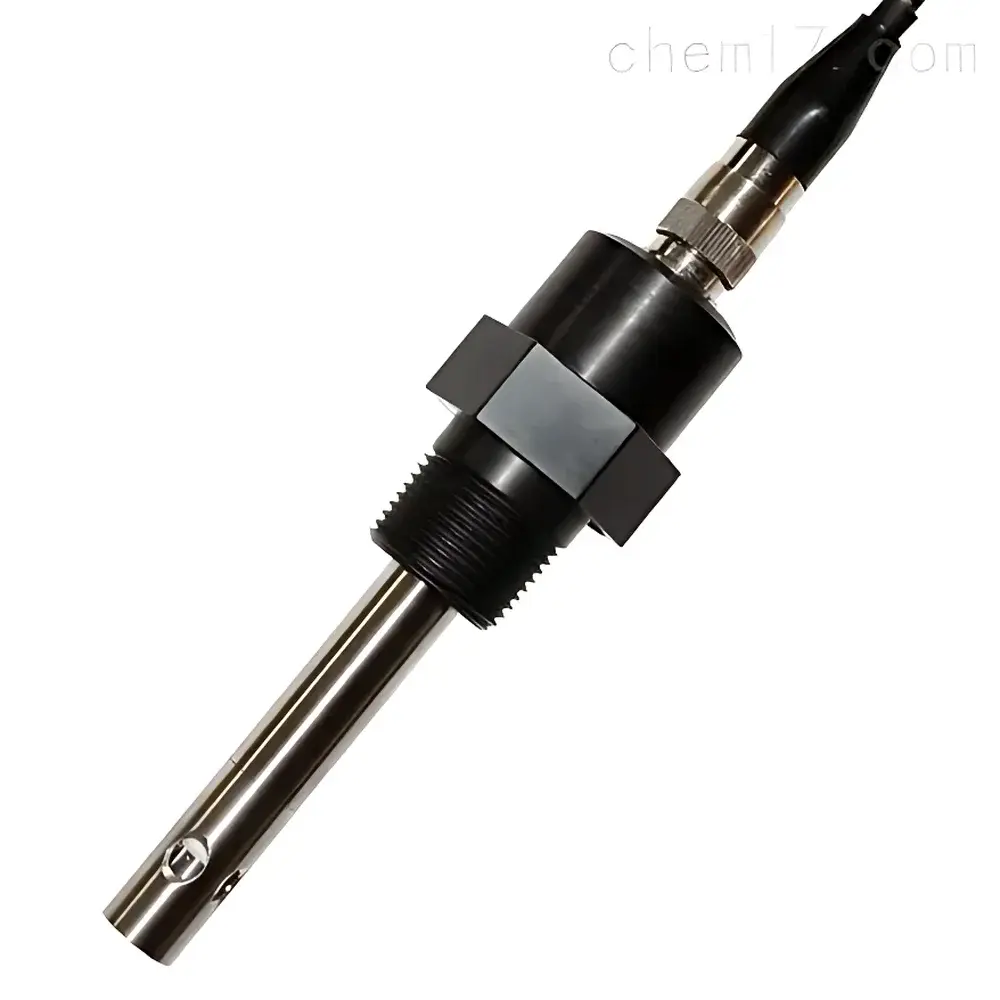
The innoCon 6500C is designed for use with JENSPRIMA’s innoSens 320 conductivity sensors—available in stainless steel, titanium, or PEEK-bodied configurations with cell constants from 0.01 to 10.0 cm⁻¹—to accommodate low-conductivity ultrapure water (UPW), high-salinity seawater, aggressive acids/bases, and viscous process fluids. Its automatic temperature compensation algorithm conforms to the nonlinear relationship defined in IEC 60746-3 and incorporates selectable compensation curves for pure water (DIN EN 27888), natural waters, and NaCl-based electrolytes. While not intrinsically safe, the unit meets EMC Directive 2014/30/EU (EN 61326-1) for industrial environments and carries CE marking. For regulated industries, its analog outputs and relay events are traceable via timestamped internal logs, supporting GLP/GMP documentation requirements when paired with external SCADA or historian systems.
Software & Data Management
The innoCon 6500C operates as a standalone field instrument with no embedded operating system or remote connectivity. All configuration, calibration, and alarm thresholds are managed locally via the front-panel keypad and LCD interface. System events—including relay activation, calibration initiation, range changes, and power-on cycles—are logged internally with timestamps and retained across power cycles. Though it lacks native digital communication protocols (e.g., Modbus RTU, HART, or Ethernet/IP), its dual 4–20 mA outputs enable seamless integration into DCS, PLC, or PAC-based control architectures. When deployed in validated pharmaceutical water systems, users may configure the 4–20 mA outputs to feed into FDA 21 CFR Part 11-compliant data acquisition systems that provide electronic signatures, audit trails, and change control—fulfilling ALCOA+ data integrity principles.
Applications
- Monitoring conductivity in pharmaceutical purified water (PW) and water-for-injection (WFI) distribution loops per USP <731> and EP 2.2.38
- Real-time detection of ion leakage in mixed-bed deionization (MBDI) and electrodeionization (EDI) units
- Feedwater quality assurance in high-pressure steam boilers to prevent scaling and corrosion
- TDS verification in reverse osmosis (RO) permeate and reject streams for membrane performance trending
- Process water quality control in semiconductor fab rinse stations (e.g., post-etch, post-CMP)
- Effluent monitoring in wastewater treatment plants prior to discharge compliance reporting
FAQ
Does the innoCon 6500C support digital communication protocols such as Modbus or HART?
No—it provides only analog 4–20 mA outputs and relay contacts. Integration with digital control systems requires external signal converters or gateway devices.
Can the unit be used for conductivity measurements below 0.1 µS/cm, such as in ultrapure water applications?
Yes, when paired with an innoSens 320 sensor configured with a 0.01 cm⁻¹ cell constant and operated in the 0.00–20.00 µS/cm range, it achieves stable sub-0.1 µS/cm resolution with appropriate shielding and grounding.
Is temperature compensation mandatory, or can it be disabled?
Temperature compensation is enabled by default but can be switched to manual mode or fully disabled via the configuration menu—useful for fixed-temperature reference measurements or troubleshooting.
What is the maximum loop impedance supported for each 4–20 mA output?
Each output supports up to 600 Ω at 24 VDC supply, compliant with standard current-loop specifications per NAMUR NE43.
How frequently should calibration be performed in continuous operation?
Calibration interval depends on application severity; typical recommendations range from daily (critical PW systems) to quarterly (stable cooling water loops), aligned with internal SOPs and regulatory expectations.