
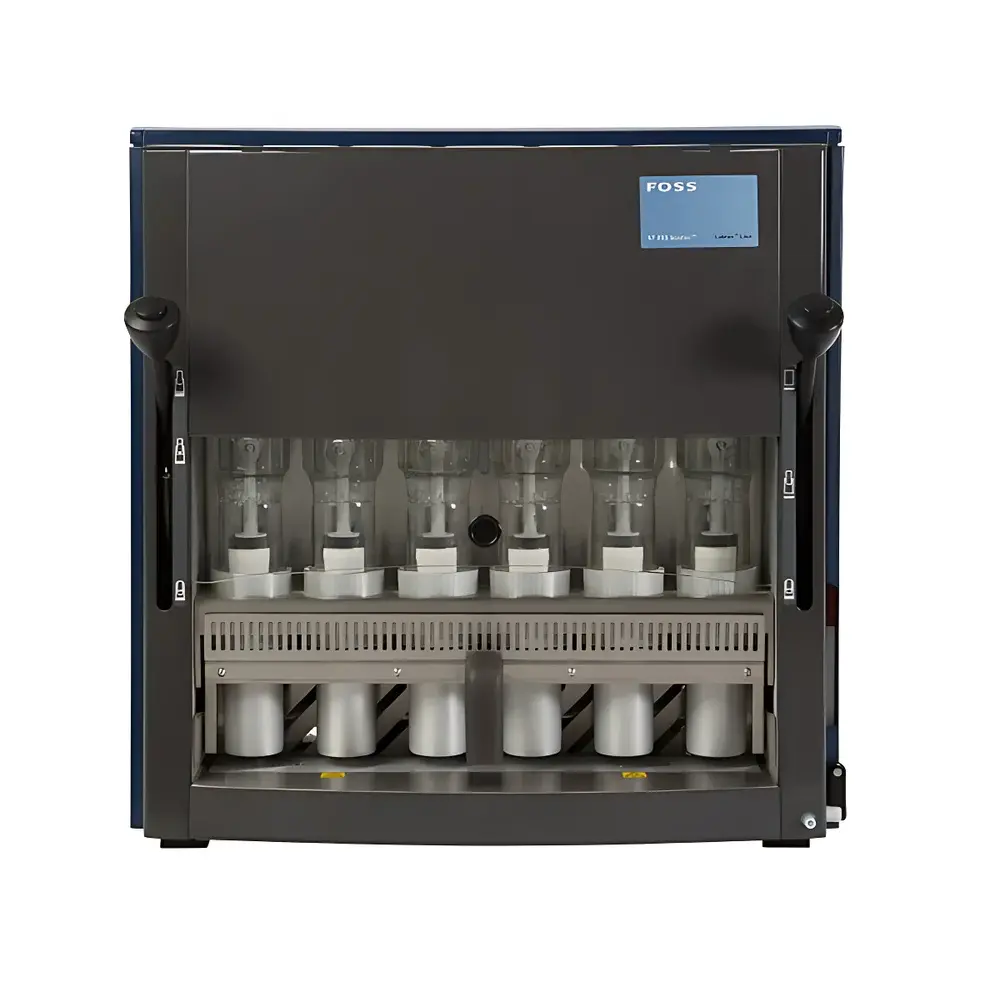
FOSS Soxtec™ 255 Automated Soxhlet Extraction System
| Brand | FOSS |
|---|---|
| Origin | Denmark |
| Model | Soxtec™ 255 |
| Extraction Chamber Volume | 30 mL |
| Receiver Flask Volume | 70–90 mL |
| Temperature Range | 0–285 °C |
| Temperature Control Accuracy | ±1% |
| Throughput | 6 samples per batch |
| Solvent Consumption per Sample | ~16 mL |
| Solvent Recovery Rate | up to 80% |
| Heating Time (20 °C → 280 °C) | 7–9 min |
| Typical Extraction Duration | 40–60 min |
| Repeatability | ±1% RSD |
| Sample Mass Range | 0.5–15 g |
| Sample Cup Dimensions | 33 × 80 mm (approx. 65 mL capacity) |
| Measurement Range | 0.1–100% fat content |
Overview
The FOSS Soxtec™ 255 Automated Soxhlet Extraction System is a fully integrated, benchtop instrument engineered for precise, reproducible, and compliant fat determination in solid and semi-solid matrices. It implements the classical Soxhlet principle—continuous solvent reflux extraction—but replaces manual operation with a closed-loop, programmable architecture based on patented heating, solvent delivery, and vapor condensation control. Unlike conventional open-bath systems, the Soxtec™ 255 employs electronically regulated heating plates, sealed solvent handling pathways, and sequential thermal phases (extraction, rinsing, solvent recovery, and pre-drying) to eliminate operator intervention during run cycles. Designed for regulatory environments, it supports method validation under AOAC Official Method 920.39, EPA Method 9071B, and ISO 1443:2022, delivering traceable, auditable results aligned with GLP and GMP laboratory requirements.
Key Features
- 6-position parallel processing enables high-throughput fat analysis without cross-contamination or thermal interference between units.
- Precision temperature control (±1% over 0–285 °C range) ensures consistent solvent boiling point management across diverse solvents—including petroleum ether, diethyl ether, and hexane—critical for method fidelity.
- Integrated solvent management system automates addition, reflux, condensation, and recovery; reduces operator exposure and achieves up to 80% solvent reuse efficiency.
- Patented thermal ramp profile delivers rapid heating (20 °C to 280 °C in 7–9 minutes), minimizing cycle time while preserving thermolabile analytes.
- Sealed extraction chamber (30 mL volume) and receiver flask (70–90 mL) conform to standardized cup geometry (33 × 80 mm), ensuring compatibility with AOAC-certified cellulose extraction thimbles.
- No manual sample handling required: all operations—from solvent injection to post-extraction drying—are executed via programmable logic controller (PLC) with non-contact actuation.
Sample Compatibility & Compliance
The Soxtec™ 255 accommodates heterogeneous samples ranging from cereal grains and meat products to soil, feedstuffs, and polymer composites. Sample mass flexibility (0.5–15 g) and cup volume (≈65 mL) support both low-fat matrices (e.g., leafy vegetables) and high-fat materials (e.g., oilseeds). All wet chemistry workflows comply with internationally recognized standards: AOAC 920.39 (crude fat in animal feed), EPA 9071B (total recoverable hydrocarbons in environmental solids), ISO 1443:2022 (milk and dairy products), and GB/T 5009.6–2016 (Chinese national standard for food fat). The system’s closed solvent path meets OSHA PEL and EU Directive 2004/37/EC requirements for occupational exposure limit (OEL) mitigation.
Software & Data Management
The embedded control interface provides intuitive step-by-step protocol configuration, real-time temperature and status monitoring, and automatic log generation per run. Each extraction cycle records timestamped parameters—including setpoint temperature, actual chamber temperature, solvent volume dispensed, reflux duration, and recovery yield—stored locally with tamper-resistant audit trails. Data export is compatible with LIMS integration via CSV or direct RS-232/USB output. For laboratories operating under FDA 21 CFR Part 11, optional software modules provide electronic signatures, role-based access control, and full revision history—ensuring compliance with digital record integrity mandates.
Applications
- Food & Agriculture: Crude fat quantification in cereals, nuts, dairy powders, and animal feed per AOAC and Codex Alimentarius protocols.
- Environmental Testing: Total petroleum hydrocarbon (TPH) recovery from sediment, sludge, and contaminated soils per EPA SW-846 methods.
- Pharmaceutical & Biotech: Lipid extraction prior to GC-FID or HPLC-ELSD analysis of excipients, lipid nanoparticles, or botanical extracts.
- Industrial Materials: Fat/oil content verification in leather, rubber compounds, and recycled plastics for quality release testing.
- Research Laboratories: Method development for total fat, free fatty acids, or wax extraction where solvent selectivity and thermal stability are critical.
FAQ
Is the Soxtec™ 255 compatible with hydrolysis-based total fat analysis?
Yes—when paired with the FOSS Hydrotec 8000 acid/base hydrolysis module, the system enables complete total fat determination per AOAC 983.23 and ISO 1443 Annex B protocols.
What solvent types are validated for use with this system?
Petroleum ether (b.p. 40–60 °C), diethyl ether, n-hexane, and chloroform are routinely validated; solvent selection must align with method-specific flash point and boiling point constraints.
Does the system support unattended overnight operation?
Yes—the fully sealed architecture, automatic solvent shutoff, and thermal cut-off safeguards enable safe, unattended execution of multi-hour extractions.
Can extraction parameters be exported for regulatory submission?
Yes—raw parameter logs, including temperature profiles and solvent consumption metrics, are exportable in audit-ready formats compliant with ISO/IEC 17025 documentation requirements.
How does the Soxtec™ 255 improve reproducibility versus manual Soxhlet?
By eliminating operator-dependent variables—such as inconsistent condenser cooling, variable reflux rates, and subjective endpoint judgment—it achieves ±1% RSD across replicate runs under identical method conditions.



