
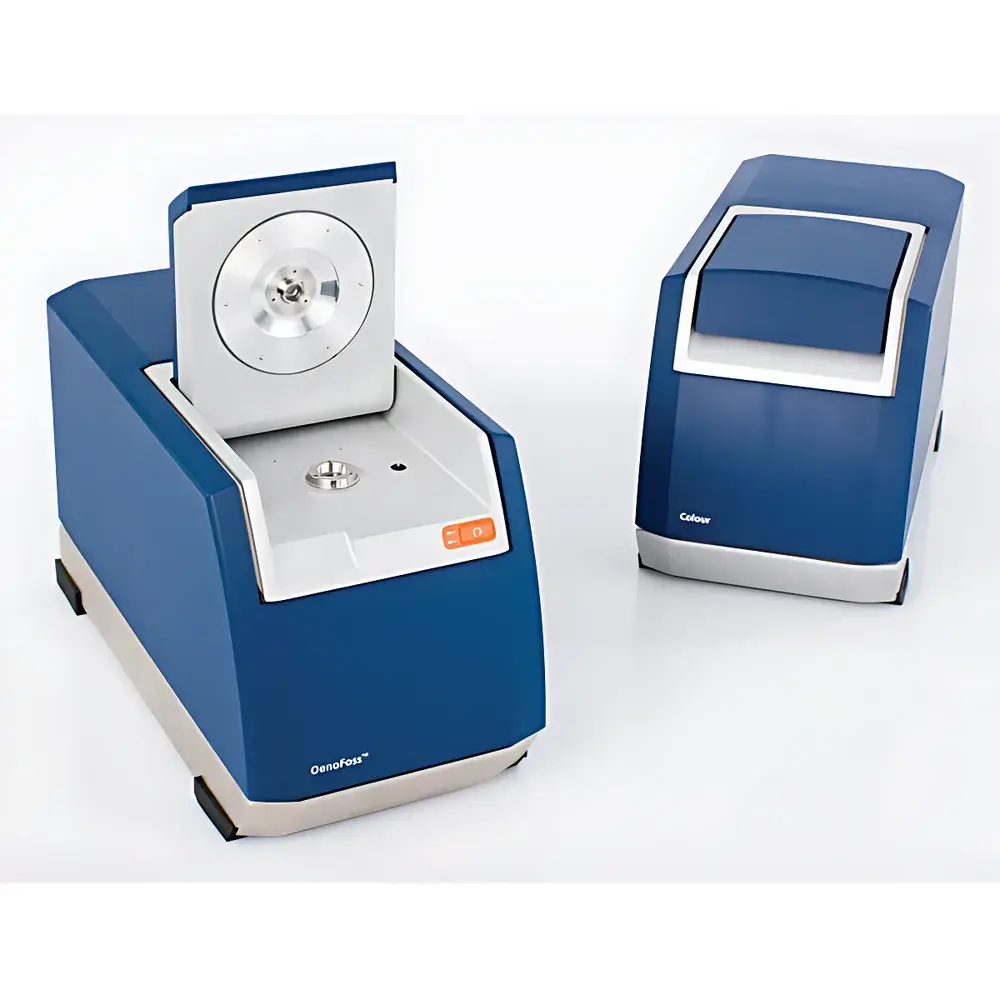
FOSS OenoFoss 2 Compact Wine Analyzer
| Brand | FOSS |
|---|---|
| Origin | Denmark |
| Model | OenoFoss 2 |
| Application Modes | Laboratory & At-line |
| Analysis Time | ≤2 min |
| Alcohol Content | 0.5–19 % vol. |
| pH Range | 2.6–4.0 |
| Dimensions (L×W×H) | 189 × 154 × 321 mm |
| Weight | 6.3 kg |
| Sample Volume | 600 µL |
| Operating Temperature | 10–35 °C |
| Detection Principle | Fourier Transform Infrared (FT-IR) Spectroscopy |
| Parameters Measured | Ethanol, Glucose, Fructose, pH, Total Acidity, Volatile Acidity, Malic Acid, Sugar Content (°Brix), Color Intensity |
Overview
The FOSS OenoFoss 2 Compact Wine Analyzer is a benchtop FT-IR spectrometer engineered specifically for rapid, reagent-free compositional analysis of grape must, fermenting juice, and finished wine. Based on mid-infrared absorption spectroscopy, the instrument quantifies multiple physicochemical parameters simultaneously by measuring characteristic vibrational band intensities across the 4000–600 cm⁻¹ spectral range. Its optical architecture employs a robust silicon carbide interferometer and thermoelectrically cooled DTGS detector, ensuring high signal-to-noise ratio and long-term baseline stability under variable laboratory conditions. Designed for winery QC labs and enology research facilities, the OenoFoss 2 delivers traceable, repeatable results without sample derivatization or chemical consumption—reducing both operational cost and analyst exposure to hazardous reagents.
Key Features
- Single-shot FT-IR analysis in ≤2 minutes per sample, covering up to nine critical oenological parameters
- Compact footprint (189 × 154 × 321 mm) and lightweight design (6.3 kg) enabling flexible placement in crowded lab environments or mobile at-line deployment near fermentation tanks
- Optimized flow cell with 600 µL sample volume requirement—minimizing waste while maintaining sufficient pathlength for precise absorbance measurement
- Integrated temperature stabilization system maintains consistent optical performance across ambient operating range (10–35 °C)
- Pre-calibrated, wine-specific chemometric models validated against reference methods per ISO 2173 (sugar), OIV-MA-AS313 (alcohol), and AOAC 985.13 (titratable acidity)
- Self-diagnostic routines monitor laser alignment, mirror velocity, and detector response—generating automated calibration alerts when drift exceeds ±0.5% absorbance units
Sample Compatibility & Compliance
The OenoFoss 2 accepts clarified or centrifuged grape must, active fermentations (including turbid samples with suspended yeast), and bottled wines—without filtration or dilution. Its chemometric algorithms are trained on >12,000 spectra spanning varietal diversity (Cabernet Sauvignon, Chardonnay, Pinot Noir, Riesling), regional terroirs (France, Italy, Chile, Australia), and fermentation stages (pre-ferment, mid-ferment, post-malolactic). All measurement protocols comply with EU Regulation No. 1308/2013 Annex VII Part II (wine analysis requirements) and support GLP/GMP documentation workflows. Instrument software includes full audit trail functionality compliant with FDA 21 CFR Part 11 for electronic records and signatures.
Software & Data Management
Controlled via FOSS WinISI III v4.5 software, the OenoFoss 2 provides intuitive method selection, real-time spectral visualization, and automatic outlier detection using Mahalanobis distance metrics. Raw interferograms and processed spectra are stored in open-format .csv and .jdx files. The system supports LIMS integration through ASTM E1384-compliant ASCII export and OPC UA server connectivity. Batch reporting includes statistical summaries (mean, SD, CV%), trend charts across production lots, and deviation flags against user-defined specification limits—exportable as PDF or Excel for internal quality reviews or regulatory submissions.
Applications
- Routine monitoring of alcohol development during alcoholic fermentation to optimize harvest timing and predict final ABV
- Quantification of residual sugar (glucose + fructose) and malic acid depletion during malolactic fermentation
- Verification of pH and total acidity prior to SO₂ dosing and cold stabilization
- Batch release testing of commercial wines against label claims (e.g., alcohol content, sweetness category)
- Research applications including yeast strain performance comparison, nutrient addition trials, and aging studies
- Support for ISO/IEC 17025-accredited laboratories seeking scope expansion in oenological testing
FAQ
What reference standards are required for daily verification?
A single NIST-traceable ethanol-water standard (5.0 % vol.) and a certified pH 3.5 buffer solution are recommended for daily system suitability checks.
Can the OenoFoss 2 analyze fortified wines or spirits?
No—the instrument’s chemometric models are validated exclusively for still and sparkling wines, grape must, and fermenting juice within the specified alcohol range (0.5–19 % vol.).
Is method transfer possible between OenoFoss 2 units?
Yes—FOSS provides standardized model transfer packages with cross-instrument validation reports demonstrating ≤1.2 % RSD for ethanol and ≤0.05 pH units across ≥5 instruments.
How often is recalibration needed?
Factory recalibration is recommended every 12 months; however, routine performance qualification (PPQ) using control samples every 40 analyses ensures ongoing accuracy.
Does the system support multi-user access with role-based permissions?
Yes—WinISI III supports up to 16 user accounts with configurable permissions for method editing, result approval, audit log review, and software configuration changes.




