
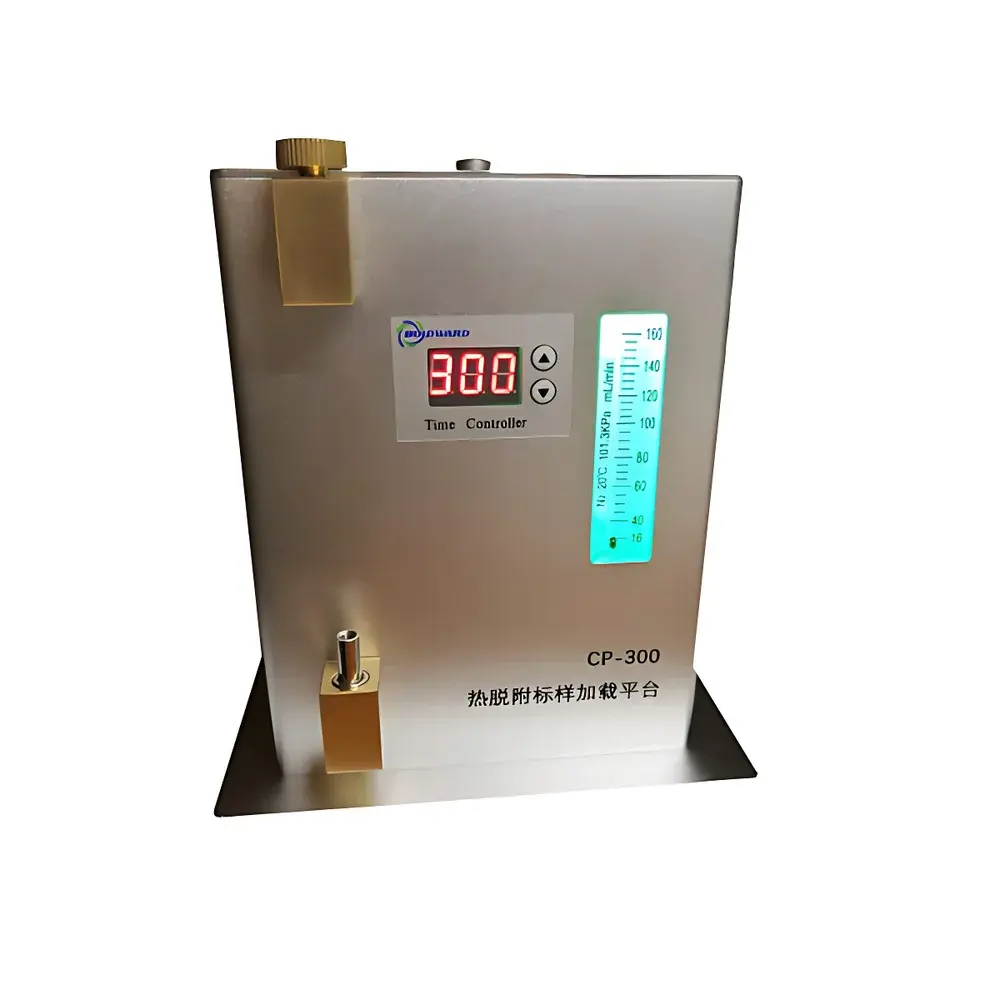
Fortelab CP300 Thermal Desorption Standard Sample Loading Platform
| Brand | Fortelab |
|---|---|
| Origin | Chongqing, China |
| Manufacturer Type | Direct Manufacturer |
| Product Category | Domestic |
| Model | CP300 |
| Price Range | USD 1,400 – 7,000 (based on current exchange rate) |
| Instrument Type | Secondary Thermal Desorber, Thermal Desorption Unit |
Overview
The Fortelab CP300 Thermal Desorption Standard Sample Loading Platform is a precision-engineered accessory designed for quantitative calibration in thermal desorption–gas chromatography (TD–GC) workflows. It enables the controlled, reproducible preparation of certified standard sampling tubes—also known as sorbent tubes or thermal desorption tubes—by dynamically spiking known volumes of liquid or gaseous standard solutions onto solid-phase sorbent media under regulated carrier gas flow and time parameters. Unlike passive soaking or static vapor-phase loading methods, the CP300 implements dynamic standard deposition via calibrated carrier gas dilution, closely mimicking real-world sampling conditions and accounting for tube-specific breakthrough behavior, adsorption kinetics, and desorption efficiency. This ensures metrological traceability when constructing external calibration curves per ISO 16017-1, ASTM D6196, EPA TO-17, and other regulatory TD–GC protocols requiring validated standard tube generation.
Key Features
- Dynamic standard loading architecture with adjustable carrier gas flow range of 16–160 mL/min, compliant with method-specified flow requirements across major environmental, occupational health, and indoor air quality standards.
- Digital timer display with programmable exposure duration from 1 to 999 seconds, enabling precise control over analyte deposition kinetics and mass loading accuracy.
- Patented thermally stable tube holder with integrated O-ring sealing and quick-release mechanism—ensures leak-tight integrity (<1×10⁻⁸ mbar·L/s He) during loading and eliminates cross-contamination between runs.
- LED status indicators (green/yellow/red) provide real-time visual feedback for operational phases: standby, active loading, and completion—supporting unattended operation and error mitigation.
- Low-power design (<15 W nominal) with passive thermal management; no external cooling or compressed air required—suitable for benchtop integration in GLP-compliant laboratories.
- Compatible with standard 6 mm OD stainless steel or glass thermal desorption tubes (e.g., Tenax TA, Carbopack B/C, Carboxen 1000), including single- and dual-bed configurations used in both primary and secondary TD systems.
Sample Compatibility & Compliance
The CP300 supports loading of volatile and semi-volatile organic compounds (VOCs/SVOCs) including BTEX, aldehydes, chlorinated hydrocarbons, PAHs, and oxygenated VOCs onto common sorbent materials such as Tenax®, Carbopack™, Carboxen®, and graphitized carbon black. Its flow and timing specifications align with calibration procedures outlined in ISO 16017-1 (Indoor, ambient and workplace air — Sampling and analysis of volatile organic compounds using sorbent tubes, thermal desorption and gas chromatography), ASTM D6196 (Standard Practice for Selecting Generic Sampling and Analysis Methods for Volatile Organic Compounds), and U.S. EPA Method TO-17. The platform’s mechanical repeatability (±1.2% RSD for triplicate loadings under identical settings) meets internal QC requirements for accredited environmental testing labs operating under ISO/IEC 17025:2017.
Software & Data Management
The CP300 operates as a standalone hardware platform with no embedded firmware or proprietary software. All parameter settings—including flow rate, loading time, and sequence order—are manually configured via front-panel controls. However, its deterministic operation enables full integration into LIMS- or ELN-managed workflows: users log loading parameters, tube IDs, standard concentrations, and analyst signatures in audit-trail-enabled electronic records. When deployed in GxP environments, the device supports 21 CFR Part 11 compliance through procedural controls (e.g., documented SOPs, dual-operator verification, and version-controlled calibration logs), as it produces no electronic data subject to direct validation—only physical reference materials traceable to NIST-traceable stock solutions.
Applications
- Preparation of certified reference sampling tubes for routine calibration of thermal desorption–GC/MS systems in environmental monitoring laboratories.
- Method development and validation studies assessing sorbent tube recovery, breakthrough volume, and thermal stability of target analytes.
- Generation of matrix-matched standard tubes for complex sample types (e.g., humid air, particulate-laden streams) where conventional liquid spiking fails to replicate adsorption dynamics.
- Supporting ISO 16000-6 and EN 16516 indoor air emission testing by enabling reproducible loading of formaldehyde, acetaldehyde, and other carbonyls onto DNPH-coated silica tubes.
- Quality assurance in occupational hygiene labs performing OSHA ID-255 or NIOSH 1501/1502 analyses for workplace exposure assessment.
FAQ
Can the CP300 be used with both primary and secondary thermal desorbers?
Yes—the platform prepares standard tubes compatible with all mainstream single-stage and two-stage thermal desorption systems, including those with cryofocusing and cold trap interfaces.
Is calibration of the mass flow controller required?
The built-in flowmeter is factory-calibrated against NIST-traceable standards; annual verification using an independent thermal mass flow calibrator is recommended per ISO/IEC 17025 Clause 6.5.
What tube formats does the CP300 accept?
Standard 6 mm outer diameter metal or glass tubes up to 120 mm in length; custom adapters are available upon request for non-standard geometries.
Does the CP300 support automated sequential loading?
No—it is a manual, single-tube loading station; however, its rapid tube exchange (<8 seconds) facilitates high-throughput batch preparation when operated by trained personnel.
Is the device suitable for Class 100 cleanroom use?
Yes—its solid-state construction, absence of moving fluids or lubricants, and low particulate shedding meet ISO 14644-1 Class 5 requirements when installed with appropriate HEPA-filtered airflow.



