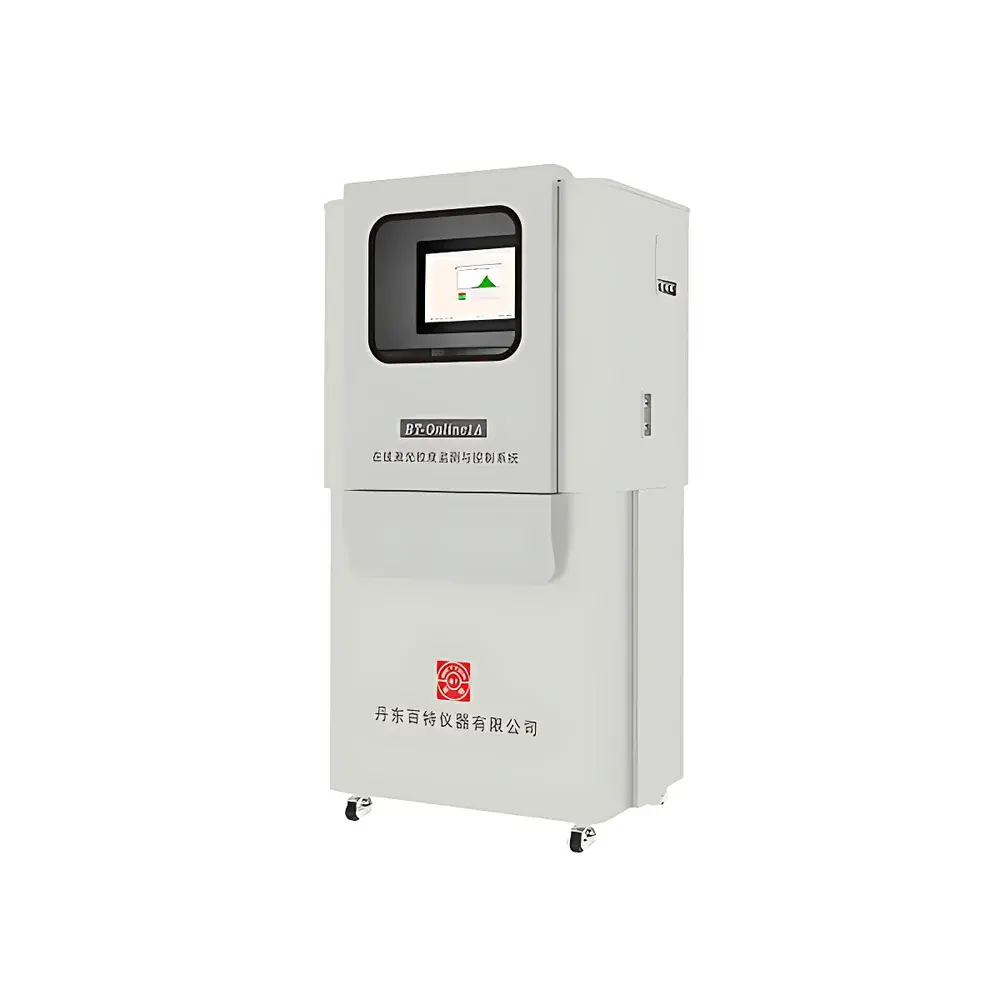
Bettersize BT-Online1A Online Dry-Process Laser Diffraction Particle Size Monitoring and Control System
| Brand | Bettersize |
|---|---|
| Model | BT-Online1A |
| Measurement Principle | Mie Scattering Theory (default), Fraunhofer Diffraction Theory (optional) |
| Particle Size Range | 0.1–2000 µm |
| Accuracy & Repeatability Error | ≤0.5% (D50 deviation against NIST-traceable or ISO-certified reference standards) |
| Optical System | Dual-path Fourier-optics architecture (patented forward + reverse Fourier configuration) |
| Detector Array | 92-channel photodetector (forward, side, and backward scattering) |
| Laser Source | High-power fiber-coupled laser |
| Sampling Methods | Venturi negative-pressure sampling (direct pipe insertion), auger-assisted Venturi sampling, or concentrator-enhanced Venturi sampling |
| Lens Protection | Dual-layer aerodynamic air curtain |
| typical maintenance-free interval | 12 months |
| Dispersion Medium | Compressed air or inert gas (N₂), 0.1–0.8 MPa |
| Test Interval Modes | Continuous measurement or programmable interval (minimum 1 s) |
| Monitoring Channels | 1–4 independent process lines (1-to-N configuration) |
| Dispersion Modes | Standard dispersion (e.g., cement) and high-energy dispersion (e.g., alumina, hard ceramics) |
| Enclosure Rating | IP65 |
| Output Interfaces | Modbus-RTU, Modbus-TCP, 4–20 mA analog output |
| Data Integrity Compliance | FDA 21 CFR Part 11 (audit trail, electronic signatures, role-based access control) |
| Standards Compliance | ISO 13320:2020, GB/T 19077–2024, GB/T 41949–2022 |
| Power Supply | AC 220 V, 50/60 Hz, 200 W |
| Reporting Parameters | Full size distribution, D10/D50/D90/D97/D98, volume-weighted mean D[4,3], surface-weighted mean D[3,2], specific surface area, and user-defined size fraction contents (e.g., <3 µm, 3–32 µm, >45 µm, >80 µm) |
Overview
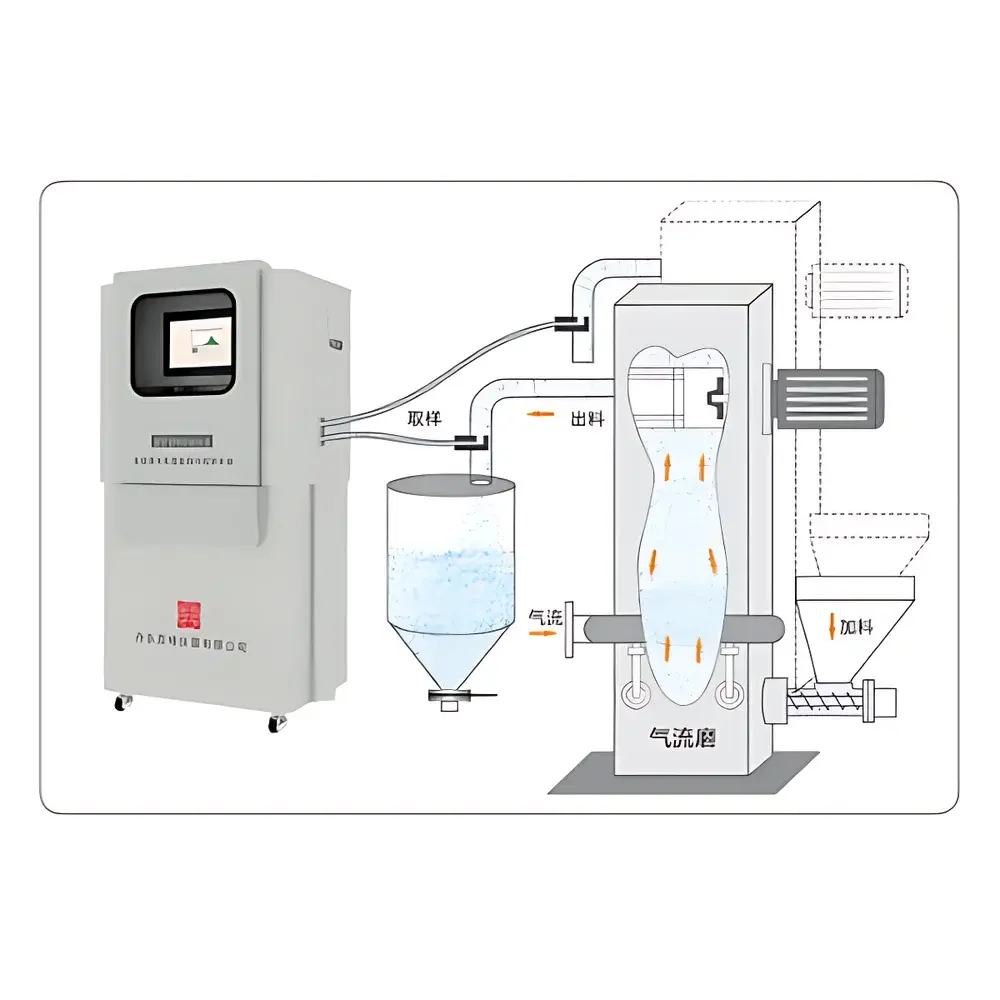
The Bettersize BT-Online1A is an industrial-grade, real-time laser diffraction particle size monitoring and control system engineered for continuous, in-line characterization of dry powders during manufacturing. It operates on the physical principle of laser light scattering—specifically Mie scattering theory for optically heterogeneous particles (default) and optionally Fraunhofer diffraction for rapid, approximate analysis of large, opaque particles. Installed directly adjacent to dry milling equipment—including fluidized-bed jet mills, vertical roller mills, and air-classifiers—the BT-Online1A performs fully automated sampling, pneumatic dispersion, optical measurement, and data-driven feedback control without interrupting production flow. Its dual-path Fourier optical architecture enables wide dynamic range (0.1–2000 µm) with enhanced resolution in the sub-10 µm region, critical for quality-critical applications such as battery cathode/anode materials and pharmaceutical excipients. The system is not a laboratory analyzer adapted for process use; rather, it is purpose-built for 24/7 operation in harsh industrial environments, meeting structural, thermal, and contamination-resistance requirements typical of cement plants, metallurgical facilities, and fine chemical production lines.
Key Features
- Patented dual-path Fourier optical design combining forward and reverse scattering detection geometry—maximizing signal capture across the full angular range and improving sensitivity to fine particles.
- 92-element photodetector array with spatially optimized segmentation for high-fidelity scattering pattern acquisition and robust inversion algorithm performance.
- Three configurable sampling modalities: direct Venturi pipe insertion, auger-assisted sampling for low-mass-flow streams, and concentrator-enhanced sampling for dilute or low-velocity particulate flows—all incorporating anti-clogging geometry and electrostatic discharge mitigation.
- Dual-layer aerodynamic air curtain protecting the optical window from dust deposition; validated for ≥12 months of uninterrupted operation without manual cleaning under typical plant conditions.
- Integrated four-stage compressed-air filtration system (particulate, coalescing, activated carbon, desiccant) ensuring clean, oil-free, and moisture-free dispersion gas—essential for long-term optical stability and detector longevity.
- Automated optical alignment subsystem using closed-loop motorized actuators and real-time centroid tracking; compensates for thermal drift and mechanical vibration to maintain beam centering within ±0.02 mm tolerance.
- Modular dispersion control: selectable standard or high-energy dispersion modes, enabling consistent deagglomeration of both easily dispersible (e.g., limestone) and highly cohesive materials (e.g., nano-alumina, spray-dried APIs).
Sample Compatibility & Compliance
The BT-Online1A is designed exclusively for dry, free-flowing, non-sticky particulates conveyed via pneumatic transport systems. It accommodates materials with densities ranging from 0.5 g/cm³ (e.g., expanded perlite) to >7 g/cm³ (e.g., tungsten carbide), provided particle morphology permits stable dispersion in compressed air or nitrogen. It complies with ISO 13320:2020 for laser diffraction methodology validation and meets the metrological requirements of GB/T 19077–2024 (China’s national standard for laser particle size analyzers). All firmware and software modules are architected to satisfy FDA 21 CFR Part 11 regulatory expectations—including secure electronic records, operator authentication, immutable audit trails, and configurable role-based permissions. The system supports GLP/GMP-aligned operational protocols, including routine accuracy verification using traceable NIST or ISO 13320 reference standards (e.g., SRM 1963, ERM-FD102), with documented calibration history retention for up to 10 years.
Software & Data Management
The embedded control software provides real-time visualization of granulometric trends via customizable time-series plots (D10, D50, D90, D[4,3], fraction contents) with configurable update intervals down to 1 second. Historical data are stored in relational SQL databases with automatic daily backup and optional cloud synchronization. The system supports OPC UA and native Modbus integration for seamless connection to DCS, MES, or SCADA platforms. Process alarms trigger automated responses—including adjustable setpoint-based control outputs via 4–20 mA loops or discrete digital signals—to modulate mill speed, classifier rotor frequency, or feed rate. All measurement raw data (scattering patterns), processed distributions, metadata (timestamp, line ID, dispersion mode, pressure), and operator actions are retained with cryptographic hashing to ensure data integrity and forensic traceability.
Applications
The BT-Online1A serves as a core analytical node in closed-loop quality control strategies across multiple regulated and high-value powder sectors. In lithium-ion battery manufacturing, it monitors cathode (e.g., NMC, LFP) and anode (e.g., synthetic graphite, silicon-carbon composites) grinding consistency to ensure electrode slurry rheology and coating uniformity. In pharmaceutical solid-dose production, it verifies micronization endpoints for active pharmaceutical ingredients (APIs) prior to blending—supporting QbD (Quality by Design) frameworks. Cement producers deploy it to stabilize Blaine fineness and optimize energy consumption in finish grinding circuits. Other validated use cases include carbon black classification in rubber compounding, pigment dispersion control in coatings, metal powder sizing for additive manufacturing feedstock, and pesticide formulation homogeneity assurance.
FAQ
Can the BT-Online1A be integrated into existing PLC-based control systems?
Yes—native Modbus-RTU and Modbus-TCP protocols enable bidirectional communication with major PLC vendors (Siemens, Rockwell, Schneider), allowing real-time setpoint adjustment and alarm forwarding.
Is sample return to the production line mandatory?
No—sample recovery is configurable: material may be returned inline (zero-waste operation) or diverted to a sealed collection vessel for offline verification.
How frequently must the optical system be calibrated?
Accuracy verification using certified reference standards is recommended before each production shift or at least every 24 hours in continuous operation; full optical recalibration is required only after lens replacement or major mechanical service.
Does the system support remote diagnostics and firmware updates?
Yes—secure HTTPS-enabled web interface allows authenticated remote monitoring, log retrieval, and over-the-air firmware upgrades with version rollback capability and SHA-256 signature validation.
What maintenance is required for the air filtration system?
Filter elements require replacement every 6–12 months depending on inlet air quality; replacement intervals are tracked automatically and reported via the HMI with predictive alerts.