
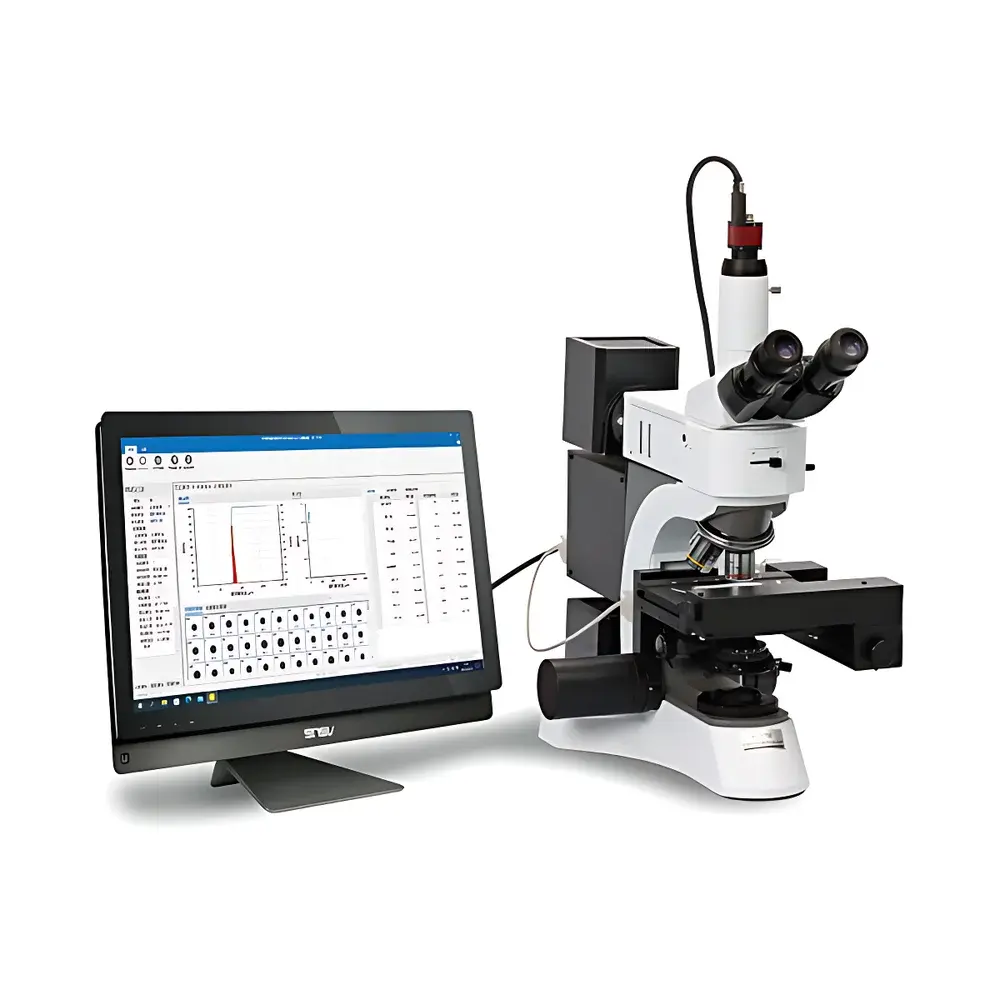
Bettersize BT-1700 Static Scanning Image-Based Particle Size and Shape Analyzer
| Brand | Bettersize |
|---|---|
| Origin | Liaoning, China |
| Manufacturer Type | Manufacturer |
| Origin Category | Domestic |
| Model | BT-1700 |
| Instrument Type | Static |
| Measurement Range | 0.3–10,000 µm |
| Magnification Options | 160×, 200×, 400×, 800× |
| Repeatability Error | ≤1% (D₅₀ deviation against national standard reference materials) |
| Accuracy Error | ≤1% (D₅₀ deviation against national standard reference materials) |
| Illumination | Dual-mode (transmitted + reflected light) |
| Particle Recognition Speed | ≥10,000 particles/minute |
| Camera Resolution | 12 MP |
| Scan Area Diameter | 50 mm |
| Analysis Time per Sample | ≤10 minutes |
Overview
The Bettersize BT-1700 is a fully automated static scanning image-based particle size and shape analyzer engineered for high-fidelity morphological characterization of dry powders and dispersed particulates. Unlike dynamic or laser diffraction systems, the BT-1700 employs high-resolution digital microscopy coupled with precision motorized stage control to acquire and reconstruct large-area, seamless panoramic images of static particle beds—enabling true single-particle analysis across the full 0.3–10,000 µm range. Its core measurement principle relies on pixel-accurate segmentation of individual particles within calibrated optical fields, followed by geometric parameter extraction using ISO 9276-6 compliant algorithms. This approach delivers not only conventional size distributions (e.g., D₁₀, D₅₀, D₉₀) but also quantitative shape descriptors—including circularity (sphericity), aspect ratio (length-to-width), convexity, solidity, and elongation—each traceable to standardized definitions in ASTM E2457 and ISO/IEC 17025-accredited workflows.
Key Features
- Motorized XYZ stage with programmable auto-origin homing and sub-micron positioning repeatability, enabling reproducible field-of-view navigation across 50 mm diameter sample areas.
- Real-time autofocus algorithm synchronized with stage movement, ensuring optimal depth-of-field and edge contrast for every captured frame—critical for accurate boundary detection of irregular or overlapping particles.
- Seamless panoramic stitching engine that aligns and blends adjacent micrographs using sub-pixel registration and intensity normalization, eliminating stitching artifacts while preserving morphological fidelity across magnifications up to 800×.
- Dual-illumination optics (transmitted brightfield + reflected oblique lighting) support simultaneous contrast optimization for transparent, opaque, metallic, and fibrous particles—enabling reliable segmentation without manual threshold tuning.
- Material-discrimination capability via grayscale histogram analysis: leverages differential light absorption/reflection signatures to quantify binary-phase mixtures (e.g., graphite vs. binder residue, metal vs. oxide) at the single-particle level.
- Automated workflow execution—from slide loading detection to final report generation—with no operator intervention required beyond initial sample mounting.
Sample Compatibility & Compliance
The BT-1700 accommodates standard 25 × 75 mm glass slides or custom substrates compatible with transmitted/reflected illumination. It supports diverse particulate classes including spherical battery anode materials (e.g., synthetic graphite), angular abrasives (SiC, Al₂O₃), dendritic metal powders (Al, Sn-Pb alloys), acicular minerals (wollastonite), polymer microspheres (PS), and composite fillers. All measurements adhere to ISO 13322-1:2014 (static image analysis) and are compatible with GLP/GMP documentation requirements. Audit trails, user access logs, and electronic signature support align with FDA 21 CFR Part 11 readiness when deployed with validated software configurations.
Software & Data Management
The proprietary Bettersize ImagePro Suite provides ISO/IEC 17025-compliant data handling: raw image archives (TIFF/RAW), annotated particle maps, exportable CSV/Excel datasets, and customizable PDF reports with embedded metadata (instrument ID, calibration date, operator ID, environmental conditions). Batch processing supports statistical comparison across multiple samples; trend analysis tools enable longitudinal QC monitoring. Software architecture includes role-based permissions, encrypted database storage, and optional integration with LIMS via HL7 or RESTful API endpoints.
Applications
- Quality control of spherical graphite in lithium-ion battery anode production—verifying sphericity >0.92 and aspect ratio <1.15 per batch.
- Characterization of gas-atomized metal powders for additive manufacturing—assessing satellite formation, surface roughness proxies, and flowability predictors (e.g., convexity <0.95).
- Mineral processing R&D—quantifying aspect ratio distribution of wollastonite to optimize reinforcement efficacy in composites.
- Pharmaceutical excipient qualification—measuring particle elongation and surface texture to predict blend uniformity and tablet compaction behavior.
- Academic research in colloidal science, catalysis, and nanomaterial synthesis—where morphological heterogeneity directly influences functional performance.
FAQ
What sample preparation protocols are recommended for optimal BT-1700 performance?
Standard protocols include dry dispersion on conductive carbon tape or ethanol-assisted settling on silanized slides; minimum coverage density should be 10–20% to avoid aggregation bias while ensuring statistical representativeness.
Does the system support regulatory audit requirements for pharmaceutical or medical device manufacturing?
Yes—the software supports 21 CFR Part 11 compliance through electronic signatures, immutable audit trails, and configurable user roles when installed in validated environments.
Can the BT-1700 analyze particles smaller than 0.5 µm?
While the nominal lower limit is 0.3 µm, reliable detection below 0.5 µm requires oil-immersion objectives and strict vibration isolation; metrological validation against NIST-traceable latex standards is recommended for sub-micron applications.
How does the system handle overlapping or agglomerated particles?
Advanced watershed segmentation combined with multi-threshold intensity mapping reduces false merges; users may apply post-processing filters based on convex hull area ratio or Feret diameter variance to exclude ambiguous clusters.
Is third-party microscope integration supported?
Yes—the system accepts TTL-triggered cameras and stage controllers from Olympus, Zeiss, and Leica platforms via standard RS-232/USB interfaces; OEM-level SDKs are available for custom integration.



