
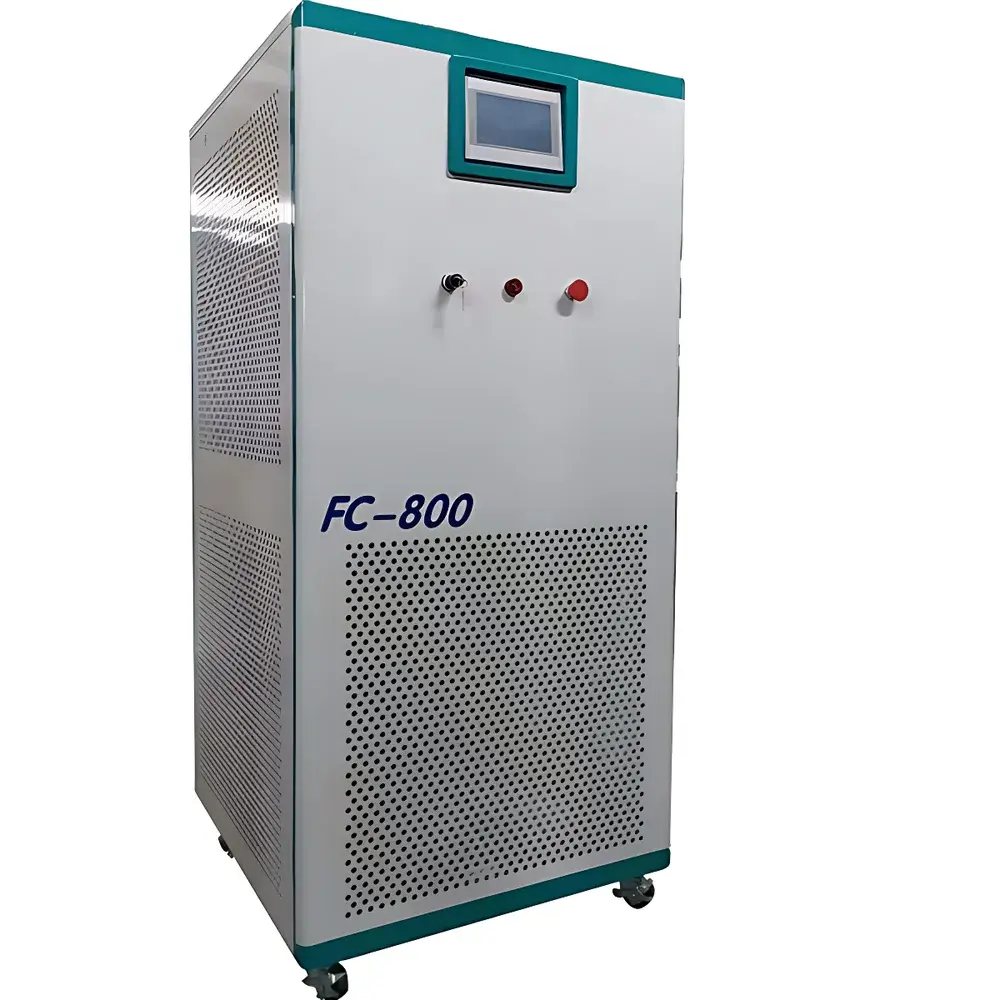
AA OPTO Electronic BIOCOOL20-200-1 Multi-Channel Precision High-Low Temperature Circulating Chiller
| Brand | AA OPTO Electronic |
|---|---|
| Model | BIOCOOL20-200-1 |
| Temperature Range | −20 °C to 200 °C |
| Nominal Cooling Capacity | 2.5 kW |
| Low-Temp Cooling Capacity | 0.9 kW @ −20 °C, 2.0 kW @ 20 °C, 2.0 kW @ 200 °C |
| Temperature Control Accuracy | ±0.5 °C |
| Pressure Range | 1.5–2.5 bar |
| Flow Rate (Customizable) | 8–80 L/min |
| Max. Ramp Rate | 20 °C/min |
| Standard Programmable Stages | 12 (expandable to 36) |
| Interface | Industrial communication ports (RS485, Modbus TCP, optional Ethernet/IP), PC & mobile APP support |
| Dimensions (W×D×H) | 500 × 500 × 1500 mm |
| Inlet/Outlet Port | 1/2″ BSP/Female NPT |
Overview
The AA OPTO Electronic BIOCOOL20-200-1 is a multi-channel precision high-low temperature circulating chiller engineered for demanding thermal management applications in analytical instrumentation, material testing, pharmaceutical stability chambers, and reactor jacketing systems. It integrates a dual-mode thermodynamic architecture—combining cascade refrigeration with electric resistance heating—to deliver stable, programmable thermal control across an extended operating range of −20 °C to +200 °C. Unlike conventional single-loop chillers, the BIOCOOL20-200-1 employs independent PID-controlled fluid circuits per channel, enabling simultaneous yet distinct temperature profiles across multiple process points. Its core operation relies on real-time feedback from high-stability Pt1000 sensors (IEC 60751 Class A), coupled with adaptive control algorithms that dynamically adjust compressor staging, expansion valve modulation, and heater duty cycle to maintain ±0.5 °C thermal stability—even under variable load conditions or ambient fluctuations. The system’s hydraulic design minimizes thermal lag and ensures uniform heat transfer coefficient distribution across all connected equipment.
Key Features
- Multi-stage programmable temperature control: Up to 12 standard ramp-hold segments per channel; upgradeable to 36 segments for complex thermal cycling protocols (e.g., ICH Q5C freeze-thaw validation, ASTM D3418 polymer transition analysis).
- Wide dynamic range: Achieves −20 °C minimum with 2.5 kW nominal cooling capacity; optimized for both cryogenic pre-cooling and high-temperature process heating without refrigerant changeover.
- High-fidelity flow regulation: Variable-speed centrifugal pump supports precise flow control from 8 to 80 L/min, maintaining consistent Reynolds number (>4000) for turbulent, reproducible heat exchange.
- Industrial-grade connectivity: Native support for Modbus TCP and RS485 RTU protocols; compatible with SCADA, MES, and LIMS platforms via OPC UA gateway integration (optional).
- Robust thermal architecture: Stainless steel reservoir and circulation lines; low-viscosity synthetic heat transfer fluid (HTF) certified for continuous operation between −40 °C and +220 °C.
- Remote operational oversight: Web-based HMI accessible via desktop browser or native iOS/Android application; includes alarm logging, runtime diagnostics, and firmware update capability over TLS 1.2 encrypted connection.
Sample Compatibility & Compliance
The BIOCOOL20-200-1 is designed for closed-loop circulation with external equipment requiring precise thermal conditioning—including HPLC column ovens, rheometer jackets, calorimeter cells, and bioreactor temperature sleeves. Its fluid path complies with USP extractables profile requirements when operated with certified HTF. The unit meets CE marking directives (2014/30/EU EMC, 2014/35/EU LVD) and conforms to ISO 13849-1 PL e safety integrity level for emergency shutdown functions. For regulated environments, audit trail functionality—including user action logs, parameter change timestamps, and electronic signature support—can be enabled to satisfy FDA 21 CFR Part 11 and EU Annex 11 requirements. Calibration certificates traceable to NIST standards are available upon request.
Software & Data Management
The embedded controller runs a deterministic real-time OS with deterministic loop execution (<100 ms). Configuration and monitoring occur through the BioCool Control Suite—a Windows/Linux-compatible desktop application supporting CSV export of time-stamped temperature, pressure, flow, and power consumption data at user-defined intervals (1 s to 60 min). All logged data include metadata (channel ID, operator ID, protocol version), enabling full traceability per GLP/GMP documentation practices. Optional cloud synchronization enables centralized fleet monitoring across multiple laboratory sites with role-based access control (RBAC) and automated backup retention policies compliant with ISO/IEC 27001.
Applications
- Pharmaceutical R&D: Controlled-rate freezing of monoclonal antibody formulations; accelerated stability testing per ICH Q1A(R3) guidelines.
- Materials science: Dynamic mechanical analysis (DMA) sample conditioning; glass transition (Tg) mapping in polymers using ASTM D7028.
- Chemical synthesis: Exothermic reaction quenching in flow chemistry reactors; precise jacket temperature control during Grignard or lithiation steps.
- Instrument calibration: Thermal validation of reference standards for IR spectrometers, DSC instruments, and thermal conductivity analyzers.
- Biotechnology: Temperature profiling of cell culture bioreactors during fed-batch fermentation cycles.
FAQ
What is the maximum allowable working pressure of the circulation loop?
The system is rated for continuous operation at 2.5 bar (36.3 psi) static pressure; burst pressure exceeds 10 bar per EN 13445-3.
Can the chiller operate with water-glycol mixtures?
Yes—compatible with aqueous glycol solutions up to 60% v/v; viscosity must remain below 25 cSt at operating temperature to ensure pump efficiency.
Is external PT100 input supported for master-slave temperature referencing?
Yes—the controller accepts external Pt100 inputs via dedicated analog input terminals, enabling cascade control where process temperature is measured directly at the load.
How is calibration verification performed?
The unit includes built-in self-calibration routines for sensor offset and gain; field verification uses NIST-traceable dry-block calibrators with probe insertion into designated test ports.
Does the system support automatic failover to backup cooling if primary compressor faults?
Not standard; redundant compressor configuration is available as a factory-configured option (BIOCOOL20-200-1-RD) with dual independent refrigeration circuits.



