
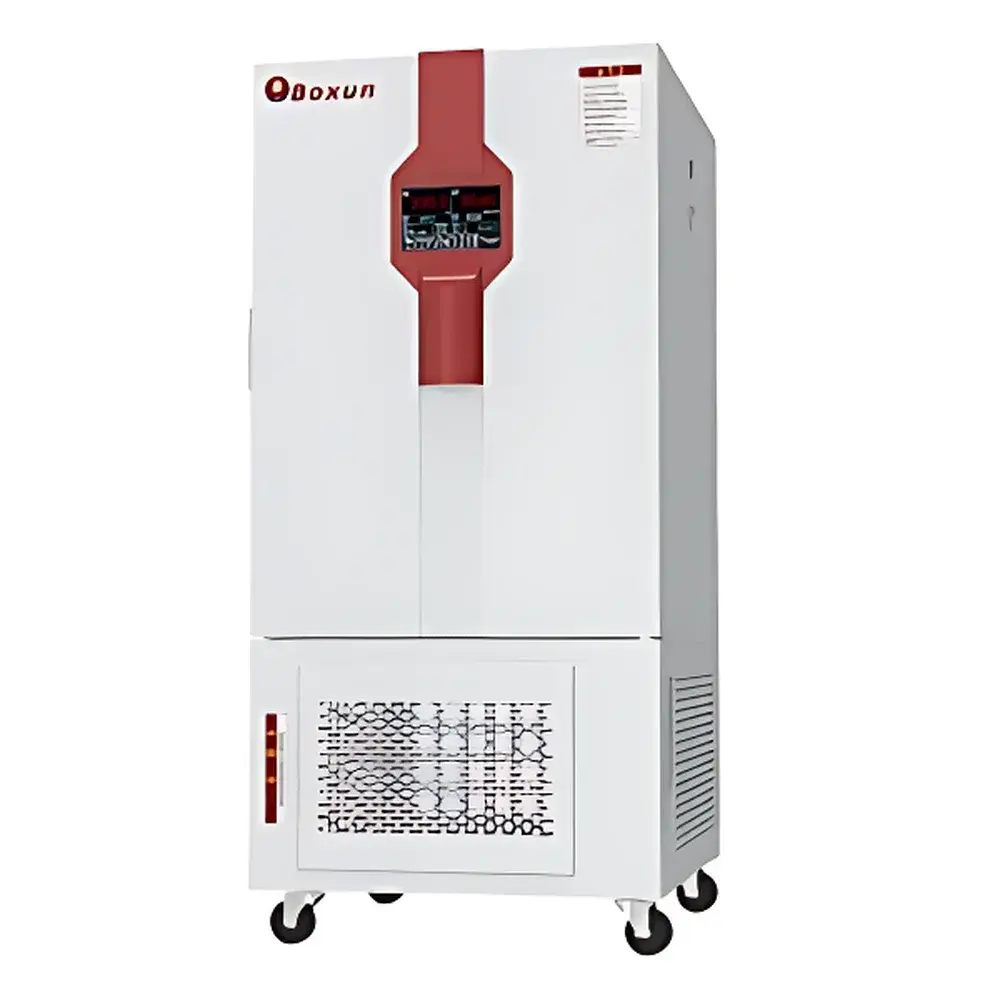
Boxun BXZ-250S Pharmaceutical Stability Testing Chamber
| Brand | Boxun |
|---|---|
| Origin | Shanghai, China |
| Manufacturer Type | Direct Manufacturer |
| Model | BXZ-250S |
| Temperature Control Range (Dark) | −10–85°C |
| Temperature Control Range (Illuminated) | 0–85°C |
| Temperature Resolution | 0.1°C |
| Temperature Uniformity (at 25°C) | ±1°C |
| Temperature Fluctuation (at 25°C) | ±0.5°C |
| Humidity Range | 15–98% RH |
| Humidity Fluctuation | ±3% RH |
| Illuminance Range | 0–10,000 Lux (continuously adjustable) |
| Illuminance Accuracy | ±500 Lux |
| UV Irradiance Range (optional) | 0–2 W/m² (320–400 nm) |
| UV Dose Compliance | ≥200 W·hr/m² (per ICH Q1B) |
| Photometric Dose Compliance | ≥1.2 × 10⁶ Lux·hr (per ICH Q1B) |
| Programmable Stages | 30 stages × 99 cycles |
| Stage Duration | 1–9999 hours per stage |
| Internal Chamber Dimensions (L×W×H) | 506 × 450 × 1100 mm |
| External Dimensions (L×W×H) | 669 × 822 × 1794 mm |
| Standard Shelves | 3 (max. 12) |
| Shelf-Mounted Illumination Modules | 1 standard (up to 3 optional) |
| Input Power | 1850 W |
| Data Storage Capacity | 1,000,000 records |
| Real-time Data View | Last 1600 entries or 6.5-hour trend curve |
| Interface Ports | 1 × USB, 1 × RS232, 1 × RS485 |
| Standard Accessories | Mechanical door lock, embedded thermal printer, C.H. heat-recycling system |
| Compliance Options | FDA 21 CFR Part 11–compliant software (optional), GMP-compliant 3Q validation documentation (IQ/OQ/PQ), wireless temperature/humidity data loggers with calibration certificates (0°C, 60°C, 121°C |
| and RH combos | 15°C/40% RH, 20°C/60% RH, 30°C/80% RH) |
Overview
The Boxun BXZ-250S Pharmaceutical Stability Testing Chamber is an engineered environmental simulation system designed to meet the stringent requirements of ICH Q1A(R3), Q1B, and Q5C guidelines for stability testing of active pharmaceutical ingredients (APIs) and finished drug products. It integrates precise, independent control of temperature, humidity, and photometric irradiance within a single chamber—enabling concurrent execution of accelerated, long-term, intermediate, and photostability studies in accordance with regulatory mandates. The chamber employs a dual-loop fuzzy PID control architecture with high-stability refrigeration (imported variable-frequency compressor), low-drift capacitive humidity sensors, and calibrated LED-based illumination modules—all validated for reproducibility across extended operational durations. Its thermodynamic design incorporates the proprietary C.H. (Cycle Heat) energy-recycling system, minimizing thermal overshoot and reducing stabilization time by up to 35% compared to conventional static-heating chambers.
Key Features
- 7-inch high-resolution resistive touchscreen interface running on Windows CE OS with 512 MB RAM and 1 GHz ARM Cortex-A8 processor—supporting intuitive multi-stage programming (30 segments × 99 cycles), real-time parameter overlay (setpoint/actual values, elapsed time, cycle count, alarm status), and password-protected screen lock.
- Imported high-efficiency variable-speed refrigeration system with rapid recovery (<15 min to re-stabilize after 30-sec door opening at 40°C/75% RH), ensuring minimal disturbance during routine sample access.
- Shelf-mounted, independently controllable illumination modules (up to 3 layers optional) delivering 0–10,000 Lux (±500 Lux accuracy) with continuous dimming, programmable on/off timing, and cumulative dose tracking—fully compliant with ICH Q1B photostability thresholds (≥1.2 × 10⁶ Lux·hr).
- Dual-channel data logging with non-volatile memory storing 1 million timestamped entries (temperature, humidity, illuminance, UV intensity if equipped, system events); exportable via USB to CSV or PDF with embedded metadata (operator ID, timestamp, parameter change history).
- Comprehensive hardware-level safety: triple-redundant overtemperature cutoff (mechanical + electronic + software), door-open detection with audible/visual alert, low-water-level alarm for humidifier reservoir, sensor fault diagnostics with automatic fallback mode.
- Standard RS232/RS485 interfaces enable integration into centralized lab monitoring networks; optional FDA 21 CFR Part 11–compliant software provides electronic signatures, audit trails, and role-based access control for GxP environments.
Sample Compatibility & Compliance
The BXZ-250S accommodates standard ISO 17025–compatible stability test containers—including glass vials, blister packs, HDPE bottles, and aluminum-laminated pouches—on up to 12 adjustable stainless-steel shelves (3 standard, 9 optional). Its internal airflow pattern ensures uniform exposure across all shelf levels, verified per ASTM E2739-22 for chamber qualification. The system supports full IQ/OQ/PQ execution with vendor-supplied 3Q documentation packages traceable to NIST standards. Optional wireless temperature/humidity data loggers (calibrated at three points: 0°C, 60°C, 121°C; and three RH combinations) provide independent verification for regulatory audits. UV module variants comply with ICH Q1B near-UV requirements (320–400 nm, ≥200 W·hr/m²), with real-time irradiance display and printable dose reports.
Software & Data Management
Data integrity is maintained through built-in event logging (power on/off, parameter modifications, alarm triggers, door openings) with millisecond-accurate timestamps. The embedded thermal printer produces hard-copy records meeting ALCOA+ principles (Attributable, Legible, Contemporaneous, Original, Accurate). USB exports include raw time-series data, summary statistics (mean, min/max, SD), and graphical trend plots. For enterprise deployment, optional FDA/GMP software modules enforce 21 CFR Part 11 compliance: user authentication, electronic signatures, immutable audit trails, and automated backup to network drives. All firmware updates are digitally signed and version-locked to prevent unauthorized modification.
Applications
- ICH-aligned long-term stability studies (25°C/60% RH, 30°C/65% RH) and accelerated testing (40°C/75% RH) per Q1A(R3)
- Photostability assessment under cool white fluorescent and near-UV light per Q1B
- Bracketing and matrixing study designs for multi-strength/multi-package configurations
- Forced degradation studies requiring controlled thermal-hygrometric stress
- Stability protocol development and validation for ANDA, NDA, and MAA submissions
- QC release testing support for shelf-life assignment and expiration dating
FAQ
Does the BXZ-250S meet ICH Q1B photostability requirements?
Yes—the standard LED illumination module delivers ≥1.2 × 10⁶ Lux·hr total exposure with ±500 Lux accuracy; optional UV modules satisfy ≥200 W·hr/m² near-UV dose requirements (320–400 nm).
Can the chamber operate unattended for 6-month stability studies?
Yes—designed for continuous 24/7 operation with redundant safety systems, battery-backed real-time clock, and 1-million-record local storage. Optional GPRS alarm sends SMS notifications upon critical faults.
Is 3Q validation support included?
Standard delivery includes IQ/OQ templates; full PQ protocols, calibration certificates, and on-site qualification support are available as paid options.
How is data integrity ensured for FDA submissions?
With optional 21 CFR Part 11 software: electronic signatures, immutable audit trails, role-based permissions, and encrypted database backups—fully aligned with FDA and EMA expectations for regulated stability data.
What is the maximum number of illumination layers supported?
Up to three independently controlled shelf-mounted illumination modules (1 standard, 2 optional), each with programmable timing, intensity, and cumulative dose logging.





