
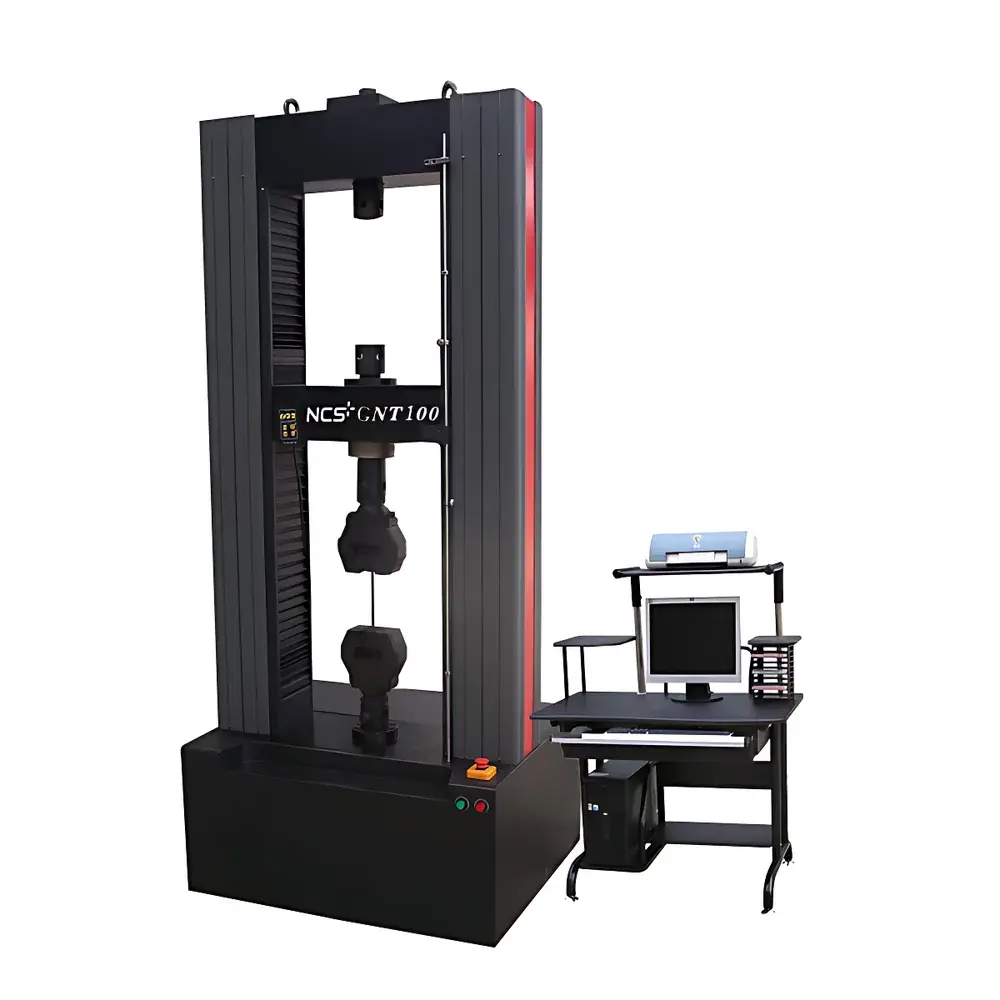
NCS GNT100 Microcomputer-Controlled Electromechanical Universal Testing Machine
| Brand | NCS |
|---|---|
| Origin | Beijing, China |
| Manufacturer Type | Direct Manufacturer |
| Product Category | Domestic |
| Model | GNT100 |
| Instrument Type | Electromechanical Universal Testing Machine |
| Max Test Load | 100 kN |
| Accuracy Class | 0.5 |
| Force Measurement Range | 0.4–100% FS (full-scale, no range switching) |
| Force Resolution | 1/500,000 of full scale, constant across entire range |
| Force Indication Error | ±0.5% of reading |
| Deformation Measurement Range | 0.2–100% FS |
| Deformation & Displacement Indication Error | ±0.5% of reading |
| Displacement Resolution | 0.016 µm |
| Crosshead Speed Range | 0.001–500 mm/min (infinitely variable) |
| Force Control Rate Range | 0.005–5% FS/s |
| Strain Rate Range | 0.02–5% FS/s |
| Closed-Loop Control Modes | Constant Force, Constant Strain, Constant Displacement (0.5–100% FS) |
| Speed Accuracy | ±0.2% of set value (0.01–500 mm/min) |
| Effective Tensile Space | 800 mm |
| Effective Test Width | 600 mm |
| Dimensions (H×W×D) | 1921 × 1997 × 660 mm |
| Software Platform | LZCX-800, Windows 7-based, open architecture, graphical UI, multi-method support (tension, compression, bending, shear), unit conversion (N, kN, gf, kgf, lbf, mm, in), real-time stress–strain plotting |
| Protection Functions | Overload, mechanical limit, overcurrent, overvoltage, overtemperature |
| Control Interchange | Seamless, shock-free transition among force, strain, and displacement control modes |
Overview
The NCS GNT100 Microcomputer-Controlled Electromechanical Universal Testing Machine is a high-precision, servo-driven mechanical testing system engineered for static mechanical characterization of metallic and non-metallic materials under uniaxial loading conditions. Based on the fundamental principles of Hooke’s law and quasi-static continuum mechanics, the GNT100 implements fully digital triple-closed-loop control—simultaneously regulating load, strain, and displacement—to ensure metrological traceability and experimental repeatability in accordance with ISO 7500-1, ASTM E4, and GB/T 228.1 standards. Its rigid C-frame architecture—constructed from high-strength precision-ground columns and reinforced crossheads—minimizes frame compliance and eliminates parasitic bending moments, thereby preserving measurement fidelity during high-force tensile, compression, flexural, and shear tests up to 100 kN. Designed for laboratory and quality control environments requiring regulatory compliance, the system supports audit-ready data acquisition and GLP/GMP-aligned test execution workflows.
Key Features
- Triple-closed-loop digital control architecture enabling simultaneous, independent regulation of force, strain, and displacement—with seamless, zero-shock mode switching during active testing.
- Rigid monolithic frame structure featuring hardened chrome-plated guide columns and preloaded ball screws, delivering structural stiffness >1.2 × 10⁶ N/mm and minimizing deflection-induced measurement uncertainty.
- High-resolution force transduction: 1/500,000 internal resolution at full scale (100 kN), with linearity error ≤±0.5% of reading across the full 0.4–100% FS range—no range switching required.
- Sub-micron displacement resolution (0.016 µm) and precise crosshead velocity control (0.001–500 mm/min, accuracy ±0.2%) for low-strain-rate creep and high-speed rupture studies.
- Integrated safety system including hardware-based overload cutoff, dual-limit switch protection, and real-time thermal/electrical monitoring (overcurrent, overvoltage, motor overtemperature).
- Modular load cell compatibility supporting interchangeable sensors (e.g., 10 kN, 50 kN, 100 kN) without recalibration—facilitating multi-range testing within a single platform.
Sample Compatibility & Compliance
The GNT100 accommodates standardized test specimens per ISO 6892-1 (tensile), ISO 14126 (compressive strength of composites), ASTM D695 (rigid plastics), ASTM D790 (flexural properties), and GB/T 228.1 (metallic materials). Grip systems include wedge-action tensile grips, compression platens, four-point bending fixtures, and shear adapters—all designed to minimize stress concentration and ensure uniform load distribution. All measurement outputs comply with ISO/IEC 17025 requirements for accredited testing laboratories. The system’s force and displacement calibration certificates are traceable to NIM (National Institute of Metrology, China) and compatible with international interlaboratory comparison protocols.
Software & Data Management
The LZCX-800 software suite operates natively on Windows 7 (32/64-bit) and provides an intuitive, icon-driven interface with real-time synchronized display of load–displacement, stress–strain, and time–property curves. It supports method templates compliant with ASTM E8, ISO 6892, and EN 10002, and enables automatic calculation of yield strength (Rp0.2), ultimate tensile strength (Rm), elongation at break (A%), modulus of elasticity (E), and Poisson’s ratio (ν). Data export is available in CSV, Excel, and XML formats; raw channel data (1 kHz sampling rate) is stored with full metadata (operator ID, environmental conditions, calibration status). Audit trail functionality meets FDA 21 CFR Part 11 requirements—including electronic signatures, user access levels, and immutable change logs—for regulated QC/QA applications.
Applications
- Mechanical qualification of structural alloys (e.g., aluminum 6061-T6, stainless steels 304/316) per aerospace material specifications (AMS, BMS).
- Quality assurance of polymer composites and thermoplastics used in automotive interior components and medical device housings.
- Research-grade characterization of additive-manufactured metals (Ti-6Al-4V, Inconel 718) under monotonic and cyclic loading protocols.
- Evaluation of civil engineering materials including concrete prisms, mortar cubes, and fiber-reinforced cementitious composites.
- Calibration verification and inter-laboratory proficiency testing for national metrology institutes and third-party certification bodies.
FAQ
What standards does the GNT100 comply with for force calibration?
The system conforms to ISO 7500-1:2018 (static calibration of tension/compression testing machines) and is supplied with a factory calibration certificate traceable to NIM.
Can the GNT100 perform cyclic or fatigue testing?
No—the GNT100 is optimized for quasi-static monotonic tests only. For dynamic or high-cycle fatigue, NCS recommends the dedicated GFT series electrodynamic fatigue testers.
Is the LZCX-800 software validated for 21 CFR Part 11 compliance?
Yes—when deployed with Windows domain authentication, role-based permissions, and enabled audit trail logging, the software satisfies electronic record and signature requirements for pharmaceutical and medical device QA labs.
What is the maximum specimen height supported in compression mode?
With standard platens, the effective compression height is 800 mm; optional extended-height columns increase this to 1200 mm (part number GNT100-EXT-COL).
Does the system support third-party extensometers?
Yes—via analog voltage input (±10 V) and digital TTL trigger signals; compatible with clip-on, video, and laser extensometers meeting ASTM E83 Class B-1 specifications.



