
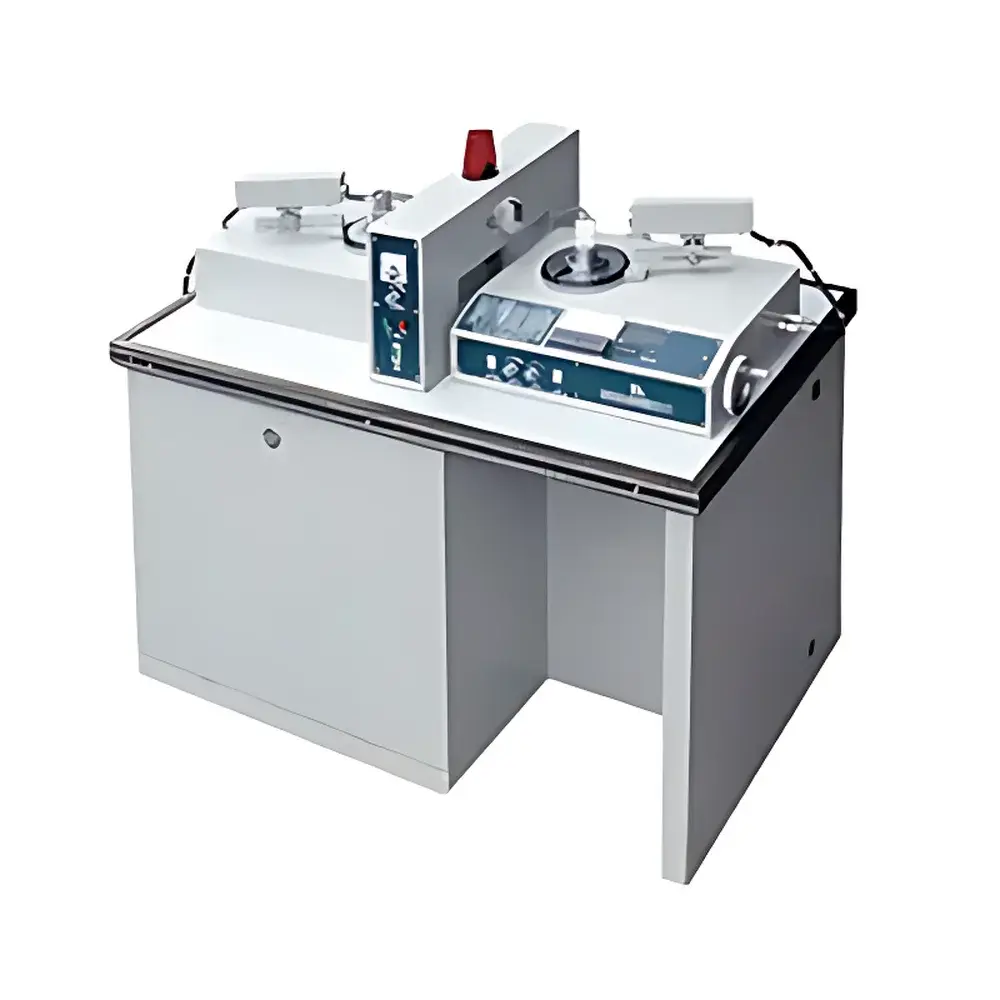
Hefei Kejing X-3/4/4A High-Precision X-ray Single-Crystal Orienting Instrument
| Brand | Hefei Kejing |
|---|---|
| Model | X-3 / X-4 / X-4A |
| Type | Double-Crystal Diffractometer-Based Orienting System |
| Angular Accuracy | ±15 arcseconds |
| Minimum Readout Resolution | 15″ (X-3), 10″ (X-4), 1″ (X-4A) |
| Angular Range | 2θ = 10°–120°, θ = −10°–60° |
| X-ray Source | Cu-target, air-cooled tube |
| Max. Operating Voltage/Current | 30 kV / 1 mA |
| Time Constants | 0.4 s / 0.8 s |
| Power Supply | AC 220 V, 50 Hz, 0.5 kW |
| Monochromator | Built-in graphite monochromator |
| Compliance | JB/T 5482–2004 |
| Dimensions (L×W×H) | 1140 × 650 × 1100 mm |
| Weight | 300 kg |
Overview
The Hefei Kejing X-3/4/4A High-Precision X-ray Single-Crystal Orienting Instrument is a double-crystal diffractometer-based system engineered for accurate crystallographic orientation determination of single-crystal materials—particularly quartz wafers, lithium niobate, silicon carbide, sapphire, and other optoelectronic or piezoelectric substrates. Unlike conventional powder X-ray diffractometers, this instrument operates on the Bragg diffraction principle using a primary monochromatic beam (Cu Kα, λ = 1.5418 Å) incident upon a reference crystal and subsequently reflected from the sample surface. The angular alignment between the incident beam and the crystallographic plane is measured with sub-arcsecond resolution, enabling precise cut-angle verification required in wafer slicing, epitaxial substrate preparation, and crystal growth monitoring. Designed to meet the stringent metrological requirements of semiconductor fabrication and optical component manufacturing, the system delivers high reproducibility in lattice-plane indexing without requiring full structural solution.
Key Features
- Triple-model configuration (X-3, X-4, X-4A) offering scalable angular readout resolution—from mechanical vernier scale (15″) to digital display with 1″ minimum resolution
- Dual-axis goniometer with independent θ and 2θ motion control; calibrated angular range: θ = −10° to +60°, 2θ = 10° to 120°
- Integrated graphite monochromator ensures high spectral purity and suppresses Kβ radiation, improving peak-to-background ratio in rocking-curve measurements
- Air-cooled Cu-anode X-ray tube (30 kV / 1 mA max) optimized for long-term stability and low thermal drift during extended alignment sessions
- Dedicated vacuum-compatible ceramic sample holder (standard), plus optional spring-loaded, elongated, and bulk-sample fixtures for heterogeneous crystal geometries
- Real-time analog intensity meter and dual digital angle display (degrees-minutes-seconds format) with presettable target angles for repeatable positioning
- Rugged steel-frame construction (300 kg mass) minimizes vibration-induced angular uncertainty; meets JB/T 5482–2004 mechanical and radiometric performance criteria
Sample Compatibility & Compliance
The instrument accommodates flat, polished, or as-cut single crystals up to 100 mm in diameter and 50 mm in thickness. Samples are mounted manually via precision-machined vacuum chucks or spring clamps, ensuring minimal strain-induced lattice distortion. All models comply with China’s national standard JB/T 5482–2004 for X-ray crystal orienting instruments—including specifications for angular repeatability, radiation safety interlocks, collimator alignment tolerance, and detector linearity. While not certified to ISO/IEC 17025 or ASTM E975 (Standard Practice for X-ray Diffraction Crystal Orientation Measurement), the system’s angular accuracy (±15″) aligns with typical requirements for industrial quartz wafer orientation per IEC 60424-3 and SAE AS7473. Radiation shielding conforms to GBZ 117–2020 for Class II X-ray equipment; operational dose rate at 50 cm is <1 µSv/h during normal use.
Software & Data Management
The X-3/4/4A operates as a hardware-controlled manual orienting platform with no embedded microprocessor or proprietary software stack. Angle readings and intensity values are displayed directly on front-panel analog meters and LED digit displays. For traceability in regulated environments (e.g., ISO 9001-certified fabs or GLP-compliant R&D labs), users integrate external digital calipers or encoder-equipped rotation stages—paired with third-party data acquisition tools (e.g., LabVIEW, Python-based PyVISA scripts)—to log angle/time/intensity sequences. Audit trails, electronic signatures, and 21 CFR Part 11 compliance require supplemental validation of such external systems; the instrument itself provides no built-in audit logging, user access controls, or encrypted data storage.
Applications
- Verification of crystal cut angles (e.g., AT-cut, SC-cut quartz) prior to wafer slicing and electrode patterning
- Orientation mapping of boule-grown crystals to identify optimal slicing planes for piezoelectric coefficient maximization
- Quality assurance in production of laser host crystals (Nd:YAG, Yb:YAG) and nonlinear optical materials (BBO, LBO)
- Calibration reference for automated XRD texture analyzers and electron backscatter diffraction (EBSD) systems
- Academic teaching of Bragg’s law, Laue geometry, and reciprocal lattice concepts in solid-state physics laboratories
FAQ
Does the X-4A support automated scanning or motorized stage control?
No—the X-3/4/4A series uses manual goniometer adjustment only. Motorized axes, programmable scan routines, or computer-driven data collection are not supported natively.
Is the Cu-target X-ray tube replaceable in the field?
Yes; the air-cooled tube is designed for user-level replacement following factory-specified torque and alignment procedures. Tube lifetime is rated at ≥1,000 hours under nominal operating conditions (25 kV / 0.5 mA).
Can the instrument be used with non-Cu anode tubes (e.g., Mo or Co)?
No—the collimation, monochromator, and detector response are optimized for Cu Kα radiation. Substitution would require recalibration of all angular scales and intensity normalization factors.
What safety certifications does the system hold?
It complies with GBZ 117–2020 (China’s radiation protection standard for industrial X-ray devices) and includes interlocked shutter, warning LEDs, and lead-lined housing. CE or UL listing is not provided.
Is technical documentation available in English?
The manufacturer supplies bilingual (Chinese/English) operation manuals, mechanical drawings, and JB/T 5482–2004 conformance reports upon request. Firmware or GUI localization is not applicable, as the device lacks embedded software.



