
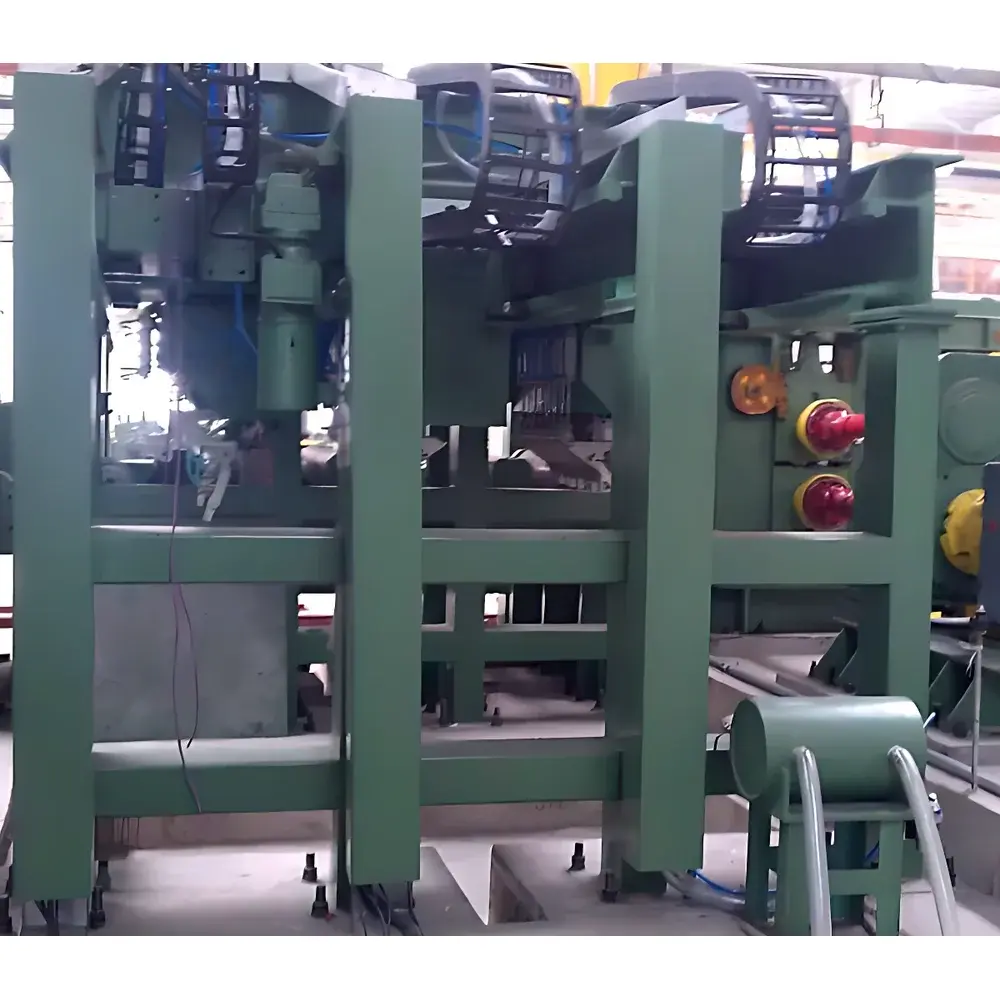
NC-PUT Series Ultrasonic Testing System for Steel Plates and Strips
| Brand | NCS (China Iron and Steel Research Institute Group) |
|---|---|
| Origin | Beijing, China |
| Manufacturer | Yes |
| Country of Origin | China |
| Model | NC-PUT Series |
| Pricing | Upon Request |
Overview
The NC-PUT Series Ultrasonic Testing System is an industrial-grade, fully automated ultrasonic inspection platform engineered for high-reliability non-destructive evaluation (NDE) of flat-rolled ferrous products—including carbon steel plates, alloy steel plates, shipbuilding plates, container plates, tool steels, and cold-rolled or hot-rolled steel strips. Based on pulse-echo and through-transmission ultrasonic principles, the system employs high-frequency broadband transducers operating in immersion or semi-immersion coupling modes to detect internal discontinuities such as laminations, inclusions, voids, and delaminations with high spatial resolution and signal-to-noise ratio. Designed specifically for continuous or batch production environments, the NC-PUT system integrates real-time A-scan, B-scan, and C-scan data acquisition synchronized with material conveyance speed—ensuring full volumetric coverage across the entire width and thickness of the inspected material.
Key Features
- Multi-element transducer architecture utilizing “one-transmit-multiple-receive” (OTMR) piezoelectric crystal configuration for enhanced sensitivity and defect localization accuracy across variable plate thicknesses (6–200 mm typical range).
- Adaptive surface-following mechanism with dynamic lift-off compensation—capable of maintaining consistent coupling and focal depth despite plate edge curl, head-end bending, and mid-span waviness (up to ±3 mm vertical deviation).
- Robust probe carriage system featuring shock-absorbing suspension, self-aligning guide rollers, and ceramic-coated wear-resistant contact surfaces—extending transducer service life under high-throughput rolling mill conditions.
- Real-time echo amplitude and time-of-flight (TOF) analysis with automatic gain control (AGC), threshold-based defect classification, and configurable rejection logic per ASTM E273 and ISO 12718.
- Modular mechanical frame designed for integration into existing hot strip mill exit lines, pickling lines, or plate finishing lines—with optional motorized entry/exit roller tables and hydraulic leveling modules.
Sample Compatibility & Compliance
The NC-PUT Series accommodates flat steel products with nominal widths up to 2,500 mm and thicknesses from 6 mm to 200 mm, including but not limited to API 5L line pipe plates, GB/T 9711.1–9711.3 pipeline steels, ISO 3183-3 compliant materials, ASME Section III Class 2/3 components, RCC-M Grade Z2CN18.10 stainless plates, and JB/T 4730.3–2015 Level II/III inspection requirements. All system performance verification procedures follow EN 12680-1 (Founding – Ultrasonic examination of steel castings) and EN 10160 (Ultrasonic testing of steel plates for pressure purposes). Calibration traceability is maintained to national standards via NCS’s in-house metrology laboratory accredited to ISO/IEC 17025.
Software & Data Management
The embedded inspection software suite supports Windows-based operation with dual-mode interface: operator console for real-time monitoring and engineering workstation for post-processing. Key capabilities include synchronized multi-channel waveform display, C-scan image reconstruction with false-color amplitude mapping, automatic defect marking (size, depth, location), and export of inspection reports in PDF, XML, and CSV formats compliant with ISO 10893-11 and ASTM E2375. Audit trail functionality records all user actions, parameter changes, and calibration events—meeting GLP/GMP documentation requirements and supporting FDA 21 CFR Part 11 electronic signature readiness when deployed in regulated manufacturing facilities.
Applications
- Final quality assurance of hot-rolled and normalized steel plates prior to shipment to OEMs in energy, marine, and infrastructure sectors.
- In-line inspection during plate processing at integrated steel mills—enabling immediate feedback for process parameter adjustment.
- Re-inspection of stored or aged plates where hydrogen-induced cracking (HIC) or stress-oriented hydrogen-induced cracking (SOHIC) susceptibility must be verified per NACE MR0175/ISO 15156.
- Verification of weld overlay integrity on clad plates used in chemical processing equipment.
- Support for third-party certification audits requiring full digital inspection records aligned with TÜV, DNV-GL, Lloyd’s Register, or BV approval protocols.
FAQ
What standards does the NC-PUT system comply with for certification reporting?
The system supports generation of inspection records compliant with API RP 2X, ISO 10893-11, EN 10160, and JB/T 4730.3—enabling direct submission to classification societies and regulatory bodies.
Can the system be retrofitted onto existing production lines?
Yes—the mechanical design includes modular mounting interfaces and programmable PLC communication (PROFINET, EtherNet/IP) for seamless integration with legacy mill automation systems.
Is probe recalibration required after each shift?
No—systematic drift compensation algorithms and reference block auto-recall reduce manual recalibration frequency; scheduled verification per ASTM E1158 is recommended every 8 operational hours.
Does the software support remote diagnostics and firmware updates?
Yes—secure TLS-encrypted remote access is available via NCS’s authorized service portal, enabling predictive maintenance alerts and version-controlled software upgrades without on-site intervention.



