
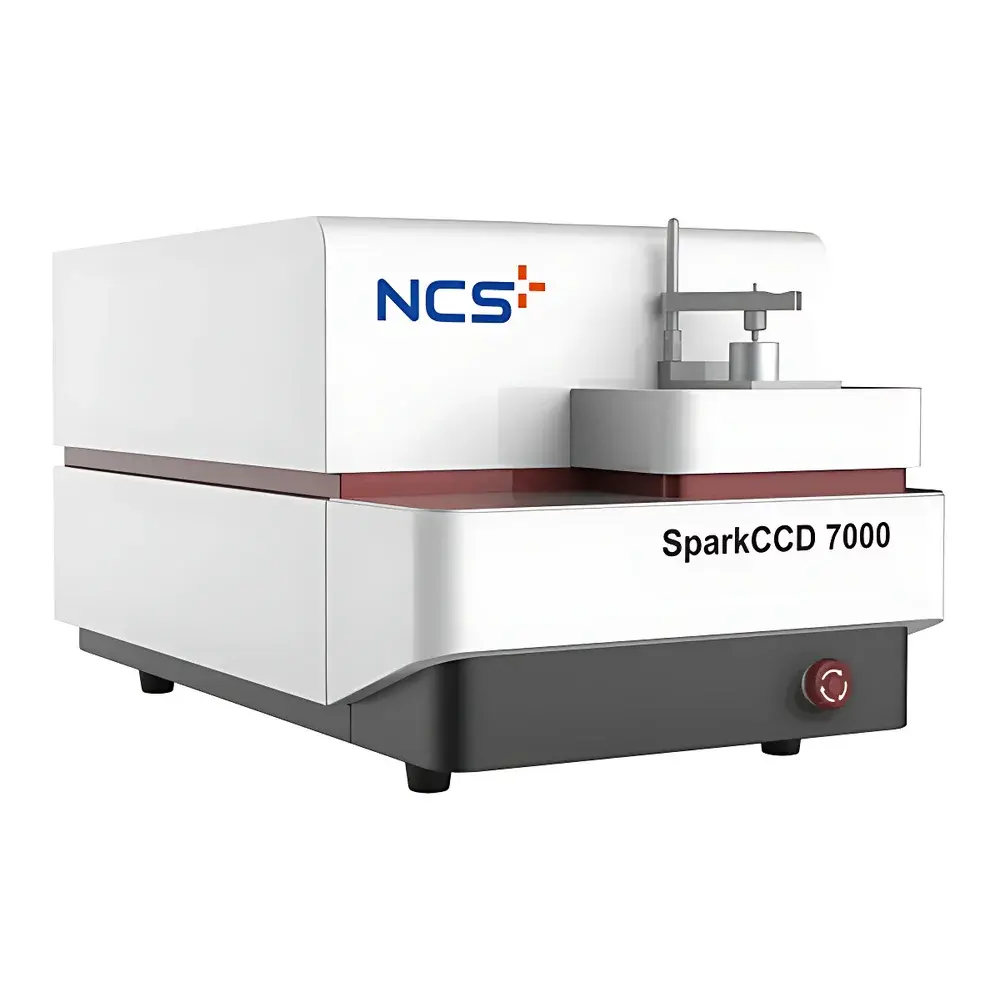
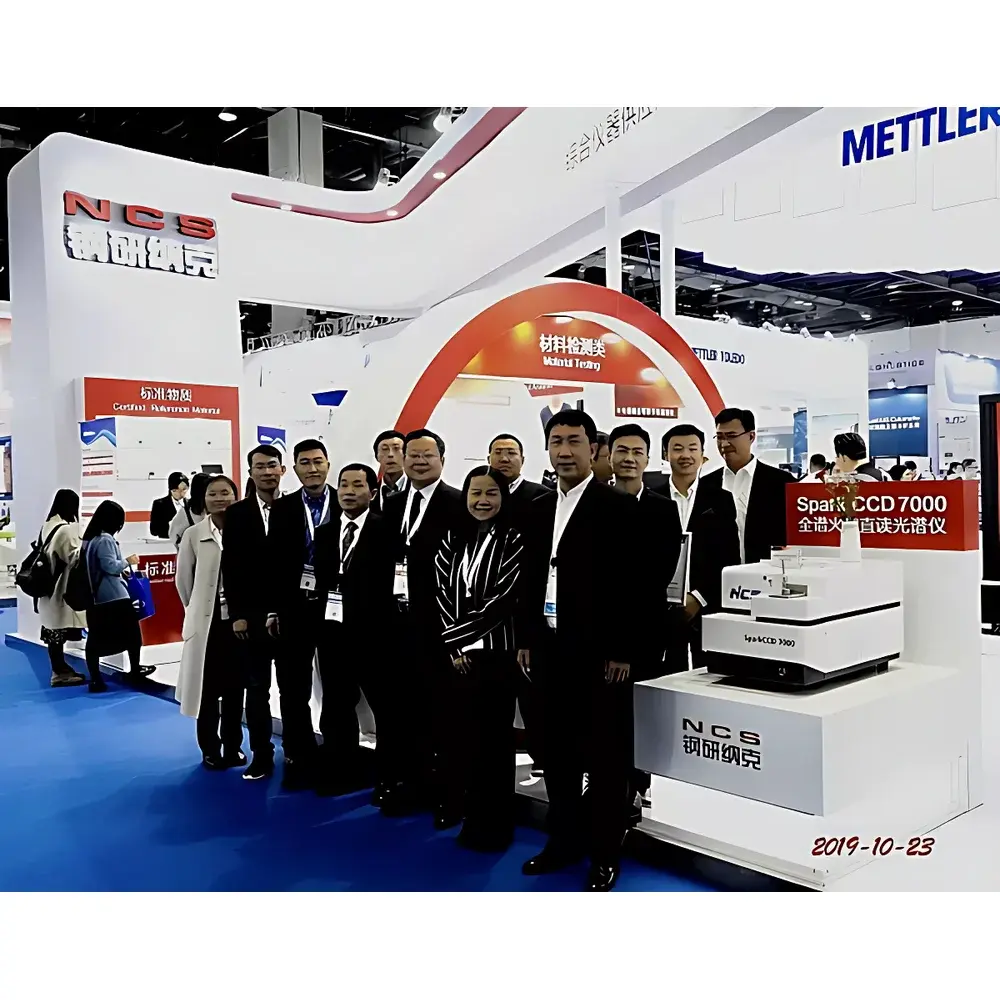
NCS SparkCCD 7000 Full-Spectrum Spark Optical Emission Spectrometer
| Brand | NCS (China Iron and Steel Research Institute Group) |
|---|---|
| Origin | Jiangsu, China |
| Manufacturer Type | Direct Manufacturer |
| Instrument Type | Benchtop |
| Excitation Method | Spark Discharge |
| Detector Type | Charge-Coupled Device (CCD) |
| Focal Length | 500 mm |
| Grating Groove Density | 2700 lines/mm |
| Wavelength Range | 130–800 nm (enabling detection of N, Li, Na, K, and other elements) |
| Spectral Coverage | Full-spectrum acquisition |
| Pixel Array | 3648 + 46 pixels |
| Pixel Size | 8 µm |
| Optical Architecture | Paschen-Runge mounting with holographic concave grating |
| Temperature Stability | ±0.1 °C via integrated thermostatic shielding |
| Argon Consumption | 60 mL/min in standby mode |
| MTBF | >3000 hours |
| Dimensions (W×D×H) | 470 × 872 × 435 mm |
| Weight | 100 kg |
| Power Requirement | 220 V ±10%, single-phase, 10 A, 2.5 kVA |
Overview
The NCS SparkCCD 7000 is a benchtop full-spectrum spark optical emission spectrometer (OES) engineered for high-precision elemental analysis of metallic materials. Based on the fundamental principle of spark discharge atomic emission spectroscopy, the instrument atomizes and excites solid metal samples under controlled argon atmosphere, generating characteristic line spectra that are dispersed by a high-resolution holographic concave grating and simultaneously captured across the entire spectral range (130–800 nm) using a custom-designed CCD detector array. Its Paschen-Runge optical layout ensures zero optical aberration, uniform spectral resolution, and long-term photometric stability—critical for quantitative analysis in production-critical environments such as foundry floor QC, metallurgical R&D, and certified testing laboratories. As the primary drafting entity of GB/T 4336–2016—the Chinese national standard for multi-element determination in carbon and low-alloy steels by spark OES—the SparkCCD 7000 is designed to meet and exceed the metrological and procedural requirements of ISO 11577, ASTM E415, and EN 10315 for routine metal analysis.
Key Features
- High-dispersion optical system: 500 mm focal length holographic grating with 2700 lines/mm groove density, delivering a linear dispersion of 0.7407 nm/mm and theoretical pixel resolution of 0.005926 nm.
- UV-optimized CCD detector: 3648 + 46-pixel array with 8 µm pixel pitch and proprietary thin-film coating, enabling sub-ppm detection limits for nitrogen, lithium, sodium, and potassium down to 130 nm.
- Segmented exposure control: Independent integration time adjustment per spectral region allows simultaneous high-intensity capture of major elements and enhanced signal-to-noise for trace analytes in a single spark event.
- Thermostatically stabilized optical chamber: Integrated temperature control maintains ±0.1 °C uniformity across the entire optical path, eliminating thermal drift and ensuring reproducibility over extended operation cycles (MTBF >3000 h).
- Digital spark source: Fully programmable generator with adjustable frequency up to 1000 Hz, optimized pulse shape, and real-time energy feedback—enabling precise excitation tuning for Fe-, Al-, Cu-, Ni-, Mg-, Ti-, Zn-, and Co-based alloys.
- Tidal argon purging system: Intelligent inter-analysis interval recognition reduces standby argon flow to 60 mL/min; one standard cylinder supports >70 days of standby operation.
- Self-rotating coaxial spark stand: Patented gas-channel geometry ensures uniform plasma distribution and complete electrode cleaning during every spark—requiring no maintenance after >1000 analyses.
- Optical isolation valve: Integrated lens-sealed shutter automatically isolates the spark stand from the optical chamber during maintenance, preventing contamination and preserving long-term intensity stability.
Sample Compatibility & Compliance
The SparkCCD 7000 is validated for direct solid-sample analysis of ferrous and non-ferrous metals including carbon steels, stainless steels, aluminum alloys, copper alloys, nickel superalloys, titanium grades, zinc die-castings, and magnesium castings. It complies with ISO/IEC 17025 quality management requirements for testing laboratories and supports audit-ready data handling per FDA 21 CFR Part 11 when configured with optional electronic signature and audit trail modules. Routine calibration verification follows GB/T 4336–2016, ASTM E1086 (for stainless steels), and ISO 11577 (for aluminum alloys), with certified reference materials (CRMs) traceable to NIST, BAM, or IRMM standards. The instrument’s full-spectrum architecture enables retrospective reanalysis without physical resampling—supporting GLP/GMP investigations and method validation protocols.
Software & Data Management
The SparkCCD 7000 operates with NCS SpectraSuite™ software—a Windows-based platform compliant with IEC 62443-3-3 for industrial cybersecurity fundamentals. It features intuitive workflow navigation, customizable reporting templates (PDF, CSV, XML), and embedded statistical process control (SPC) tools aligned with AIAG CQI-9 guidelines. All analytical events—including spark parameters, integration times, background correction models, and spectral raw data—are timestamped and stored in an encrypted SQLite database with configurable retention policies. Optional network deployment supports centralized instrument monitoring, remote diagnostics, and LIMS integration via ASTM E1384-compliant HL7 or OPC UA interfaces. Software validation documentation (IQ/OQ/PQ) is available upon request for regulated environments.
Applications
Primary application domains include incoming raw material inspection, melt-shop process control, heat-treatment verification, and finished-part certification across metallurgy, heavy machinery, automotive powertrain manufacturing, aerospace component forging, shipbuilding, rail infrastructure, and electronics-grade alloy development. Specific use cases encompass nitrogen quantification in austenitic stainless steels, lithium detection in aluminum-lithium aerospace alloys, sodium/potassium monitoring in high-purity copper conductors, and rapid grade identification of scrap metal streams. Educational institutions utilize the system for teaching atomic spectroscopy fundamentals, while national metrology institutes deploy it for CRM characterization and inter-laboratory comparison studies.
FAQ
What sample preparation is required for analysis?
Flat, clean, and properly ground surfaces (Ra ≤ 0.8 µm) are required; no acid etching or special coatings are needed.
Does the instrument support automated sample changers?
Yes—optional motorized XYZ stage and robotic sample loader kits are available for unattended batch analysis.
Can spectral libraries be customized for proprietary alloys?
Yes—users may build, validate, and lock custom calibrations using certified reference materials and internal standards.
Is UV spectral performance stable over time?
The sealed, argon-purged optical chamber and UV-enhanced CCD coating ensure consistent 130–190 nm response over 5+ years without recalibration.
How is data integrity ensured during long-term deployment?
All raw spectra, processing logs, and user actions are cryptographically hashed and archived with immutable timestamps—fully compliant with ALCOA+ principles.






