
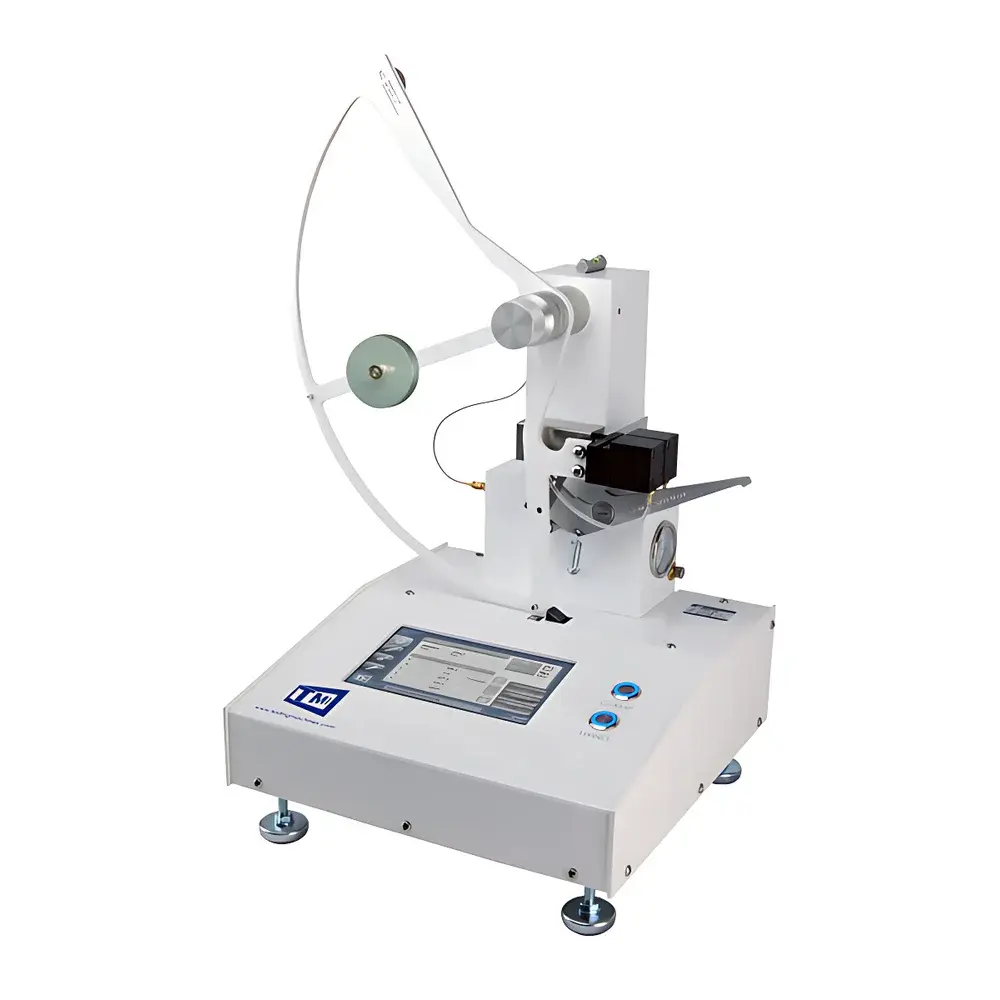
TMI 83-76 Elmendorf Tear Tester
| Brand | TMI |
|---|---|
| Origin | USA |
| Model | 83-76 |
| Power Supply | 120/240 VAC, 50/60 Hz |
| Pneumatic Pressure Requirement | 600 kPa |
| Dimensions (W×D×H) | 305 × 305 × 508 mm |
| Weight | 10.4 kg |
| Display | 7-inch full-color touchscreen |
| Data Storage Capacity | up to 200 test records |
| Tear Force Units | gf, mN, lbf, % full scale |
| Clamping Pressure | adjustable in psi |
| Optional Pendulums | 200 g, 400 g, 800 g, 1600 g (83-11-08), 3200 g (83-11-06), 6400 g (83-11-07) |
| Interface Options | USB flash drive, USB ESC/POS printer, RS232, GraphMaster™ software port |
| Compliance | ASTM D1922, ASTM D1424, ISO 1974, TAPPI T414, GB/T 455 |
Overview
The TMI 83-76 Elmendorf Tear Tester is a precision-engineered instrument designed for quantitative measurement of tear resistance in flexible sheet materials using the standardized pendulum (Elmendorf) method. This gravimetric principle relies on the conversion of gravitational potential energy into kinetic energy as a calibrated pendulum swings through a pre-notched specimen. The energy loss—corresponding to the work required to propagate the tear—is measured via an optical encoder tracking angular displacement with high angular resolution. The resulting value is normalized to specimen length and reported as average tear force in user-selectable units (gf, mN, lbf, or % full scale). As a fundamental mechanical property test, Elmendorf tear resistance directly correlates with end-use performance in packaging integrity, label durability, bag seam reliability, and web handling stability. The 83-76 complies with internationally recognized test standards including ASTM D1922 (plastic films), ASTM D1424 (paper and paperboard), ISO 1974 (paper and board), TAPPI T414 (tensile tear resistance), and GB/T 455 (Chinese national standard), ensuring data traceability and inter-laboratory comparability.
Key Features
- 7-inch full-color capacitive touchscreen interface with intuitive icon-driven navigation and real-time graphical feedback during test execution
- Optical encoder-based angular measurement system delivering high-resolution, drift-free tear energy quantification without mechanical wear
- Pneumatically actuated clamping jaws and pendulum release mechanism ensuring consistent specimen alignment and zero operator-induced variability
- Automatic pendulum calibration routine executed at power-on and configurable via menu—eliminating manual zeroing errors and reducing setup time
- Modular pendulum system supporting six interchangeable masses (200 g to 6400 g), enabling broad dynamic range coverage from lightweight tissue to heavy-duty corrugated board
- Onboard data management: store, review, edit, and export up to 200 test records with timestamp, operator ID, specimen ID, and statistical summaries (mean, min/max, standard deviation)
- Multi-mode output architecture: direct USB flash storage, ESC/POS-compatible thermal printing, RS232 serial communication, and GraphMaster™ software integration for advanced curve analysis and report generation
Sample Compatibility & Compliance
The 83-76 accommodates a wide spectrum of planar, anisotropic materials commonly encountered in packaging R&D and QC environments. Validated substrates include uncoated and coated papers, corrugated and solid fiberboards, polyethylene and polypropylene films, metallized laminates, nonwovens, woven and knitted textiles, and aluminum foils. Specimen thickness is unrestricted within standard pendulum clearance limits; multi-layer composites (e.g., paper-plastic-aluminum laminates) may be tested provided notch geometry adheres to applicable standards. All test protocols align with regulatory expectations for GLP and GMP environments: audit trails are maintained in GraphMaster™ software (21 CFR Part 11 compliant when configured with electronic signatures), raw angular displacement data is retained alongside final tear values, and calibration history—including date, technician, reference standard ID, and deviation logs—is permanently archived.
Software & Data Management
GraphMaster™ software (optional but recommended for regulated labs) extends the 83-76’s functionality beyond basic pass/fail reporting. It enables real-time tear force vs. angle plotting, comparative overlay of multiple specimens or batches, automated statistical process control (SPC) charting (X̄-R, Cp/Cpk), and customizable PDF/Excel report templates meeting internal SOP or external customer requirements. Raw encoder data (16-bit angular position vs. time) is streamed continuously during each swing, permitting post-test reanalysis of transient tearing behavior—critical for identifying onset of unstable propagation or material heterogeneity. USB flash export preserves full metadata, while RS232 supports legacy LIMS integration. All firmware updates are delivered via encrypted .bin files validated against SHA-256 checksums.
Applications
- Quality assurance of folding cartons and corrugated shipping containers per ASTM D642 and ISO 3034
- Validation of heat-seal integrity in flexible food packaging films (ASTM F88)
- Development of tear-initiation-resistant labels and pressure-sensitive adhesives
- Comparative evaluation of recycled fiber content impact on paperboard tear strength
- Process monitoring of calendering, coating, and laminating operations affecting directional tear anisotropy
- Regulatory submission support for FDA 510(k) dossiers requiring mechanical property characterization of medical device packaging (ISO 11607-1)
FAQ
What standards does the TMI 83-76 support out-of-the-box?
The instrument is factory-configured to meet ASTM D1922, ASTM D1424, ISO 1974, TAPPI T414, and GB/T 455. Additional standards can be implemented via GraphMaster™ software configuration modules.
Can the 83-76 test specimens thicker than 1 mm?
Yes—provided the total stack height (including clamping plates) remains within the 12 mm maximum throat depth and the notch geometry conforms to the selected standard’s dimensional tolerances.
Is pneumatic supply included with the system?
No. A clean, dry, oil-free compressed air source delivering stable 600 kPa (87 psi) is required and must be supplied by the user facility.
How is traceability ensured for calibration records?
Each pendulum carries a serialized calibration certificate traceable to NIST. The instrument logs all calibration events—including date, operator, mass value, and deviation from nominal—in non-volatile memory accessible via GraphMaster™ audit trail reports.
Does the touchscreen support glove operation?
Yes—the projected capacitive display responds reliably to standard lab nitrile or latex gloves without requiring stylus input.






