
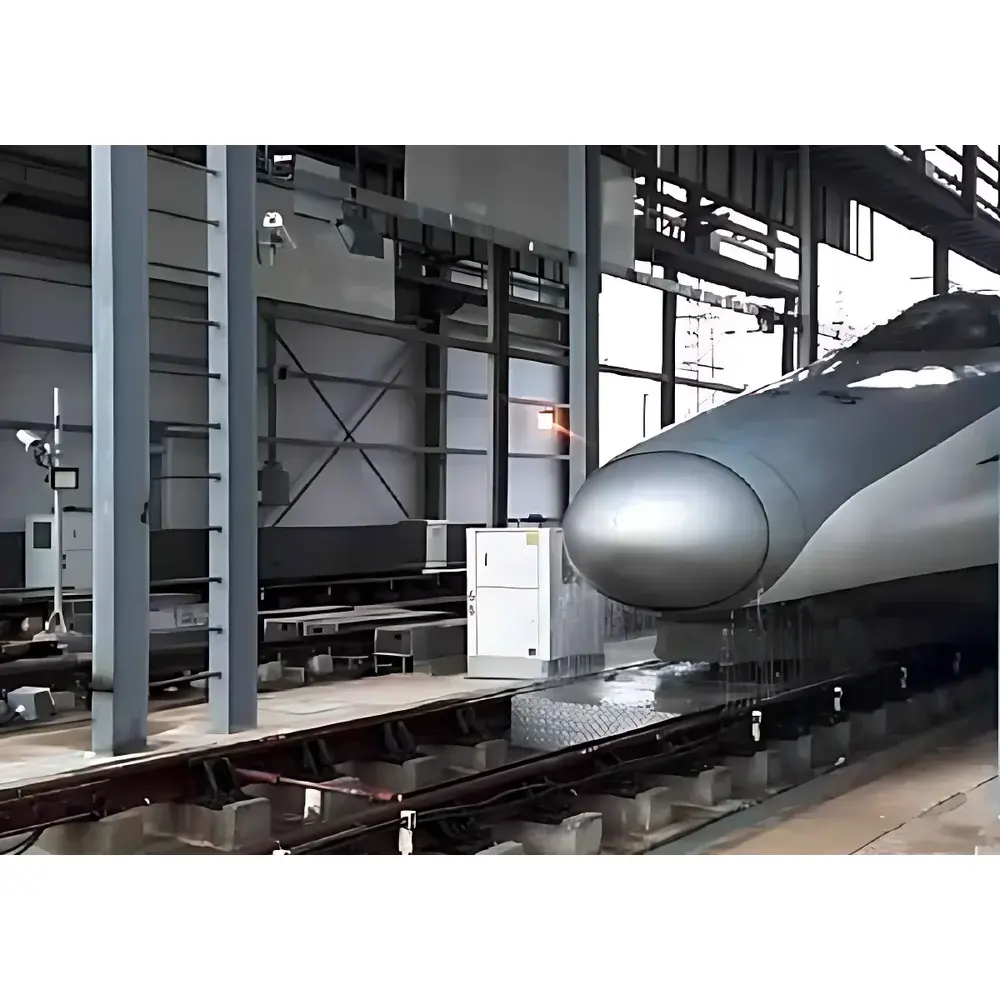
NC-CUT Series In-Service Railway Wheel Ultrasonic Testing System by NCS (China Steel Research Institute)
| Brand | NCS (China Steel Research Institute) |
|---|---|
| Origin | Beijing, China |
| Manufacturer Type | Manufacturer |
| Origin Category | Domestic |
| Model | NC-CUT Series |
| Pricing | Upon Request |
Overview
The NC-CUT Series In-Service Railway Wheel Ultrasonic Testing System is a purpose-built, trackside non-destructive testing (NDT) platform engineered for automated, high-reliability ultrasonic inspection of railway wheelsets during routine service operations. Unlike offline static wheel inspection systems, the NC-CUT operates under dynamic conditions—enabling real-time evaluation of wheels mounted on rolling stock as trains pass at low to moderate speeds (typically 3–15 km/h). The system employs pulse-echo and pitch-catch ultrasonic modalities with phased array transducers, optimized for detection of subsurface and surface-breaking flaws in critical structural zones: the rim (including radial cracks from tread to inner flange), the web (radial and circumferential cracks in the spoke region), and the transition zone between flange root and rim. Its measurement principle is grounded in time-of-flight diffraction (TOFD) and amplitude-based flaw sizing, calibrated per TB/T 3182–2008 “Ultrasonic Testing Method for Railway Vehicle Wheels” and aligned with technical specifications outlined in “Technical Requirements for Dynamic Wheelset Fault Detection Systems” (issued by China Railway Group). Designed for integration into depot inspection lanes or maintenance sidings, it delivers repeatable defect characterization without wheel removal—supporting predictive maintenance strategies and regulatory compliance in heavy-haul and passenger rail fleets.
Key Features
- Modular single-unit architecture enabling scalable deployment: multiple NC-CUT units can be synchronized via Ethernet backbone for full-wheelset coverage across multi-axle configurations.
- Parallel ultrasonic channel operation: simultaneous excitation and acquisition across ≥8 independent transducer groups ensures sub-second dwell time per wheel, compatible with scheduled train throughput requirements.
- Integrated wheel positioning subsystem: optical encoders and proximity-triggered axle counters provide ±0.5 mm positional repeatability relative to wheel geometry, ensuring consistent probe-to-surface coupling and scan path fidelity.
- Distributed network topology: all sensor data, A-scan waveforms, C-scan reconstructions, and alarm metadata are transmitted via TCP/IP over industrial-grade Gigabit Ethernet, supporting remote monitoring, centralized diagnostics, and integration with enterprise CMMS platforms.
- Field-serviceable mechanical design: modular transducer carriages, quick-release couplant delivery manifolds, and tool-free access panels reduce mean time to repair (MTTR) to under 30 minutes per maintenance event.
- Railway-specific environmental hardening: IP65-rated enclosures, wide operating temperature range (−25 °C to +70 °C), and EMI/EMC compliance per EN 50121-3-2 ensure stable performance in depot and outdoor trackside environments.
Sample Compatibility & Compliance
The NC-CUT Series is validated for use on standard Chinese railway wheel profiles including LM, LMA, and S1002, with nominal diameters ranging from 840 mm to 950 mm and rim widths of 135–150 mm. It accommodates both solid and spoked wheel designs used in CRH, Fuxing, and freight locomotive applications. All inspection procedures and acceptance criteria conform to TB/T 3182–2008 and supplementary guidance in CRTSI Technical Bulletin No. 2021-017. System validation documentation includes traceable calibration records against NIST-traceable reference standards (e.g., ISO 2400 artificial notches in aluminum wheel simulators), and supports audit readiness for GB/T 19001 (ISO 9001), GB/T 24001 (ISO 14001), and China Railway’s internal GMP-equivalent quality assurance protocols.
Software & Data Management
The NC-CUT Control & Analysis Suite (v4.2+) provides a deterministic real-time operating environment for acquisition, visualization, and reporting. Each inspection generates a structured dataset comprising raw RF signals, time-gated B-scans, depth-coded C-scan maps, and geometrically registered defect reports (X/Y/Z coordinates, estimated depth, length, and orientation). Data files adhere to ASTM E2371-compliant XML schemas and are archived with SHA-256 checksums. Role-based user authentication, audit trail logging (per ISO/IEC 17025 clause 7.10), and optional FDA 21 CFR Part 11-compliant electronic signature modules are available upon configuration. Export formats include PDF inspection certificates, CSV summary tables, and DICOM-RT-compatible volumetric datasets for third-party analysis.
Applications
- Depot-level in-service inspection of EMU, DMU, and freight locomotive wheelsets during scheduled maintenance windows.
- Pre-departure screening at hub terminals to verify wheel integrity prior to high-speed or long-haul routes.
- Root cause analysis support following wheel-related incidents (e.g., flange fractures, thermal cracking).
- Longitudinal fleet health monitoring: aggregated defect statistics feed into reliability-centered maintenance (RCM) models and asset life prediction algorithms.
- Verification of post-turning or reprofiling quality before wheel re-entry into service.
FAQ
What wheel speeds are supported during inspection?
The NC-CUT Series is rated for continuous operation at train speeds from 3 km/h to 15 km/h, with optimal signal-to-noise ratio achieved between 5–10 km/h.
Does the system require wheel lifting or jacking?
No. It is designed for true in-service inspection—wheels remain fully loaded and rotating on rails during scanning.
How is couplant applied and managed in outdoor environments?
An automated, closed-loop water-glycol mixture delivery system maintains consistent acoustic coupling; excess fluid is recovered and filtered for recirculation.
Can the NC-CUT integrate with existing depot SCADA or MES infrastructure?
Yes. OPC UA and MQTT interfaces are standard; custom API adapters for Siemens Desigo, GE Proficy, or SAP PM modules are available under NDA.
Is operator certification required for system deployment?
Personnel must hold Level II certification per ISO 9712 in Ultrasonic Testing (UT), with additional NC-CUT-specific procedural training provided by NCS Field Engineering.



