
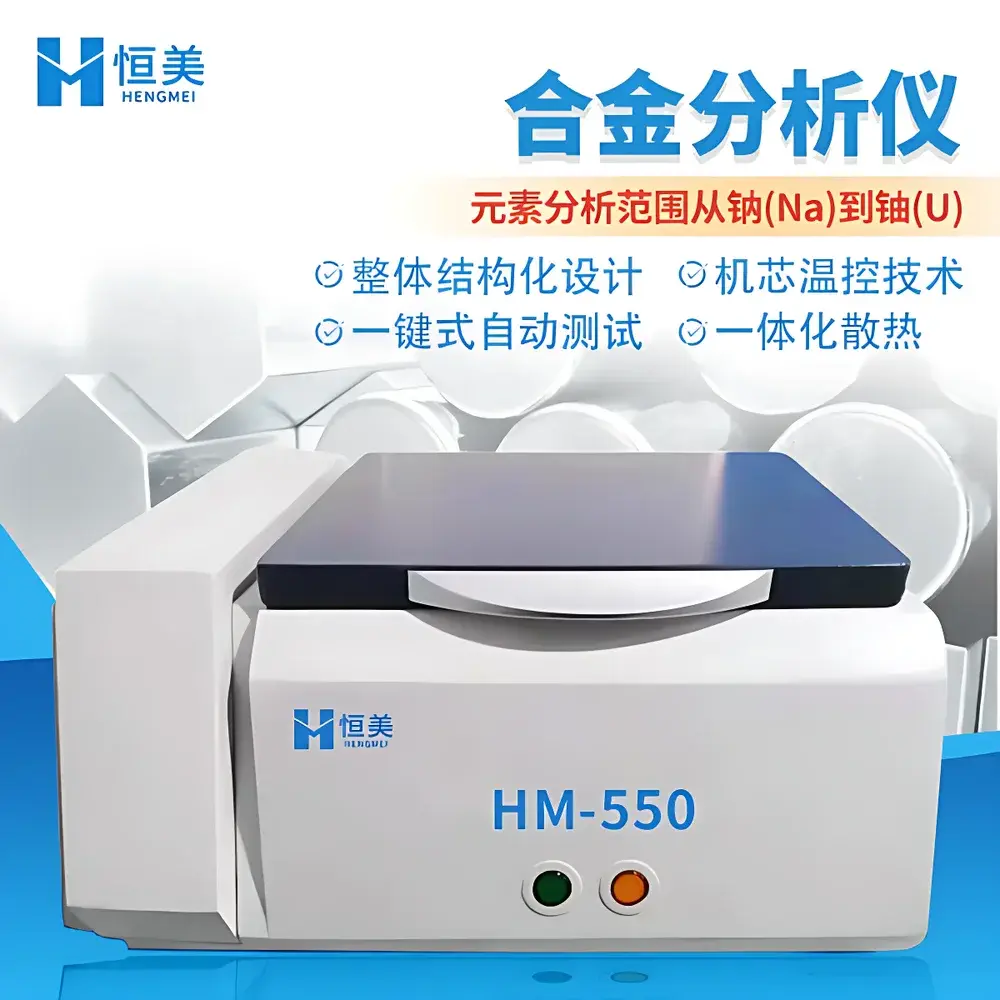
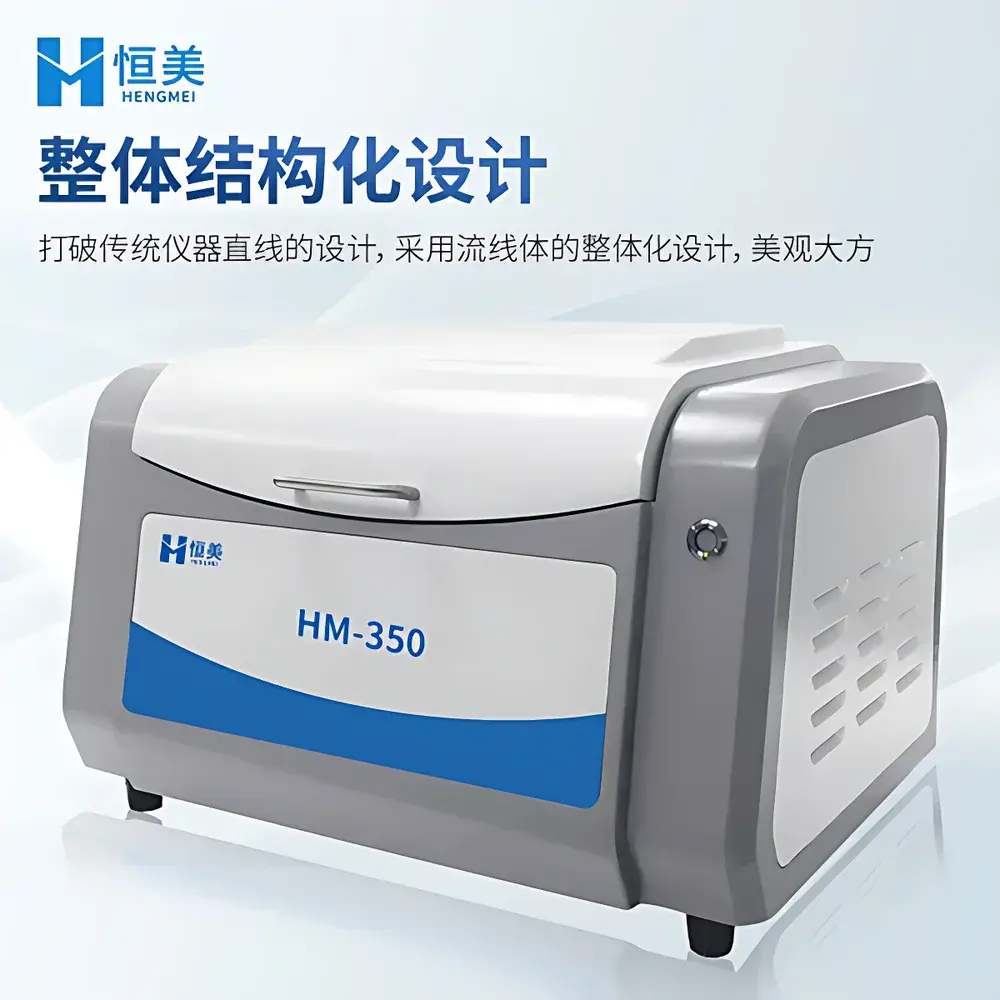
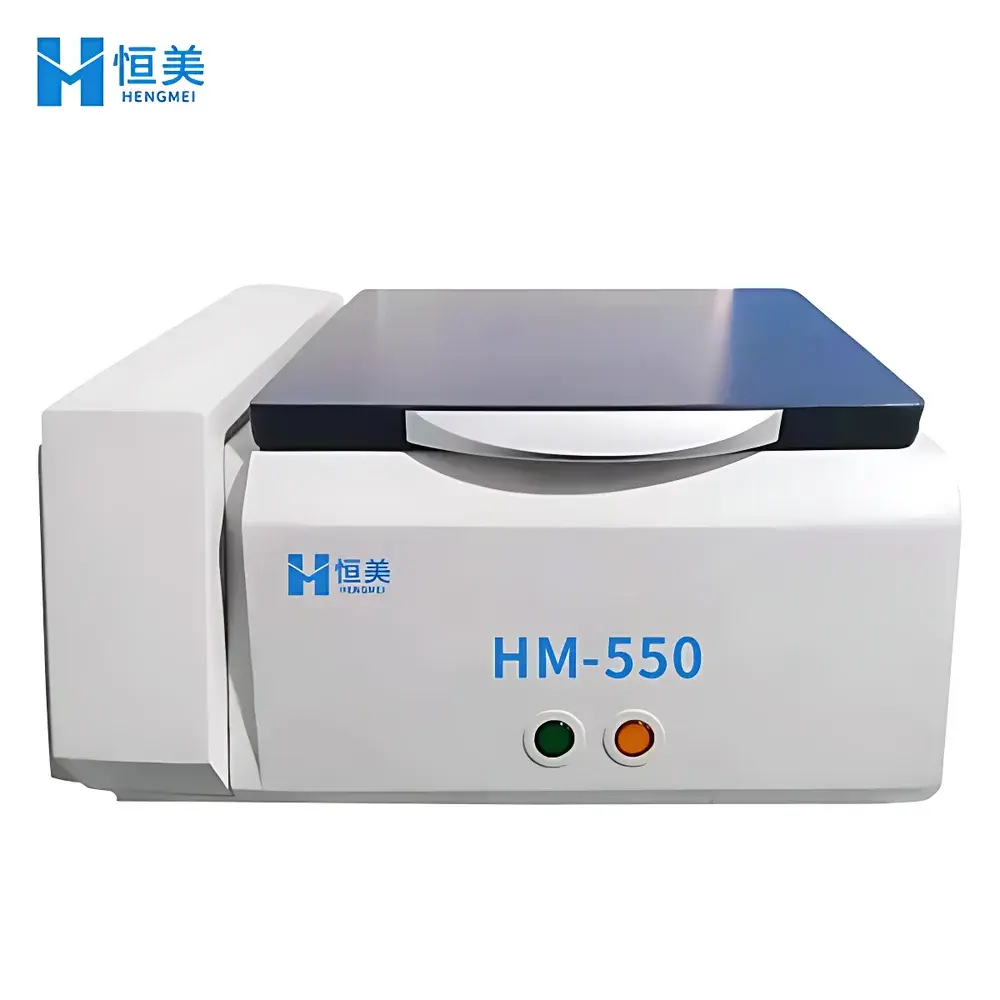
Hengmei HM-550 Benchtop Energy-Dispersive X-ray Fluorescence (EDXRF) Elemental Analyzer for Metal Alloys
| Brand | Hengmei |
|---|---|
| Origin | Shandong, China |
| Manufacturer Type | OEM Manufacturer |
| Region | Domestic (China) |
| Model | HM-550 |
| Price | USD 25,000 (FOB Qingdao) |
| Measurable Elements | Na (11) to U (92) |
| Dimensions | 700 mm × 510 mm × 336 mm |
| Weight | 56 kg |
| Vacuum Chamber Dimensions | 400 mm × 340 mm × 80 mm |
| Operating Temperature | 15–30 °C |
| Relative Humidity | 40–70 % RH |
| Power Supply | AC 220 V ±5 V, 50/60 Hz |
| Detection Limit (RoHS elements) | 1 ppm |
| Measurement Time | 100–300 s (user-adjustable) |
| Energy Resolution | 129 ±5 eV (Mn Kα) |
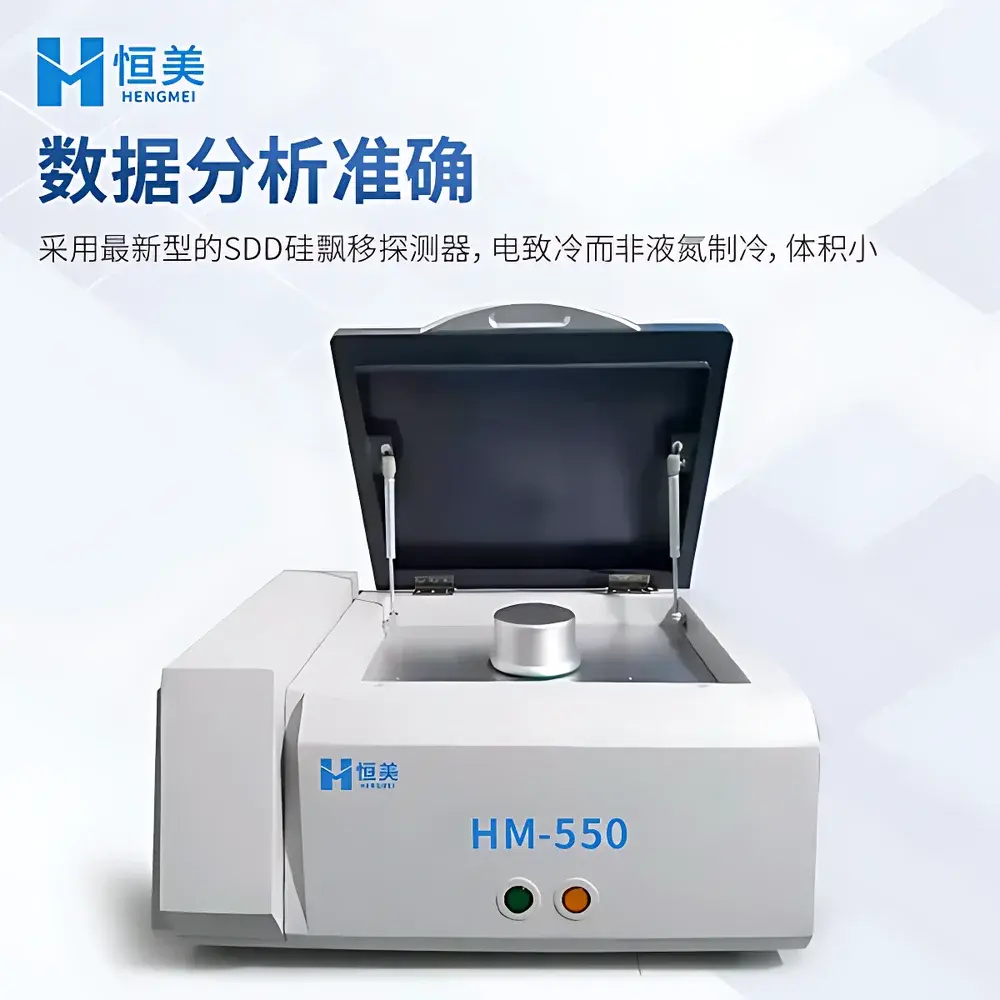
| Detector | Silicon Drift Detector (SDD), Peltier-cooled |
| X-ray Tube | Max. 50 kV / 1 mA, tungsten anode |
| Vacuum Pump | 60 L/min, ultimate pressure 6.7×10⁻² Pa |
| Collimator Options | 7 fixed apertures (2–8 mm diameter) |
| Filter Options | 5 automatic filters |
| Spectral Channels | 4096-channel digital MCA |
| Interface | USB 2.0 |
Overview
The Hengmei HM-550 is a benchtop energy-dispersive X-ray fluorescence (EDXRF) spectrometer engineered for precise, non-destructive elemental analysis of metallic alloys and coated materials. It operates on the fundamental principle of X-ray excitation: when a sample is irradiated with high-energy X-rays from a microfocus tube, inner-shell electrons are ejected from constituent atoms; subsequent electron transitions emit characteristic secondary X-rays whose energies are unique to each element. The HM-550 captures these emissions using a high-resolution silicon drift detector (SDD), enabling quantitative and qualitative determination of elements from sodium (Na, Z=11) to uranium (U, Z=92). Its integrated vacuum chamber eliminates atmospheric absorption—particularly critical for light elements (Na–Cl)—thereby extending detection capability beyond air-path limitations. Designed for industrial QC labs, foundries, scrap metal recyclers, and RoHS compliance testing facilities, the instrument delivers trace-level sensitivity (1 ppm for Cd, Pb, Cr, Hg, Br, Cl), high spectral fidelity, and robust reproducibility across heterogeneous metal matrices.
Key Features
- Integrated high-efficiency vacuum system with 60 L/min dry scroll pump, achieving ≤6.7×10⁻² Pa in under 60 seconds—enabling reliable detection of light elements (Na, Mg, Al, Si, P, S, Cl) without liquid nitrogen or operator intervention.
- Silicon drift detector (SDD) with 129 ±5 eV energy resolution (Mn Kα), Peltier-cooled for zero cryogen dependency, low maintenance, and stable long-term calibration.
- Configurable excitation: 5–50 kV adjustable tube voltage and 0–1 mA current control, optimized for matrix-specific excitation and minimized spectral overlap.
- Automated multi-collimator and multi-filter module: 7 collimator sizes (2–8 mm) and 5 primary beam filters enable dynamic optimization of signal-to-background ratio per sample type.
- Digital pulse processing via proprietary SES multi-channel analyzer (4096 channels), incorporating real-time pile-up rejection, baseline restoration, and peak deconvolution algorithms.
- Full hardware interlock architecture: vacuum status monitoring, tube temperature regulation, radiation shielding (lead-lined chamber + shuttered beam path), and auto-shutdown on lid opening.
- USB 2.0 interface ensures deterministic data transfer integrity and compatibility with Windows-based lab networks and LIMS integration.
Sample Compatibility & Compliance
The HM-550 accommodates solid metallic samples up to 400 mm × 340 mm × 80 mm (vacuum chamber internal volume), including castings, extrusions, machined parts, and plated substrates. It supports standardized test methods aligned with ASTM E1621 (EDXRF for metals), ISO 21043 (RoHS screening), and IEC 62321-3-3 (determination of Cd, Pb, Hg, Cr(VI), Br in polymers and metals). For regulated environments, the system supports audit-ready operation: all measurement parameters (voltage, current, time, vacuum level, collimator/filter selection) are timestamped and stored with spectra; software logs user actions, method changes, and calibration events—facilitating GLP/GMP documentation and FDA 21 CFR Part 11 compliance when deployed with validated electronic signatures and access controls.
Software & Data Management
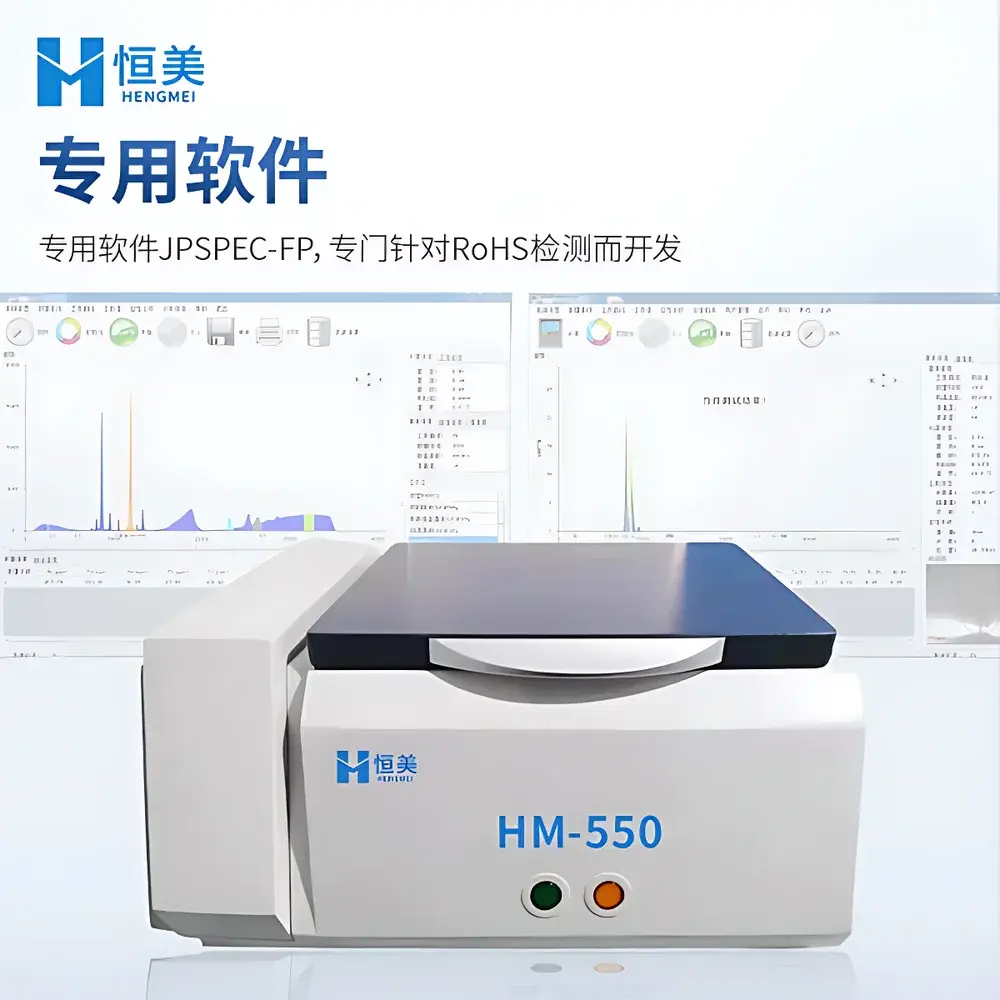
JPSPEC-FP is a dedicated Windows-based analytical suite developed exclusively for metal alloy characterization. It implements fundamental parameter (FP) quantification with matrix correction algorithms trained on certified reference materials (CRMs) for aluminum, copper, zinc, stainless steel, and cast iron alloys. Key capabilities include: automated working curve selection based on sample type recognition; real-time vacuum pressure display and manual/auto vacuum mode toggle; spectral overlay comparison for batch consistency assessment; customizable reporting (PDF/CSV/XLSX) with pass/fail flags against user-defined specification limits; and full spectral archive management with metadata tagging (operator ID, sample ID, date/time, method version). All raw spectra and processed results are stored in a structured SQLite database, supporting SQL queries for trend analysis and SPC charting.
Applications
- Alloy Grade Identification: Rapid verification of aluminum (e.g., 6061 vs. 7075), copper (C11000 vs. C26000), zinc (Zamak 3 vs. Zamak 5), and stainless steel (304 vs. 316) grades via multi-element fingerprinting.
- RoHS & Halogen-Free Compliance Screening: Quantitative determination of restricted substances (Cd, Pb, Hg, Cr, Br, Cl) at sub-ppm levels in finished components, meeting EU Directive 2011/65/EU and JEDEC JS-709E requirements.
- Coating & Plating Analysis: Simultaneous measurement of coating composition (e.g., Ni–P, Sn–Cu, Zn–Fe) and thickness (via fundamental parameter modeling) on ferrous and non-ferrous substrates.
- Scrap Sorting & Recycling QC: On-site sorting of mixed metal streams by elemental signature, reducing downstream smelting impurities and improving yield.
- Foundry Process Control: In-line verification of melt chemistry prior to casting, minimizing rework and ensuring mechanical property consistency.
FAQ
Does the HM-550 require liquid nitrogen cooling?
No. It uses a thermoelectrically cooled silicon drift detector (SDD), eliminating cryogenic handling, refills, and associated downtime.
Can it analyze light elements such as magnesium or aluminum in air?
Light element detection below phosphorus (Z=15) requires vacuum operation to minimize air absorption. The integrated vacuum system enables reliable Na–Cl quantification.
Is the software compliant with FDA 21 CFR Part 11?
Yes—when configured with role-based user accounts, electronic signatures, and audit trail activation, JPSPEC-FP meets core Part 11 requirements for electronic records and signatures in regulated laboratories.
What maintenance is required for the X-ray tube?
The tungsten-anode tube is rated for >5,000 hours of operation. No routine replacement is needed within typical industrial service life; performance is monitored continuously via tube current stability and spectral noise metrics.
How does the instrument handle heterogeneous or irregularly shaped samples?
The large chamber (400 × 340 × 80 mm) accommodates complex geometries. Optional sample positioning fixtures and height-sensing stage compensation ensure consistent source-to-sample distance and excitation geometry.
Related Products




