
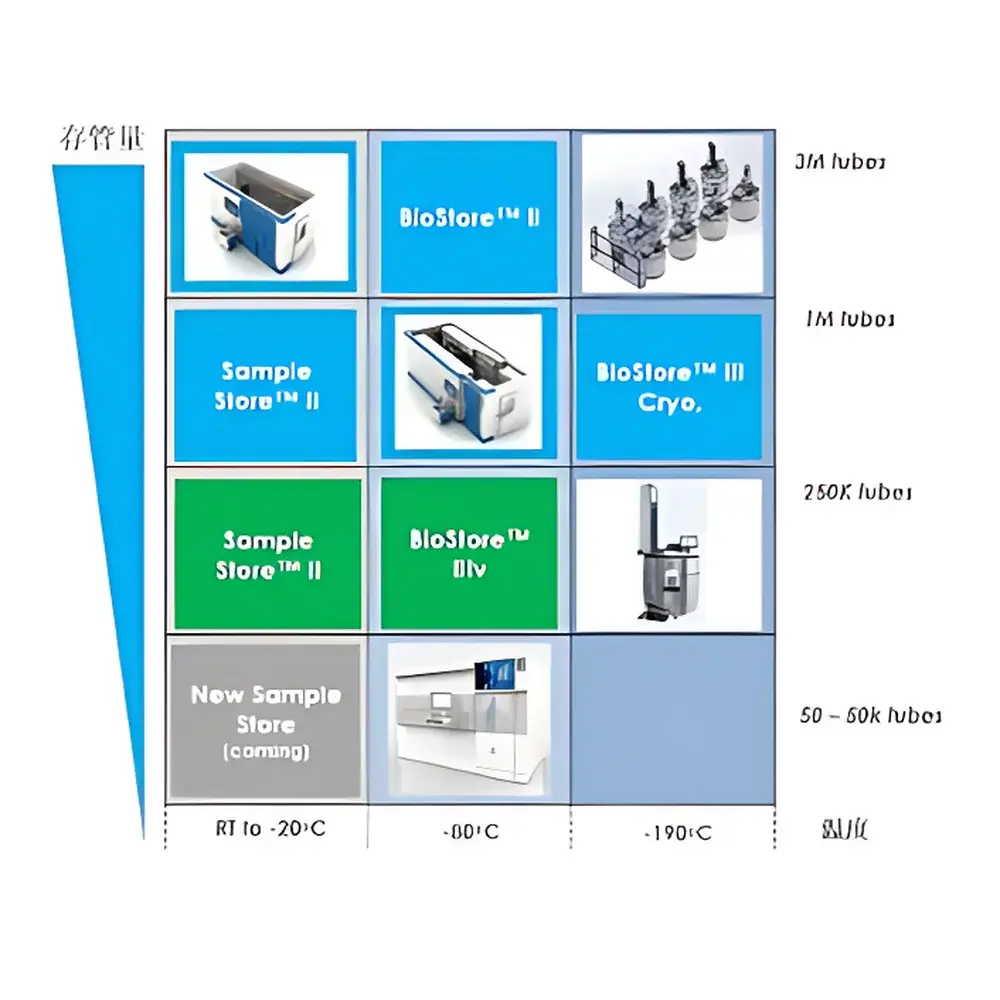
Azenta B3C 1500 Automated Cryogenic Storage System
| Brand | Azenta |
|---|---|
| Origin | USA |
| Model | B3C 1500 |
| Temperature Range | -190°C (vapor-phase liquid nitrogen) |
| Static LN₂ Consumption | ~9.5–12.5 L/day |
| Thermal Hold Time (Power Loss) | ~21 days |
| Operation Mode | Fully Automated with Manual Override Capability |
| Compliance | Designed for GLP/GMP-aligned biobanking workflows, supports 21 CFR Part 11–compliant audit trails via integrated software |
| Footprint Options | Configurable modular layouts (standard, double-height, quad-height, and ultra-capacity variants available) |
Overview
The Azenta B3C 1500 Automated Cryogenic Storage System is an engineered solution for long-term, high-integrity biobanking at ultra-low temperatures. Operating in vapor-phase liquid nitrogen (LN₂) at a stable -190°C, the system eliminates direct sample immersion while maintaining cryogenic stability essential for nucleic acid integrity, cell viability, and protein conformational fidelity. Unlike mechanical freezers, the B3C 1500 leverages passive thermal inertia and precision LN₂ vapor management to deliver exceptional temperature uniformity (< ±0.5°C across storage zones) and minimal thermal cycling risk. Its architecture is purpose-built for mission-critical repositories—including clinical trial biobanks, translational research cores, and pharmaceutical biorepositories—where sample traceability, chain-of-custody rigor, and regulatory readiness are non-negotiable requirements.
Key Features
- True vapor-phase cryostorage at -190°C, eliminating ice contamination and cross-contamination risks associated with liquid-phase systems
- Modular, scalable footprint design: supports standard laboratory (SE), single-, double-, quad-, and ultra-capacity configurations (up to 18.17 m length × 4.78 m height × 3.24 m width)
- Automated robotic retrieval with dual-axis gantry and barcode-verified sample handling; <10 s average access time per tube or bag
- Integrated real-time environmental monitoring: continuous logging of LN₂ level, internal temperature (multiple sensor zones), door status, and dew point
- Fail-safe thermal hold capability: maintains -150°C or colder for ≥21 days during full power loss or LN₂ supply interruption
- Manual override mode accessible at any time without system shutdown—enabling emergency access or maintenance without compromising data continuity
- Redundant safety architecture: dual independent LN₂ level sensors, pressure-relief valves, oxygen deficiency monitors (ODM), and fire-rated insulation
Sample Compatibility & Compliance
The B3C 1500 accommodates diverse primary biospecimen formats including 2D-barcoded cryovials (FluidX-compatible), SBS-standard microplates, cryo-bags (e.g., blood, cord tissue), and custom rack-mounted modules. All storage modules are validated for ISO 15189 and ISO 20387 biobanking compliance frameworks. The system’s hardware and software infrastructure supports alignment with FDA 21 CFR Part 11 requirements—including electronic signatures, role-based user permissions, immutable audit trails, and automated backup of all inventory and environmental logs. It is routinely deployed in CAP-accredited laboratories and meets the physical infrastructure criteria outlined in ISBER Best Practices (4th ed.) and MIABIS 2.0 metadata standards.
Software & Data Management
Powered by Azenta’s SampleManager™ biobank informatics platform, the B3C 1500 integrates seamlessly with enterprise LIMS and ELN systems via HL7/FHIR and RESTful APIs. The software enforces “three-code unification” (tube barcode, rack barcode, location barcode) to eliminate misplacement errors. Every sample movement triggers timestamped, user-attributed, and instrument-logged entries—including temperature history per retrieval event. Automated reconciliation reports compare physical inventory against digital records daily. Audit logs are encrypted, tamper-evident, and exportable in PDF/A-2 or CSV format for internal QA review or regulatory inspection. Optional validation packages include IQ/OQ/PQ documentation templates compliant with GAMP 5 guidelines.
Applications
- Clinical biobanking for longitudinal cohort studies and biomarker discovery
- Cell and gene therapy (CGT) material archiving under ATMP regulatory frameworks
- Pharmaceutical compound libraries requiring cryopreserved viability over decades
- Genomic resource centers managing large-scale DNA/RNA biorepositories
- Academic core facilities supporting multi-institutional consortia with federated access controls
- Disaster-resilient secondary storage for irreplaceable legacy collections
FAQ
What temperature uniformity can be expected across the storage chamber?
Temperature deviation remains within ±0.5°C across all validated storage zones under normal operating conditions, verified per ASTM F2697-21 protocols.
Does the system support integration with existing LIMS or EMR platforms?
Yes—via configurable HL7 v2.x, FHIR R4, and secure REST API endpoints with OAuth 2.0 authentication and TLS 1.2+ encryption.
How is sample integrity protected during robotic retrieval?
Each retrieval cycle includes pre-access temperature stabilization, vacuum-insulated transfer path, and post-retrieval resealing verification—all logged with thermal exposure duration.
Can the B3C 1500 be validated for GMP environments?
Full IQ/OQ/PQ validation support is provided, including protocol templates, test scripts, and traceable calibration certificates aligned with ISO/IEC 17025-accredited service partners.
What happens if the LN₂ supply is interrupted?
The system automatically transitions to conservation mode, prioritizing thermal mass retention; hold time exceeds 21 days at ambient lab conditions (20–25°C), per IEC 61000-4-29 surge immunity testing.





