
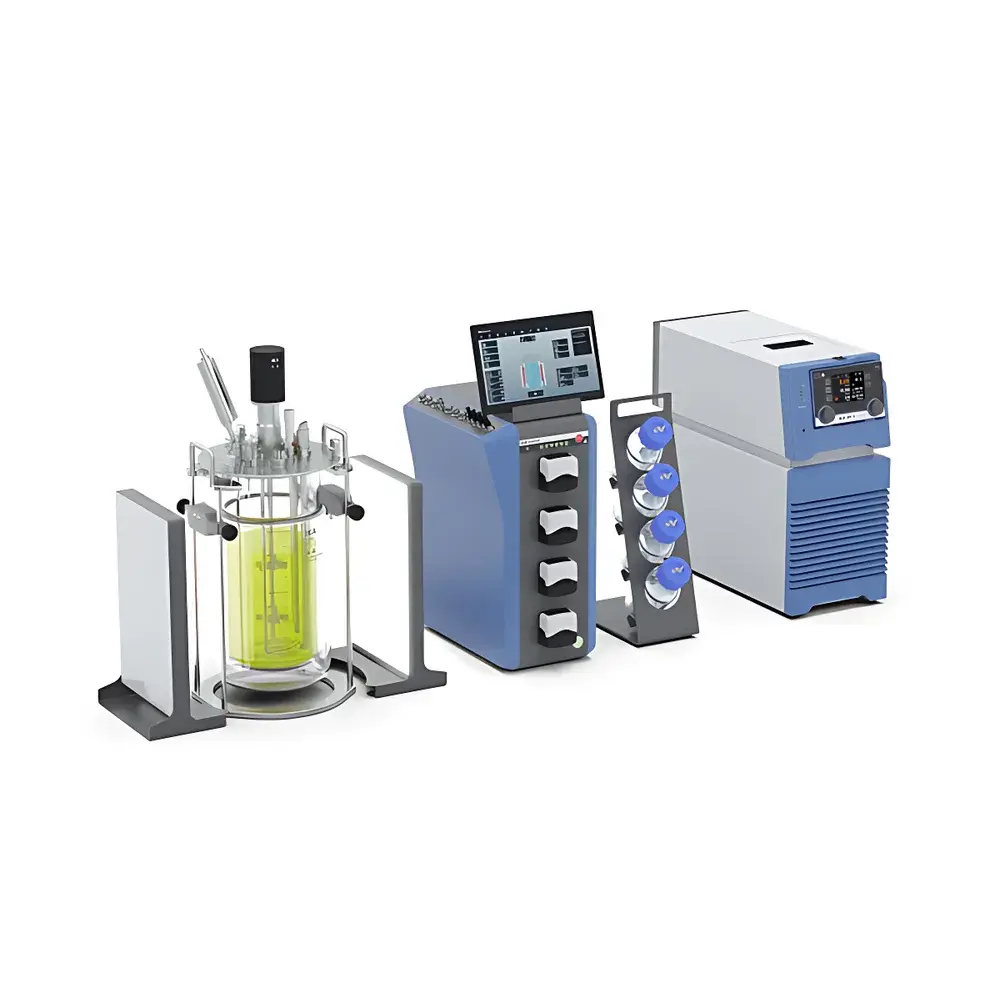
IKA HABITAT Photo Cell Bioreactor
| Brand | IKA |
|---|---|
| Origin | Germany |
| Manufacturer | IKA Works GmbH & Co. KG |
| Product Type | Photobioreactor System |
| Model | HABITAT photo cell |
| Construction Material | Borosilicate Glass (DIN ISO 3585) |
| Regulatory Compliance | CE, RoHS, IP20 |
| Power Supply | 100–240 V AC, 50/60 Hz |
| Dimensions (W×D×H) | 224 × 624 × 405 mm |
| Weight | 14 kg |
| Operating Ambient | 5–40 °C, ≤80% RH (at 31 °C), linearly decreasing to 50% at 40 °C |
Overview
The IKA HABITAT photo cell is a modular, benchtop photobioreactor system engineered for precision-controlled cultivation of light-dependent microorganisms—including microalgae, cyanobacteria, and photosynthetic yeasts—under fully monitored and programmable environmental conditions. At its core, the system integrates advanced bioprocess control architecture with optical actuation via an integrated, tunable LED illumination panel. Unlike conventional stirred-tank reactors, the HABITAT photo cell employs a dual-path design: a dedicated control tower housing all actuators, sensors, and fluidic interfaces, paired with interchangeable glass vessels (single-wall or double-jacketed) ranging from 0.5 L to 10 L working volume. Its operational principle relies on real-time closed-loop regulation of critical bioprocess parameters—pH, dissolved oxygen (DO), temperature, liquid level, foam, and gas composition—while simultaneously delivering spectrally adjustable, intensity-tunable light stimuli to emulate natural diurnal cycles or optimized photoperiods. Designed in accordance with GLP-compliant laboratory infrastructure requirements, the system supports traceable process execution, audit-ready data logging, and scalable transition from lab-scale screening to pilot development.
Key Features
- Modular architecture: Separable control tower and vessel package enable flexible configuration for photobioreactor, fermenter, or standard bioreactor operation
- Tunable LED illumination panel: Programmable intensity (0–100%) and spectral profile (white + optional narrow-band channels) for simulating circadian rhythms or optimizing photon flux density (PFD)
- Chaotic Mixing™ technology: Dynamically modulated impeller speed profiles based on deterministic chaos algorithms ensure homogeneous suspension of dense algal cultures without shear-induced damage
- Four integrated Watson-Marlow 114DV peristaltic pumps: Reversible direction, flow range 1–270 mL/min, compatible with silicone tubing (ID 0.5–4.8 mm); dedicated channels for acid, base, antifoam, and feed addition
- Quad-gas mass flow control: Independent MFCs for air, O₂, N₂, and CO₂ (0–2000 sccm each) with ±2% FS accuracy; continuous or demand-driven aeration modes
- 10.4-inch tablet PC with intuitive touchscreen interface: Preloaded with IKA Labworld software supporting batch, fed-batch, and perfusion/continuous operation modes
- Comprehensive sensor suite: Integrated PT1000 temperature probe, ISFET-based pH sensor (0–14 pH, ±0.02 pH), polarographic DO sensor (0–200% saturation, ±0.3% sat), capacitive level sensor, and conductivity-compatible foam detection
- Heating blanket (250 W) or external thermostat interface (e.g., IKA HRC 2) for precise thermal control (5–60 °C, ±0.2 °C stability)
- FDA 21 CFR Part 11–compliant software option available with electronic signatures, role-based access control, and immutable audit trail
Sample Compatibility & Compliance
The HABITAT photo cell accommodates a broad spectrum of phototrophic and heterotrophic cultures, including Chlamydomonas reinhardtii, Dunaliella salina, Spirulina platensis, and recombinant Yarrowia lipolytica. Vessel compatibility extends to single-use bioreactor bags (via dedicated interface) and reusable borosilicate glass vessels conforming to DIN ISO 3585 specifications. All wetted materials meet USP Class VI and FDA-compliant material standards. The system satisfies key regulatory prerequisites for preclinical bioprocess development: full alignment with ISO 13485 design controls, adherence to ASTM E2500-13 for equipment qualification, and support for IQ/OQ/PQ documentation templates. Data integrity complies with ALCOA+ principles (Attributable, Legible, Contemporaneous, Original, Accurate, Complete, Consistent, Enduring, Available), with encrypted 32 GB onboard storage and optional cloud backup.
Software & Data Management
IKA Labworld software provides a unified environment for setup, execution, monitoring, and retrospective analysis. The platform features embedded calibration wizards for pH, DO, and temperature sensors—with automatic timestamped log entries for each calibration event. Real-time trend visualization includes synchronized multi-parameter overlays (e.g., pH vs. CO₂ sparging rate), customizable alarm thresholds, and dynamic setpoint profiling. Process data are exported in CSV, PDF, or secure .iwd format (IKA proprietary binary with cryptographic hash). Audit trails record user actions, parameter changes, and system events with immutable timestamps. For regulated environments, the Part 11-compliant version enforces electronic signature workflows, 21 CFR Part 11–validated electronic records, and automated backup to network-attached storage (NAS) or validated cloud endpoints.
Applications
- Photosynthetic biomass production for biofuel feedstocks (e.g., lipid accumulation studies under nitrogen limitation)
- High-value metabolite synthesis (astaxanthin, β-carotene, phycocyanin) under controlled light spectra and intensity gradients
- Photobioreactor optimization using Design of Experiments (DoE) for light-dark cycle modulation and gas blending ratios
- CO₂ sequestration kinetics modeling with real-time off-gas analysis integration (via optional IR sensor)
- GMP-aligned seed train expansion for clinical-grade algal therapeutics
- Education and training in bioprocess engineering curricula, emphasizing photobiology fundamentals and digital twin implementation
FAQ
Can the HABITAT photo cell operate as both a photobioreactor and a standard stirred-tank fermenter?
Yes—the system transitions seamlessly between configurations by swapping the LED panel for a cooling jacket interface or connecting to an external thermostat; no hardware modification is required.
Is sterilization of the vessel and sensor assembly possible in an autoclave?
All vessel components—including the lid-mounted sensor carrier and motor shaft—are designed for steam sterilization at 121 °C / 2 bar for 20 minutes; silicone tubing and LED panel must be removed prior to autoclaving.
What level of data security and traceability does the system provide?
Data are stored locally with SHA-256 hashing; Part 11–enabled deployments include role-based permissions, biometric or token-based login, and export-locked raw data archives compliant with Annex 11 and EU GMP Chapter 4 requirements.
How is mixing efficiency validated for high-density algal cultures?
Chaotic Mixing™ performance is verified using residence time distribution (RTD) analysis and particle image velocimetry (PIV) benchmarks against laminar and turbulent reference regimes—documented in IKA Application Note AN-PBR-07.
Are third-party sensors (e.g., CO₂, turbidity, conductivity) supported?
Yes—the system offers configurable analog inputs (0–10 V, 4–20 mA) and Modbus RTU over RS232/RS485, enabling integration of certified external sensors without firmware modification.



