
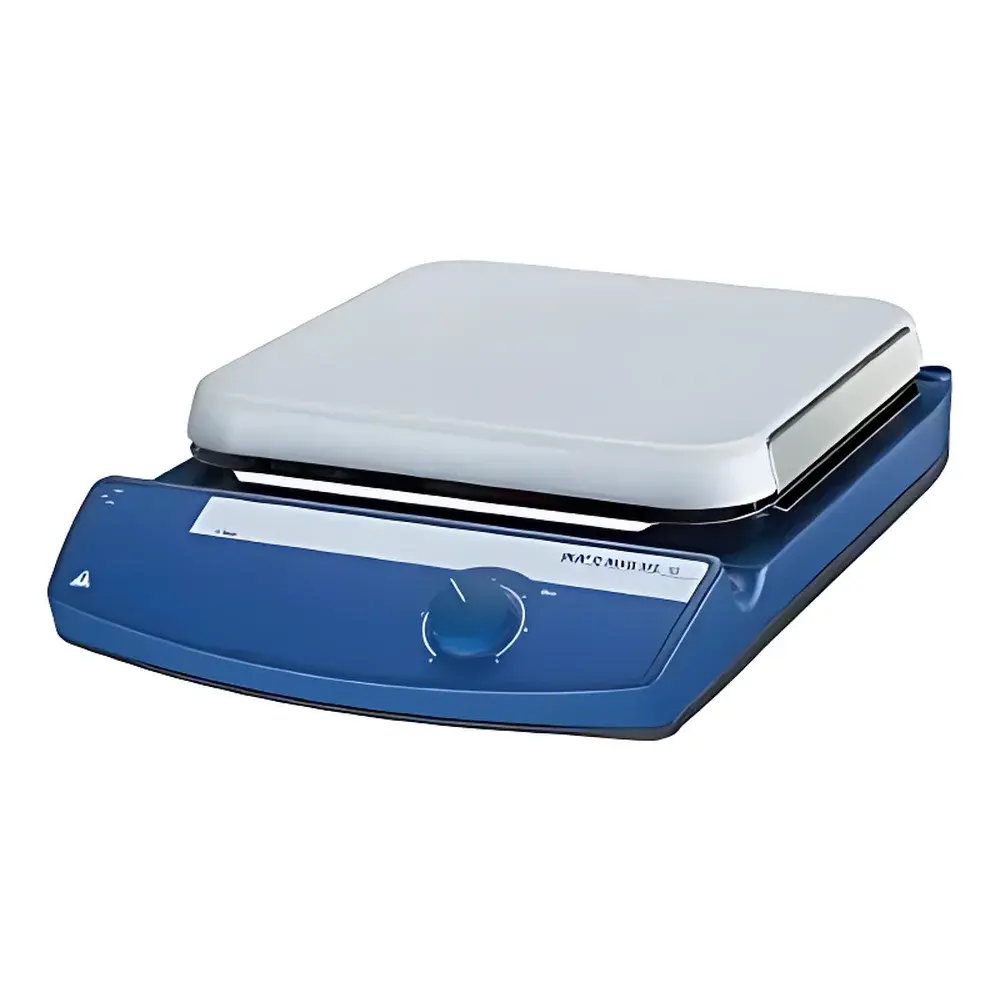
IKA C-MAG MS 10 Magnetic Stirrer
| Brand | IKA |
|---|---|
| Origin | Germany |
| Manufacturer | IKA-Werke GmbH & Co. KG |
| Product Type | Magnetic Stirrer |
| Model | C-MAG MS 10 |
| Maximum Stirring Volume (H₂O) | 15 L |
| Speed Range | 100 – 1500 rpm |
| Control Principle | Microprocessor-Controlled with Speed Feedback |
| Heating Function | None |
| Plate Material | Ceramic |
| Plate Dimensions | 260 × 260 mm |
| Overall Dimensions | 300 × 105 × 415 mm |
| Weight | 6 kg |
| IP Rating | IP21 |
| Operating Ambient Temperature | 5 – 40 °C |
| Relative Humidity Limit | ≤80 % RH (non-condensing) |
| Power Supply | 230 / 120 / 100 V, 50/60 Hz |
| Input Power | 30 W |
| Motor Output Power | 1.5 W |
| Max Stir Bar Length | 80 mm |
| Rotation Direction | Clockwise only |
Overview
The IKA C-MAG MS 10 is a compact, microprocessor-controlled magnetic stirrer engineered for precision and reliability in routine laboratory environments. Designed without integrated heating, it delivers consistent rotational motion via a high-torque permanent magnet drive system optimized for non-temperature-critical mixing applications. Its operating principle relies on synchronous coupling between the rotating internal magnet and externally placed magnetic stir bars—enabling contactless torque transfer through glass or plastic vessel walls. This architecture eliminates mechanical wear, reduces contamination risk, and supports operation under inert atmospheres or sealed vessels. The device is calibrated for aqueous media up to 15 L volume, with speed stability maintained across the full 100–1500 rpm range via closed-loop feedback control. Its robust mechanical design, combined with a seamless ceramic top plate, ensures long-term performance in chemically demanding workflows common in analytical chemistry, pharmaceutical QC, and academic research laboratories.
Key Features
- Microprocessor-based speed regulation with real-time motor feedback ensures ±3% speed reproducibility across the entire operating range.
- Ceramic work surface (260 × 260 mm) provides exceptional resistance to acids, bases, solvents, and thermal shock—compatible with prolonged exposure to HCl, NaOH, acetone, and ethanol.
- Elevated control panel minimizes liquid ingress risk during vigorous stirring and improves ergonomics for visual monitoring of digital speed readout.
- High-coercivity neodymium magnet assembly prevents “stir bar jumping” even at elevated speeds or with viscous solutions (e.g., glycerol-water mixtures, polymer solutions).
- IP21-rated enclosure offers protection against vertically falling drips and solid objects >12.5 mm—suitable for standard ISO Class 5–7 lab environments.
- Universal voltage compatibility (100/120/230 V, 50/60 Hz) enables deployment across global laboratory infrastructures without external transformers.
Sample Compatibility & Compliance
The C-MAG MS 10 accommodates standard cylindrical or oval stir bars up to 80 mm in length, supporting both PTFE- and PTFE-coated stainless steel variants. It is validated for use with borosilicate glass (DIN EN ISO 3585), polypropylene, and fluoropolymer-lined reaction vessels. No built-in temperature control eliminates regulatory requirements for thermal calibration or traceability per ASTM E2479 or ISO/IEC 17025 Annex A.5; however, its stable speed output meets GLP documentation needs when paired with external temperature monitoring systems. Device construction complies with DIN EN 61010-1:2019 for electrical safety in laboratory equipment and conforms to RoHS 2011/65/EU and REACH (EC) No. 1907/2006 material restrictions.
Software & Data Management
As a stand-alone analog-digital hybrid instrument, the C-MAG MS 10 does not feature onboard data logging, USB connectivity, or PC interface capabilities. All operational parameters—including set speed and actual RPM—are displayed on a dual-digit LED screen. For audit-trail compliance in regulated environments (e.g., FDA 21 CFR Part 11), users must implement manual logbook entries or integrate the unit into facility-wide electronic lab notebook (ELN) systems via external process sensors and programmable logic controllers (PLCs). The absence of firmware updates or network interfaces simplifies validation protocols and reduces cybersecurity exposure vectors in GxP settings.
Applications
- Homogenization of buffer solutions prior to HPLC mobile phase preparation.
- Mixing of reagent kits in clinical diagnostics workflows requiring precise stoichiometric consistency.
- Dispersion of nanoparticles in aqueous colloids for TEM sample preparation.
- Stirring of titration solutions in volumetric analysis where thermal drift must be avoided.
- Agitation of enzyme assay mixtures under ambient conditions to maintain native conformational integrity.
- Supporting dissolution testing per USP when used with non-heated vessels and standardized stir bar geometry.
FAQ
Does the C-MAG MS 10 include a heating function?
No. This model is a dedicated magnetic stirrer without integrated heating. For combined stirring and heating, consider the IKA C-MAG HS series.
What is the maximum viscosity this stirrer can handle?
While rated for 15 L of water, performance with high-viscosity fluids depends on stir bar geometry and vessel shape. Empirical validation is recommended for solutions exceeding 1000 mPa·s.
Is the ceramic plate resistant to hydrofluoric acid?
No. Standard IKA ceramic plates are not HF-resistant. Use PTFE-coated magnetic stir bars and HF-compatible vessels separately.
Can the unit operate continuously for 24 hours?
Yes. Designed for unattended operation within specified ambient conditions (5–40 °C, ≤80% RH), provided adequate ventilation around the rear cooling vents.
How is speed accuracy verified during IQ/OQ qualification?
Use a non-contact optical tachometer traceable to NIST standards, measuring at three points (300, 900, and 1400 rpm) across three consecutive cycles per point.



