
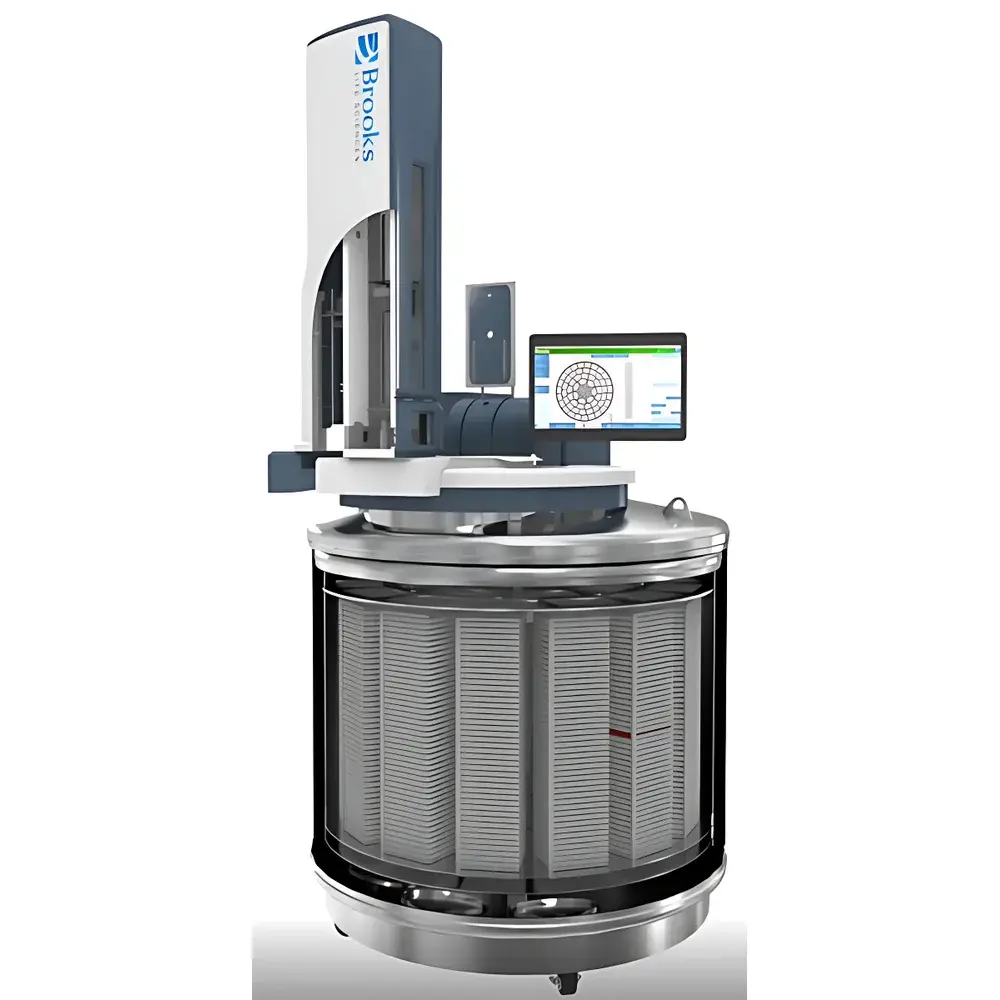
Azenta BioStore III Cryo Automated Liquid Nitrogen Storage System
| Brand | Azenta (formerly Brooks Life Sciences) |
|---|---|
| Origin | USA |
| Model | BioStore III Cryo (B3C) |
| Weight | 1067 kg |
| Operating Temperature | -190°C (vapor-phase LN₂) |
| Static LN₂ Consumption | ~9.5–12.5 L/day |
| Sample Retention at >-135°C (Tg) During LN₂ Interruption | ≥21 days |
| Capacity | 63,000 × 2 mL tubes or 123,000 × 1 mL tubes |
| Footprint | 42 in (107 cm) wide |
| Regulatory Classification | Atmospheric-pressure cryogenic storage system (non-pressure vessel) |
| Compliance | Designed for GLP/GMP-aligned biobanking workflows, supports 21 CFR Part 11-compliant audit trails |
Overview
The Azenta BioStore III Cryo (B3C) Automated Liquid Nitrogen Storage System is an engineered solution for high-integrity, large-scale biobanking at ultra-low temperatures. Operating exclusively in vapor-phase liquid nitrogen (LN₂) at -190°C, the B3C eliminates direct sample immersion—thereby eliminating cross-contamination risk and minimizing thermal shock during retrieval. Unlike manual dewars, which expose entire racks to ambient conditions during access, the B3C employs a robotic gantry system that retrieves individual cryoboxes with sub-millimeter positional accuracy while maintaining chamber integrity. The system’s thermally optimized vacuum-insulated tank—built upon MVE Chart’s industry-proven cryogenic architecture—ensures stable thermal gradients across all storage zones, with continuous monitoring of internal temperature, LN₂ level, and environmental parameters. Its atmospheric-pressure design complies with ASME BPVC Section VIII exemptions and avoids regulatory classification as a pressure vessel, simplifying facility integration and safety certification.
Key Features
- Fully automated sample access via dual-axis robotic arm with barcode-scanned cryobox identification and SBS-compliant footprint compatibility
- Vapor-phase LN₂ storage maintained at ≤-190°C; validated thermal uniformity across full volume (±1.5°C deviation)
- Extended hold time: ≥21 days below glass transition temperature (-135°C) during complete LN₂ supply interruption
- Modular, scalable architecture supporting up to 16 independent storage modules per system configuration
- Integrated dual-sensor LN₂ level monitoring with predictive refill scheduling and low-level alarm escalation
- Ergonomic access height (110 cm max lift) and 107 cm width enabling passage through standard laboratory doorways (≥110 cm)
- Redundant safety systems including oxygen deficiency monitors (ODM), LN₂ leak detection, and emergency manual override mode
Sample Compatibility & Compliance
The BioStore III Cryo accommodates standardized cryogenic consumables including ANSI/SBS-format cryoboxes (e.g., 10×10, 8×12 configurations), ISO-certified blood bags (25 mL and 50 mL), and individual cryovials (1 mL and 2 mL). All sample containers are tracked via unique 2D DataMatrix barcodes scanned at every handling event. The system meets core requirements for biorepository accreditation under ISO 20387:2018 and supports compliance with FDA 21 CFR Part 11 through role-based electronic signatures, immutable audit logs, and system-generated timestamped records of every inventory action—including user ID, timestamp, location, and operation type (load/unload/verify/move). It is validated for use in GLP and GMP environments where traceability, chain-of-custody integrity, and long-term sample viability are mission-critical.
Software & Data Management
BioStore Control Software (v5.2+) provides centralized management of inventory, workflow, and system health. The web-based interface enables real-time visualization of rack occupancy, temperature maps, LN₂ consumption trends, and historical access logs. All data is stored in a secure, encrypted SQL database with configurable backup intervals and retention policies. Audit trail functionality captures every system interaction—including login attempts, parameter changes, and manual overrides—with tamper-evident hashing. Integration with LIMS platforms (via HL7 v2.5 and RESTful API) supports bidirectional synchronization of sample metadata, reducing transcription errors and enabling end-to-end sample lifecycle tracking from collection to analysis.
Applications
- Population-scale biobanks requiring >50,000-sample capacity with zero manual handling exposure
- Clinical trial sample repositories needing 21 CFR Part 11–compliant chain-of-custody documentation
- Cell therapy manufacturing facilities storing cryopreserved CAR-T and stem cell products under cGMP conditions
- Academic core facilities managing multi-cohort longitudinal studies with strict freeze-thaw limitation protocols
- National health genomics initiatives requiring interoperable, standards-aligned cryo-informatics infrastructure
FAQ
Is the BioStore III Cryo classified as a pressure vessel?
No. It operates at atmospheric pressure and is designed and certified as a non-pressure cryogenic storage system per ASME BPVC Section VIII Division 1 exemptions.
What happens if LN₂ supply is interrupted?
The vacuum-jacketed tank maintains internal temperatures below -135°C (Tg) for ≥21 days, preserving sample integrity without active cooling.
Can the system integrate with existing LIMS?
Yes—via native HL7 v2.5 messaging and RESTful API endpoints for sample metadata exchange, status updates, and audit log export.
Does it support manual access during maintenance or failure?
Yes. A validated manual override mode allows full physical access to all storage positions without compromising thermal stability of remaining samples.
What sample formats are natively supported?
SBS-standard cryoboxes (10×10, 8×12), cryovials (1 mL, 2 mL), and medical-grade blood bags (25 mL, 50 mL), all tracked via 2D DataMatrix barcodes.




