
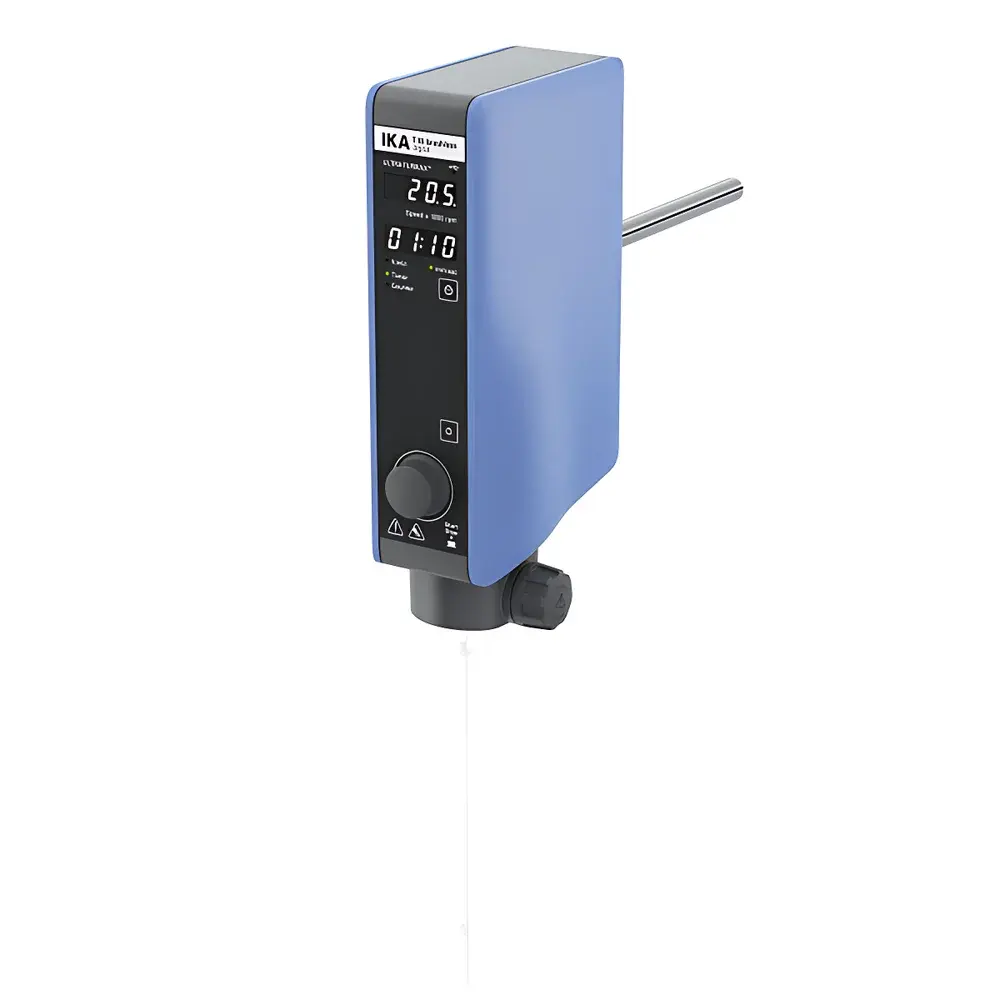
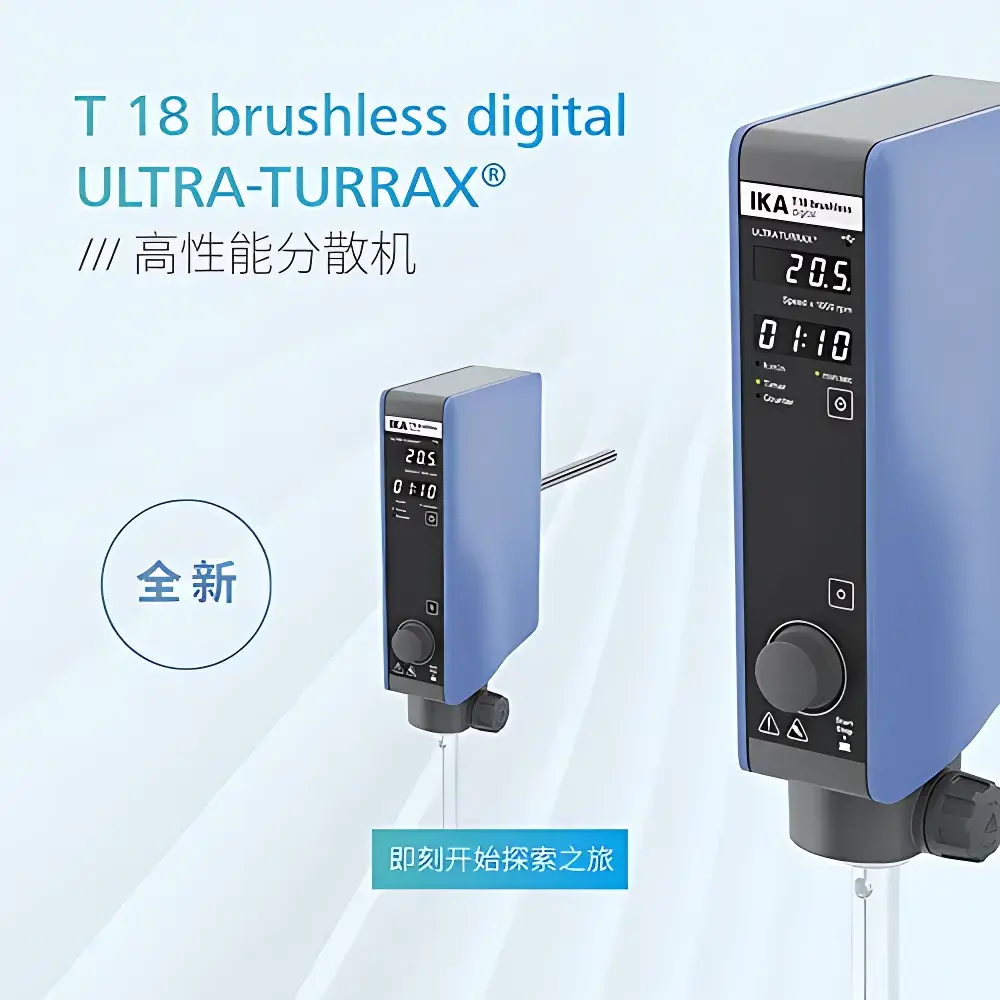
IKA T 18 Brushless Digital ULTRA-TURRAX® Disperser
| Brand | IKA |
|---|---|
| Origin | Germany |
| Manufacturer Type | Original Equipment Manufacturer (OEM) |
| Origin Category | Imported |
| Model | T 18 Brushless Digital ULTRA-TURRAX® |
| Motor Input Power | 400 W |
| Motor Output Power | 300 W |
| Volume Range (H₂O) | 0.001–1.5 L |
| Max. Viscosity | 5000 mPa·s |
| Speed Range | 3000–25,000 rpm |
| Speed Accuracy | ±2 % |
| Speed Control | Continuously Variable |
| Speed Display | LED Digital |
| Timer Function | Yes |
| Timer Display | LED |
| Continuous Duty Cycle | 100 % |
| Noise Level (no dispersing tool) | 70 dB(A) |
| Motor Principle | Brushless DC Motor |
| Extension Arm Diameter | 13 mm |
| Extension Arm Length | 160 mm |
| Process Type | Batch |
| IP Rating | IP 30 (DIN EN 60529) |
| USB Interface | Yes |
| Voltage | 220–240 V |
| Frequency | 50/60 Hz |
| Dimensions (W×H×D) | 89 × 270 × 161 mm |
| Weight | 3 kg |
| Ambient Temperature Range | 5–40 °C |
| Relative Humidity Limit | ≤80 % RH |
Overview
The IKA T 18 Brushless Digital ULTRA-TURRAX® Disperser is a high-performance, digitally controlled batch dispersing system engineered for precision homogenization, emulsification, dispersion, and suspension of liquid-phase samples in research, quality control, and pilot-scale laboratory environments. Based on high-shear rotor-stator hydrodynamic principle, the instrument generates intense mechanical energy through controlled rotational motion—enabling efficient particle size reduction, phase integration, and colloidal stabilization. Its brushless DC motor eliminates commutator wear, ensuring long-term torque consistency, minimal electromagnetic interference, and reduced maintenance intervals. Designed for ISO/IEC 17025-compliant laboratories, the T 18 integrates seamlessly into GLP- and GMP-aligned workflows where reproducibility, auditability, and equipment traceability are critical.
Key Features
- Brushless DC motor delivering stable output power (300 W) across full speed range (3000–25,000 rpm), with <2 % speed deviation under load
- Digital LED interface for real-time monitoring of set speed, actual speed, timer status, and operational mode
- Integrated electronic timer (0.1 s–99 h 59 min 59 s) supporting unattended operation with automatic shutdown
- Quick-release coupling system compatible with standardized ULTRA-TURRAX® dispersing tools—enabling tool changes in <5 seconds without tools
- USB port compliant with USB 2.0 standards, enabling bidirectional communication with labworldsoft® software for remote parameter setting, data logging, and firmware updates
- Robust aluminum housing with IP 30 ingress protection (DIN EN 60529), optimized for ambient conditions between 5–40 °C and ≤80 % RH non-condensing
- Full continuous-duty rating (100 % duty cycle) validated per IEC 60034-1, suitable for extended processing cycles without thermal derating
Sample Compatibility & Compliance
The T 18 supports aqueous, organic, and mildly corrosive media within viscosity limits up to 5000 mPa·s. Its modular tool architecture accommodates a broad spectrum of sample volumes—from 1 mL microsamples (using S-type microdispersing tools) to 1500 mL macro-batches (with R-series high-capacity rotors). All stainless-steel dispersing tools conform to ASTM F899-22 for corrosion-resistant martensitic stainless steel; disposable polypropylene tools meet USP Class VI biocompatibility requirements. The system complies with electromagnetic compatibility (EMC) per EN 61326-1:2013 and electrical safety per EN 61010-1:2010. For regulated environments, labworldsoft® enables 21 CFR Part 11-compliant user authentication, electronic signatures, and audit-trail generation when paired with appropriate IT infrastructure.
Software & Data Management
labworldsoft® serves as the native control and documentation platform for the T 18. It provides synchronized parameter logging—including timestamped speed profiles, timer events, and USB session metadata—with export options to CSV, PDF, or XML formats. The software supports multi-instrument configuration management, method template libraries, and role-based access control (RBAC) for SOP enforcement. Raw operational data (e.g., motor current draw, thermal sensor feedback) is accessible via API for integration into LIMS or MES systems. All firmware updates are digitally signed and version-locked to prevent unauthorized modification—a requirement for FDA-regulated analytical method validation.
Applications
- Preparation of nanosuspensions and lipid nanoparticles (LNPs) for pharmaceutical formulation development
- Stabilization of pigment dispersions in coatings, inks, and cosmetic emulsions
- Cell lysis and nucleic acid extraction protocols requiring shear-controlled disruption
- Homogenization of polymer blends and composite precursors prior to rheological or thermal analysis
- Standardized sample preparation for ASTM D4290 (particle size distribution by laser diffraction) and ISO 13320 compliance testing
- QC release testing of suspensions, creams, and ointments per USP and
FAQ
Is the dispersing tool included with the T 18 host unit?
No—the dispersing tools (e.g., S18N-10G, R18N-15F) are sold separately and must be selected based on application-specific requirements including volume, viscosity, and material compatibility.
Can the T 18 operate continuously for >8 hours?
Yes—the motor and electronics are rated for indefinite continuous operation at rated load, provided ambient temperature remains within 5–40 °C and ventilation is unobstructed.
Does the USB interface support direct connection to a networked PC running Windows Server?
Yes—labworldsoft® is certified for Windows 10/11 and Windows Server 2016/2019/2022; network deployment requires domain-joined configuration and Group Policy Object (GPO) management for security policy enforcement.
Are replacement brushes required during maintenance?
No—this model uses a brushless DC motor; there are no carbon brushes to replace, eliminating scheduled brush maintenance and associated downtime.
What standards govern the accuracy verification of speed control?
Speed accuracy (±2 %) is verified per ISO 5725-2:2019 for repeatability and intermediate precision, using traceable optical tachometry calibrated against NIST SRM 2034.



