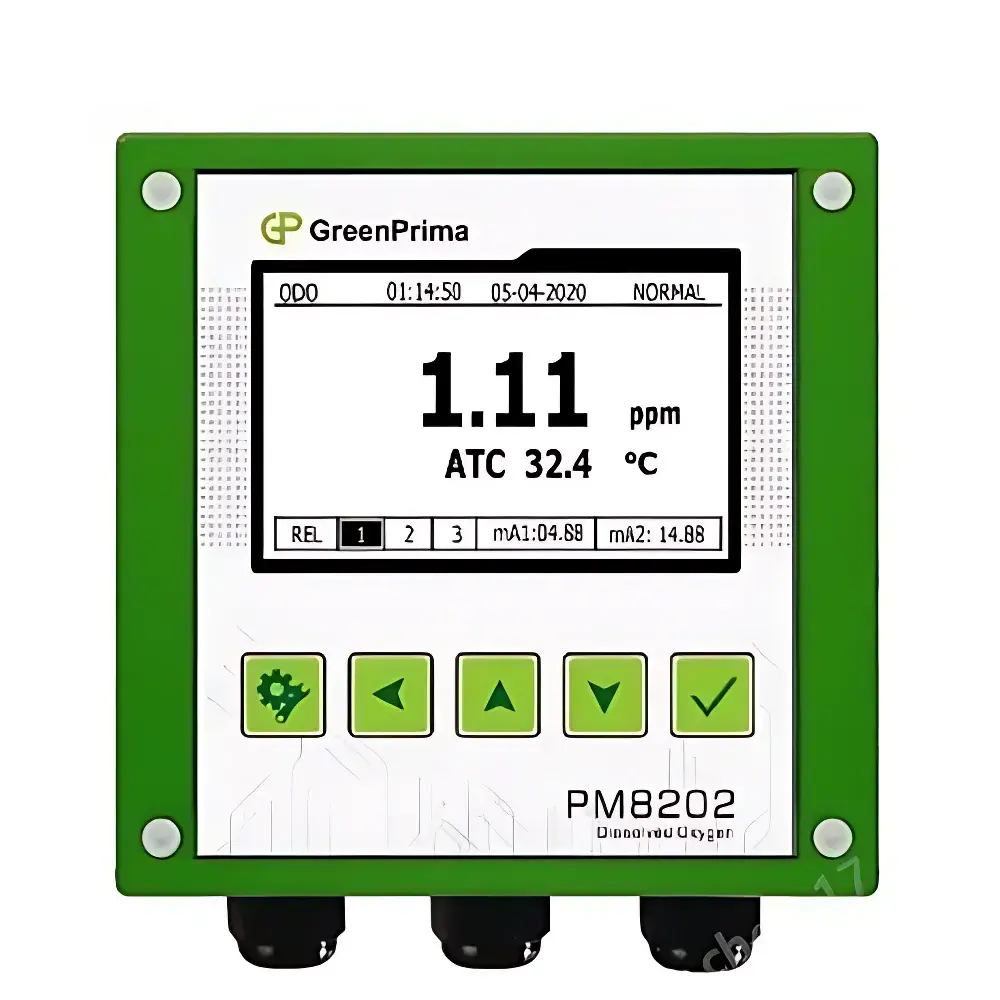
GreenPrima PM8202D Online Polarographic Dissolved Oxygen Analyzer
| Brand | GreenPrima |
|---|---|
| Origin | United Kingdom |
| Manufacturer Type | Original Equipment Manufacturer (OEM) |
| Product Category | Imported Instrument |
| Model | PM8202D |
| Measurement Range | 0.00–20.00 ppm / 0.00–200.00 ppb |
| Resolution | 0.001 ppm / 0.01 ppb |
| Temperature Compensation | −10 to 130 °C (manual/automatic |
| Communication Interface | RS485 Modbus RTU |
| Dimensions | 144 × 144 × 108 mm |
| Operating Temperature | −10 to 70.0 °C |
| Storage Temperature | −20 to 70.0 °C |
| Accuracy | ±0.02 ppm / ±0.02 ppb |
| Display | Backlit dot-matrix LCD (dual-language: English/Chinese) |
| Data Storage | 600,000 records |
| Power Supply | 90–260 VAC, 50/60 Hz or optional 24 VDC |
| Analog Outputs | Two isolated 4–20 mA outputs (max. loop resistance 500 Ω, accuracy 0.1% FS) |
| Cleaning Output | Adjustable interval (0.1–1000 h) and duration (1–1000 s) |
| Alarm Outputs | Two independent Hi/Lo relay outputs (5 A / 250 VAC / 30 VDC) |
| Enclosure Rating | IP65 |
| Mounting Options | Wall-mount, panel-mount, pipe-mount |
| Cutout Size | 138 × 138 mm |
| Weight | 0.87 kg |
Overview
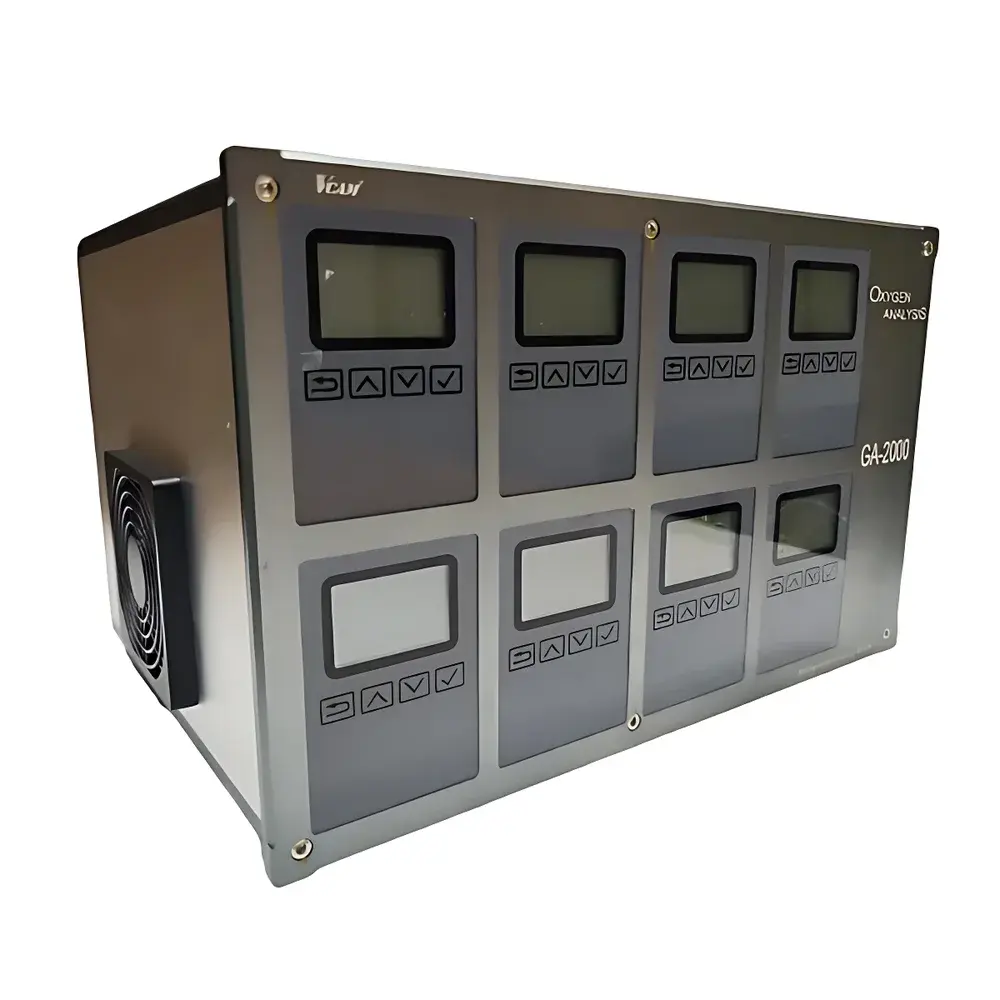
The GreenPrima PM8202D Online Polarographic Dissolved Oxygen Analyzer is an industrial-grade process analyzer engineered for continuous, real-time monitoring of dissolved oxygen (DO) concentration in aqueous systems. It operates on the Clark polarographic principle—a well-established electrochemical method in which molecular oxygen diffuses through a gas-permeable membrane (typically Teflon or polyethylene) and is reduced at a noble metal cathode (e.g., gold or platinum) under a fixed polarizing voltage. The resulting diffusion-limited current is linearly proportional to the partial pressure of oxygen in the sample, enabling precise quantification of DO in ppm or ppb units. Designed for integration into demanding water treatment, bioprocessing, and power generation infrastructure, the PM8202D delivers stable, drift-resistant measurements across wide temperature gradients and variable flow conditions—without requiring frequent recalibration when maintained per manufacturer guidelines.
Key Features
- Robust IP65-rated enclosure with full waterproof and gas-tight sealing, certified for deployment in humid, corrosive, or splash-prone environments.
- High-resolution dual-range measurement: 0.00–20.00 ppm (±0.02 ppm accuracy) and 0.00–200.00 ppb (±0.02 ppb accuracy), with resolution down to 0.001 ppm and 0.01 ppb respectively.
- Intelligent temperature compensation supporting both manual input and automatic sensing via NTC10K or PT1000 probes across −10 to 130 °C—critical for maintaining measurement fidelity during sterilization-in-place (SIP) or pasteurization cycles.
- Dual isolated 4–20 mA analog outputs configurable for DO concentration and/or temperature signals, compliant with IEC 61000-6-2/4 electromagnetic compatibility standards.
- RS485 Modbus RTU interface for seamless integration into DCS, SCADA, or PLC-based control architectures—supporting standard function codes (03h, 06h, 10h) and configurable baud rates (9.6–115.2 kbps).
- Configurable cleaning cycle output with independently adjustable interval (0.1–1000 hours) and duration (1–1000 seconds), facilitating automated maintenance in fouling-prone applications such as wastewater influent or fermentation broth.
- Two programmable relay alarms with user-defined setpoints, hysteresis control, and dry-contact ratings up to 5 A @ 250 VAC—suitable for initiating pump shutdowns, aeration control, or alarm annunciation.
- Password-protected configuration menu prevents unauthorized parameter changes, supporting audit-ready operational integrity in regulated environments.
Sample Compatibility & Compliance
The PM8202D is compatible with a range of interchangeable polarographic sensors—including the Bsens420 (general-purpose), Bsens430 (low-flow/low-conductivity), and Bsens440 (high-temperature/sterilizable)—enabling application-specific optimization without controller replacement. Its measurement performance aligns with ASTM D888-20 (Standard Test Methods for Dissolved Oxygen in Water) and ISO 5814:2012 (Water quality — Determination of dissolved oxygen — Electrochemical probe method). While not intrinsically safe, the unit meets CE marking requirements under the EU Electromagnetic Compatibility Directive 2014/30/EU and Low Voltage Directive 2014/35/EU. For GMP or GLP-regulated facilities, the device supports 21 CFR Part 11-compliant data logging when paired with validated third-party software platforms that implement electronic signatures, audit trails, and user access controls.
Software & Data Management
The embedded firmware stores up to 600,000 timestamped records—including DO value, temperature reading, system status flags, and relay event logs—in non-volatile memory. Data export is supported via Modbus polling or optional USB-to-serial adapter (not included). GreenPrima provides a Windows-compatible configuration utility for initial setup, calibration validation, and firmware updates. All logged data adhere to UTC timestamps synchronized via internal RTC, ensuring traceability across multi-site deployments. Optional cloud gateway modules (sold separately) enable MQTT-based telemetry to industrial IoT platforms, supporting predictive maintenance analytics based on sensor drift trends and cleaning event frequency.
Applications
- Municipal and industrial wastewater treatment plants—monitoring aeration basins, secondary clarifiers, and effluent discharge points.
- Drinking water distribution networks—verifying residual DO levels post-chlorination and detecting stagnation-induced anaerobic zones.
- Pharmaceutical bioreactors and clean steam systems—ensuring oxygen control within USP and EP 2.2.47 specifications for purified water and water-for-injection (WFI).
- Food & beverage fermentation tanks—maintaining optimal DO setpoints during yeast propagation, lactic acid production, or monoclonal antibody synthesis.
- Power plant condensate and boiler feedwater systems—detecting air ingress and preventing oxygen-induced corrosion per ASME PTC 19.11 and VGB-R 450 Leitfaden guidelines.
- Aquaculture recirculating aquaculture systems (RAS)—safeguarding fish health through continuous hypoxia detection and automated oxygen dosing feedback.
FAQ
What electrochemical principle does the PM8202D employ?
It utilizes the Clark-type polarographic method, relying on oxygen diffusion through a selective membrane and subsequent reduction at a polarized cathode.
Is the instrument suitable for high-purity water applications?
Yes—when paired with the Bsens440 sensor and operated under low-flow, low-conductivity conditions, it meets the sensitivity and contamination control requirements for pharmaceutical-grade water systems.
Does the analyzer support automatic temperature compensation?
Yes—via integrated NTC10K or external PT1000 sensors, with compensation applied across the full −10 to 130 °C range.
How often must the electrolyte be replaced in the sensor?
Typical replacement intervals range from 3 to 6 months depending on operating temperature, flow velocity, and sample matrix; GreenPrima recommends quarterly verification using zero-oxygen and saturated-air standards.
Can the PM8202D be integrated into a Modbus TCP network?
No—the built-in interface is RS485 Modbus RTU only; Modbus TCP requires an external protocol converter or gateway device.
What mounting options are available for field installation?
Three mechanical configurations are supported: wall-mounted (with integrated bracket), panel-mounted (138 × 138 mm cutout), and pipe-mounted (using optional clamp kits for DN25–DN100 pipes).