
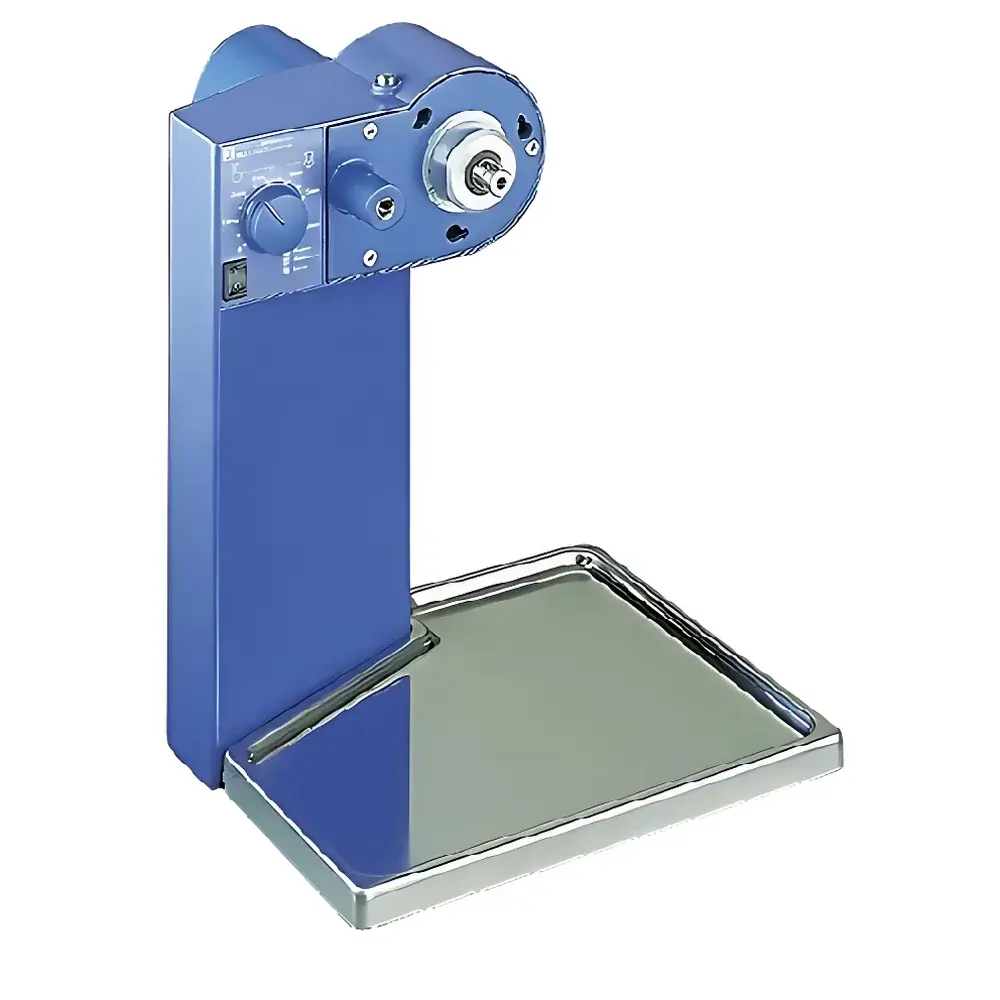
IKA MF 10 basic Microfine Grinder Drive
| Brand | IKA |
|---|---|
| Origin | Germany |
| Manufacturer | IKA Werke GmbH & Co. KG |
| Product Type | Benchtop Microfine Grinder |
| Model | MF 10 basic |
| Input Power | 1000 W |
| Output Power | 500 W |
| Speed Range | 3000–6500 rpm |
| Max. Feed Size | <15 mm |
| Final Particle Size | 0.01–0.5 mm (typical output ≤0.25 mm with appropriate sieve) |
| Continuous Operation Time | up to 120 min |
| Cooling | Optional dry ice cooling in grinding chamber |
| Dimensions (W×D×H) | 320 × 380 × 300 mm |
| Weight | 9.7 kg |
| Ambient Operating Temperature | 5–40 °C |
| Relative Humidity Limit | ≤80 % RH |
| Protection Class | IP22 (DIN EN 60529) |
| Voltage/Frequency | 230 V / 50 Hz or 115 V / 60 Hz |
| Grinding Principle | High-speed shear and impact |
| Material Contact Parts | Stainless steel (AISI 304) |
| Sieve & Grinding Head | Sold separately |
Overview
The IKA MF 10 basic Microfine Grinder Drive is a robust, continuously operating benchtop grinder engineered for reproducible size reduction of hard, brittle, and medium-hard solid samples in research laboratories, quality control environments, and pilot-scale R&D workflows. It operates on a high-efficiency rotor-stator principle combining controlled mechanical shear and impact forces—ideal for achieving fine to ultra-fine particle distributions without thermal degradation when used with optional dry ice cooling. Designed and manufactured in Staufen, Germany, the MF 10 basic adheres to IKA’s long-standing engineering standards for precision, safety, and serviceability. Its stainless-steel grinding chamber and modular drive architecture ensure compatibility with diverse sample matrices while supporting routine maintenance and component replacement per ISO 9001-aligned production protocols.
Key Features
- High-torque, brushless motor delivering 500 W mechanical output from a 1000 W electrical input—optimized for sustained operation under load
- Variable speed control (3000–6500 rpm) enabling precise adjustment of energy input to match material hardness and target particle size distribution
- Stainless-steel (AISI 304) grinding chamber and feed hopper—corrosion-resistant, non-reactive, and compliant with GLP cleaning validation requirements
- Dry ice cooling interface integrated into the grinding chamber—enables cryogenic grinding of thermolabile or polymeric materials to prevent agglomeration and heat-induced phase changes
- IP22-rated enclosure (DIN EN 60529)—provides protection against vertically falling drips and solid objects >12.5 mm, suitable for standard laboratory ambient conditions (5–40 °C, ≤80 % RH)
- Modular design: grinding heads and sieves are field-replaceable components—no tools required for rapid changeover between applications or maintenance intervals
Sample Compatibility & Compliance
The MF 10 basic is validated for processing hard and medium-hard solids including minerals, pharmaceutical tablets, ceramic precursors, polymer granules, and botanical materials. It accepts feed particles up to 15 mm in maximum dimension and delivers consistent sub-250 µm output when paired with appropriate sieve inserts (sold separately). The system complies with DIN EN 61000-6-3 (EMC emission limits) and DIN EN 61000-6-2 (immunity), and its construction meets the mechanical safety requirements of EN 61000-1-2. While not intrinsically rated for ATEX environments, its grounding design and non-sparking stainless-steel contact surfaces support safe operation in general-purpose labs handling non-explosive powders. Documentation supports traceability per ISO/IEC 17025 for method validation and equipment qualification.
Software & Data Management
The MF 10 basic operates as a stand-alone analog instrument with manual speed and timing controls—no embedded firmware or digital interface. This architecture eliminates software validation overhead and ensures deterministic performance in regulated environments where electronic record integrity (e.g., FDA 21 CFR Part 11) is not required. All operational parameters—including speed setting, run duration, and cooling status—are manually recorded in lab notebooks or LIMS-integrated log sheets. For users requiring audit-ready documentation, IKA provides calibration certificates (traceable to DAkkS-accredited standards) and preventive maintenance logs aligned with ISO/IEC 17025 Annex A.5 and GMP Annex 15 guidelines.
Applications
- Pharmaceutical pre-formulation: reducing active pharmaceutical ingredients (APIs) and excipients to defined particle size ranges for dissolution testing (USP )
- Materials science: preparing homogeneous powder batches for XRD, SEM-EDS, or laser diffraction analysis (ISO 13320)
- Food & agriculture QC: grinding cereal grains, spices, or feed pellets for proximate analysis (AOAC 991.22, ISO 6540)
- Environmental testing: homogenizing soil or sediment composites prior to heavy metal extraction (EPA Method 3050B)
- Polymer R&D: cryo-grinding thermoplastics for rheological or DSC characterization without melt history interference
FAQ
Is the MF 10 basic suitable for wet grinding?
No. The MF 10 basic is designed exclusively for dry grinding applications. Liquid introduction may damage the motor, compromise electrical insulation, and violate IP22 ingress protection specifications.
Are grinding heads and sieves included with the base unit?
No. All grinding heads (e.g., knife, toothed disc, or serrated rotor variants) and interchangeable sieves (ranging from 0.01 mm to 1.0 mm aperture) are optional accessories ordered separately to match application-specific particle size targets.
Can the MF 10 basic be integrated into automated sample preparation workflows?
Not natively. It lacks digital I/O, RS-232/USB ports, or programmable logic controller (PLC) interfaces. Integration requires external relay-based control systems and manual operator oversight per SOP-defined safety interlocks.
What maintenance schedule is recommended for routine use?
IKA recommends visual inspection before each use, lubrication of the drive shaft bearing every 500 operating hours, and full disassembly/cleaning after every 2000 hours—or immediately following abrasive or hygroscopic sample processing.
Does IKA provide method development support for particle size optimization?
Yes. Upon request, IKA Application Laboratories supply documented grinding protocols—including speed/sieve combinations, cooling strategies, and replicate precision data—for common material classes under ISO 5725-2 repeatability criteria.



