
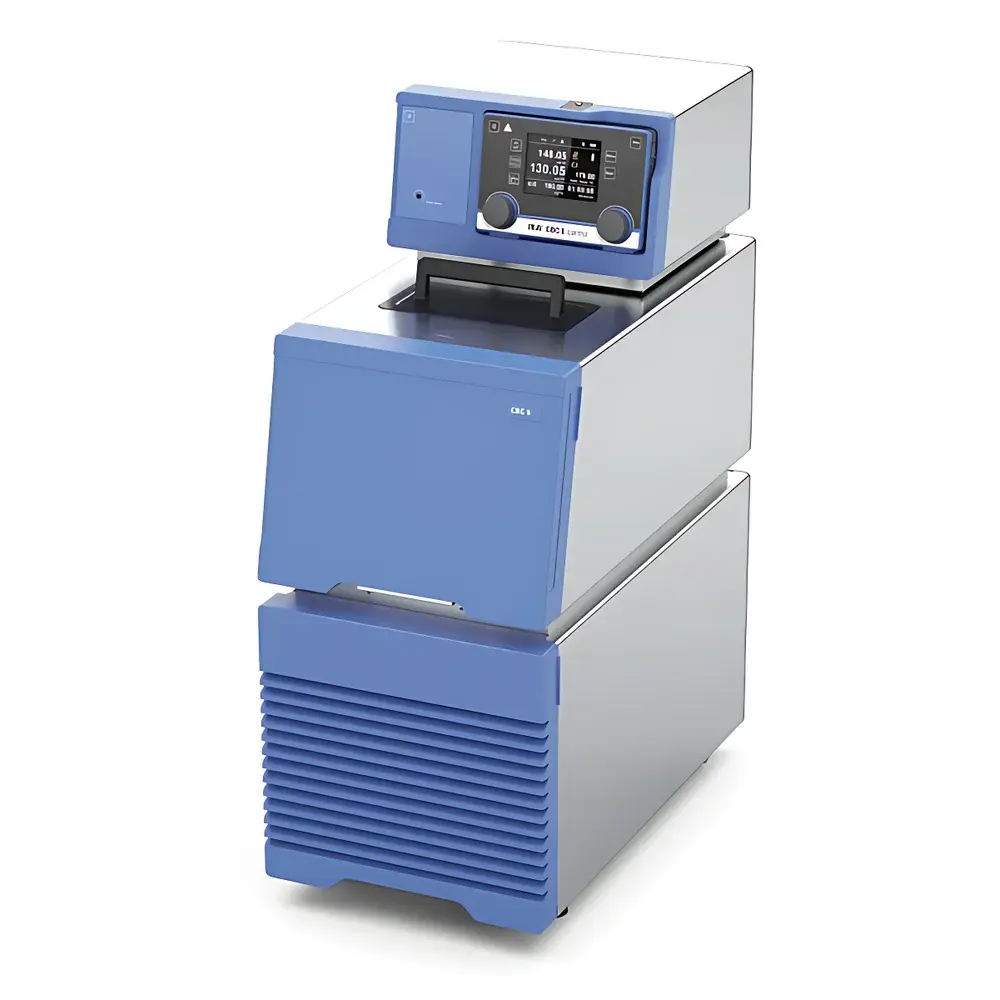
IKA CBC 5 control Refrigerated/Heating Circulator
| Brand | IKA |
|---|---|
| Origin | Germany |
| Manufacturer | IKA-Werke GmbH & Co. KG |
| Type | CBC 5 control |
| Instrument Category | Refrigerated/Heating Circulator (Water/Oil Bath) |
| Circulation Mode | Internal & External |
| Temperature Control | Dual-mode (Cooling & Heating) |
| Bath Volume | 7 L |
| Temperature Range | −25 °C to +200 °C |
| Temperature Stability | ±0.02 °C (@ +70 °C, DIN 12876) |
| Heating Power | 2500 W |
| Cooling Capacity | 400 W (@ 20 °C) |
| Input Power | 3000 W |
| Supply Voltage | 230 V (50/60 Hz) |
| Pump Type | Pressure/Suction Pump |
| Max. Flow Rate | 31 L/min (at 0 bar backpressure) |
| Max. Pressure | 0.61 bar |
| Safety Class | DIN 12876 Class III (FL) |
| Refrigerant | R134a |
| Protection Rating | IP21 |
| Dimensions (W×H×D) | 275 × 690 × 490 mm |
| Weight | 40.0 kg |
Overview
The IKA CBC 5 control is a high-precision refrigerated/heating circulator engineered for demanding laboratory applications requiring stable, wide-range temperature control across both cryogenic and elevated thermal regimes. Based on closed-loop thermofluid circulation, the unit employs a dual-stage thermal management system combining a high-efficiency compressor-based cooling circuit with a robust resistive heating element. Its operational range of −25 °C to +200 °C—enabled by optimized heat exchanger design, low-viscosity compatible coolant (R134a), and advanced PID control with dual PT100 sensing—is validated per DIN 12876 for Class III FL (Flammable Liquids) safety compliance. The device delivers ±0.02 °C temperature stability at +70 °C (per DIN 12876), making it suitable for calibration-critical workflows, reaction temperature control in synthetic chemistry, and thermal conditioning of analytical instrumentation such as HPLC columns or viscometers.
Key Features
- Integrated pressure/suction pump with fully adjustable flow rate (0–31 L/min) and digital speed control—enabling precise delivery to external jackets, reactors, or condensers.
- TFT color display with real-time visualization of setpoint, actual bath temperature, pump speed, safety limits, and alarm status—supporting intuitive operation and rapid diagnostics.
- Dual-sensor architecture: primary PT100 working sensor + redundant PT1000 safety sensor—ensuring fail-safe thermal monitoring and automatic shutdown upon deviation.
- Configurable safety temperature loop (adjustable 0–260 °C), audible/visual alarms for over-temperature, under-temperature, low fluid level, and pump fault conditions.
- Multi-interface connectivity: RS232 and USB ports for integration with lab automation systems; compatible with IKA’s labworldsoft® software for remote parameter setting, data logging, and firmware updates.
- Modular design with removable WiCo wireless controller—allowing safe operation outside fume hoods or gloveboxes without compromising access or control fidelity.
- High-performance thermal insulation and low-thermal-mass bath chamber—reducing energy consumption during ramp-up and minimizing ambient heat exchange at sub-zero temperatures.
Sample Compatibility & Compliance
The CBC 5 control is designed for use with water, water-glycol mixtures, silicone oils, and other low-volatility heat transfer fluids rated for operation between −25 °C and +200 °C. Its DIN 12876 Class III FL certification confirms suitability for handling flammable liquids (e.g., ethanol, acetone, or xylene-based baths) under controlled conditions. The unit meets IP21 ingress protection requirements and complies with EN 61000-6-3 (EMC emission) and EN 61000-6-2 (immunity). All electrical components adhere to EN 61010-1 safety standards for laboratory equipment. Optional external PT100 probe input enables accurate temperature feedback directly from the sample environment—critical for GLP/GMP-aligned processes where traceability and audit readiness are mandatory.
Software & Data Management
labworldsoft® provides full bidirectional communication via RS232 or USB, supporting configuration, real-time monitoring, and time-stamped data export (CSV/Excel). The software implements configurable logging intervals, user-access levels, and event-triggered alerts. When deployed in regulated environments, the system supports 21 CFR Part 11-compliant electronic records through optional digital signature modules and audit trail activation—facilitating validation documentation for pharmaceutical QC labs or contract research organizations. Firmware updates are delivered securely over USB, preserving instrument integrity and ensuring long-term compatibility with evolving laboratory IT infrastructure.
Applications
- Temperature control of jacketed glass reactors (1–5 L scale) in organic synthesis and catalysis studies.
- Thermal stabilization of HPLC autosamplers, column ovens, and detector cells to ensure retention time reproducibility.
- Calibration of thermometers, RTDs, and thermocouples per ISO/IEC 17025 requirements using traceable bath uniformity verification.
- Cooling of rotary evaporators and vacuum distillation systems operating near solvent boiling points.
- Material testing setups requiring controlled thermal cycling (e.g., polymer rheology, thermal expansion coefficient measurement).
- Integration into automated platforms via NAMUR-standard commands for process synchronization in pilot-scale development labs.
FAQ
What is the minimum and maximum bath fluid volume supported?
The unit operates optimally within a 5–7 L fluid capacity range; operation below 5 L may compromise pump priming and temperature homogeneity.
Can the CBC 5 control be used with silicone oil at 200 °C?
Yes—provided the selected oil meets flash point and thermal stability specifications exceeding 220 °C and exhibits viscosity ≤ 50 cSt at 200 °C.
Is external temperature feedback mandatory for accurate control?
No, but highly recommended for applications where bath temperature ≠ sample temperature; the PT100 input enables cascade control mode for superior sample-side accuracy.
Does the device support networked operation or Ethernet connectivity?
No native Ethernet port is included; however, RS232-to-Ethernet gateways may be deployed externally for TCP/IP integration.
How often does the refrigerant require servicing or replacement?
Under normal operating conditions and proper maintenance (e.g., avoiding contamination, regular filter checks), the sealed R134a system requires no scheduled refrigerant replenishment over its service life.



