
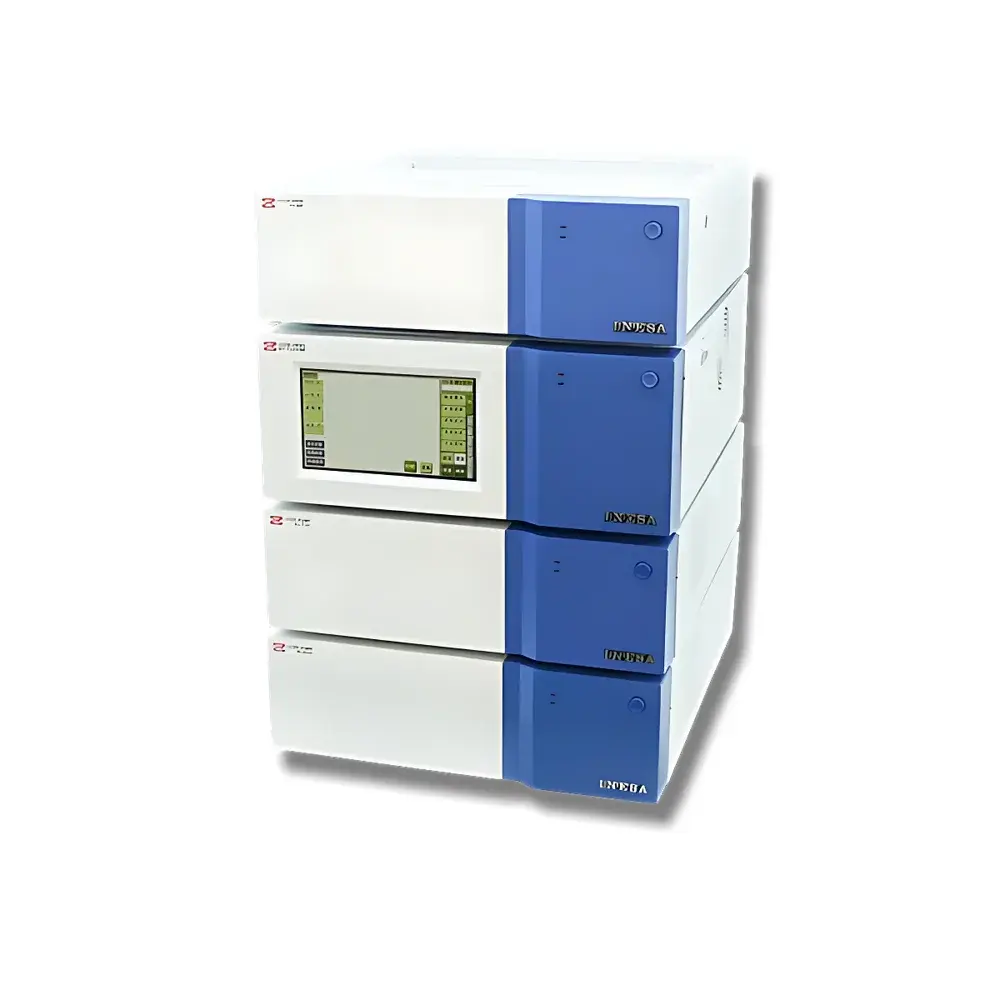
LC220 High-Performance Liquid Chromatograph (HPLC)
| Brand | 1124123/13213112 |
|---|---|
| Origin | Jiangsu, China |
| Manufacturer Type | Authorized Distributor |
| Instrument Type | Conventional HPLC System |
| Application Scope | General-Purpose Analytical Use |
| Pump Configuration | Reciprocating Dual-Piston Isocratic or Binary High-Pressure Gradient Capable |
| Detector | UV-Vis with Variable Wavelength (VWL) Capability |
| Column Oven | PID-Controlled Temperature Regulation |
| Data Acquisition | 24-bit ADC, Low-Drift Preamp, Integrated Touchscreen Workstation (Audit Trail Optional) |
| Compliance Readiness | GLP/GMP-Aligned Architecture, FDA 21 CFR Part 11–Ready Software Framework |
Overview
The LC220 High-Performance Liquid Chromatograph is a modular, general-purpose analytical HPLC system engineered for precision separation and quantitative detection of thermally labile, non-volatile, and high-molecular-weight compounds. Based on the principle of differential partitioning between a mobile phase (liquid solvent) and a stationary phase (packed chromatographic column), the LC220 enables robust resolution of complex mixtures—particularly those unsuitable for gas chromatography due to low volatility, thermal instability, or polarity constraints. Its design adheres to fundamental chromatographic performance criteria: consistent flow delivery, minimal baseline noise, reproducible retention time stability (<0.15% RSD over 24 h), and linear dynamic range exceeding 10⁴ for UV absorbance detection. The system operates across standard analytical workflows—from method development and validation to routine QC release testing—supporting compliance-driven environments in pharmaceutical, food safety, environmental monitoring, and academic research laboratories.
Key Features
- High-stability dual-piston reciprocating pump with pressure rating up to 40 MPa (400 bar), integrated pulse-dampening accumulator for <±0.1% flow ripple under isocratic conditions.
- UV-Vis detector featuring deuterium lamp source with spectral range 190–700 nm, variable wavelength scanning capability, and thermally isolated optical path to minimize ambient temperature drift (±0.02 °C stability).
- PID self-tuning column oven with temperature range 5–85 °C and uniformity ±0.2 °C across 30 cm column length.
- Integrated 7-inch capacitive touchscreen interface running embedded Linux-based workstation software; supports local method storage, real-time chromatogram display, peak integration, and export in ASTM E131-compliant .cdf format.
- Modular detector cell design with removable flow cell (10 mm pathlength, 1 µL volume) and tool-free access for cleaning or replacement.
- Intelligent leak and blockage diagnostics: real-time pressure monitoring with configurable alarm thresholds, automatic seal-wash cycle scheduling for pump heads, and status logging with timestamped event records.
- Expandable architecture: compatible with optional autosamplers (up to 120-position tray), fraction collectors, and post-column derivatization modules.
Sample Compatibility & Compliance
The LC220 accommodates a broad spectrum of sample matrices—including aqueous extracts, organic solvent solutions, biological fluids (serum, urine), polymer digests, and environmental water extracts—when paired with appropriate column chemistries (e.g., C18, phenyl-hexyl, HILIC, or ion-exchange). It meets mechanical and electrical safety requirements per IEC 61010-1 and electromagnetic compatibility standards EN 61326-1. For regulated environments, the embedded software supports audit trail activation (user login, method modification history, data reprocessing logs), electronic signature configuration, and secure data archiving—aligning with FDA 21 CFR Part 11, EU Annex 11, and ISO/IEC 17025 documentation integrity expectations. Column hardware complies with ASTM D7114 and USP dimensional tolerances.
Software & Data Management
The LC220’s native software provides full instrument control, sequence definition, real-time data acquisition, and post-run processing (baseline correction, tangent skim, peak purity assessment via spectral overlay). Raw data files are stored in vendor-neutral formats compliant with ASTM E131 and AnIML standards. Optional software modules enable method transfer validation reports (per ICH Q2(R2)), system suitability test automation (USP parameters), and integration with LIMS via HL7 or RESTful API. All user actions—including parameter edits, calibration events, and report generation—are timestamped and attributable, satisfying GLP and GMP traceability requirements.
Applications
- Pharmaceutical: Assay and impurity profiling of APIs per ICH Q5, Q6, and Q7 guidelines; dissolution testing support; stability-indicating method development.
- Food & Beverage: Pesticide residue quantification (AOAC 2007.01), mycotoxin analysis (aflatoxins, ochratoxin A), vitamin and antioxidant profiling.
- Environmental: Detection of PAHs, PCBs, pharmaceuticals in wastewater (EPA Method 1694), and perfluoroalkyl substances (PFAS) in drinking water.
- Clinical & Biomedical: Quantification of therapeutic drugs (e.g., tacrolimus, vancomycin) in plasma; metabolite screening in urine using reversed-phase and hydrophilic interaction modes.
- Materials Science: Molecular weight distribution analysis of synthetic polymers via SEC/GPC when equipped with appropriate columns and calibration standards.
FAQ
What is the maximum operating pressure of the LC220 pump system?
The dual-piston high-pressure pump is rated for continuous operation up to 40 MPa (400 bar), supporting sub-2 µm particle columns and UHPLC-compatible methods.
Does the LC220 support gradient elution?
Yes—it can be configured as a binary high-pressure gradient system using two independently controlled pumps and a low-dead-volume mixing chamber.
Is the software compliant with FDA 21 CFR Part 11?
The embedded workstation includes optional audit trail, electronic signature, and role-based access control modules—fully configurable to meet Part 11 technical and procedural requirements.
Can the detector perform wavelength scanning during a run?
Yes—the UV-Vis detector supports time-programmed wavelength switching and full-spectrum acquisition at user-defined intervals (e.g., every 0.5 s), enabling peak purity evaluation.
What column oven temperature accuracy is achievable?
The PID-controlled oven maintains setpoint accuracy within ±0.2 °C across the full 5–85 °C range, verified per ISO 17025 temperature calibration protocols.




