
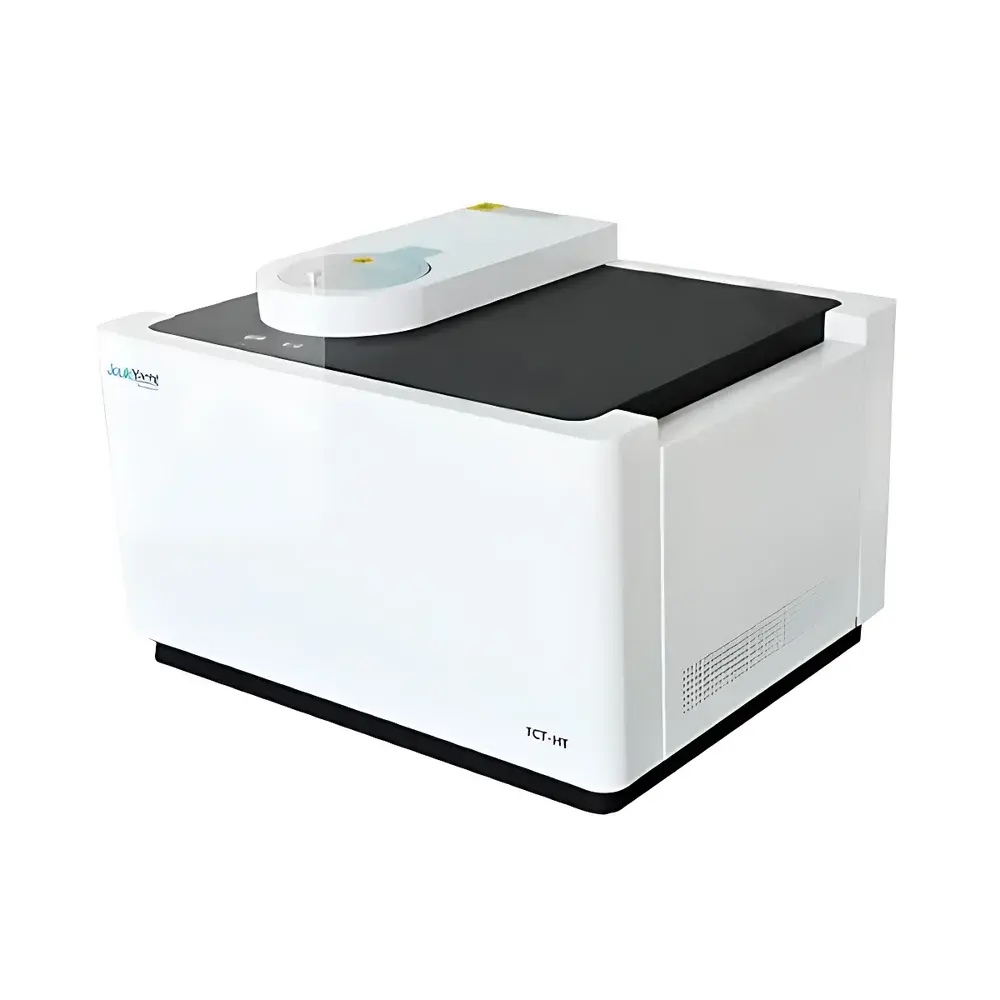
Aiyao TCT Thin-Film Thermal Conductivity Measurement System
| Brand | Aiyao Instruments |
|---|---|
| Model | TCT |
| Measurement Principle | 3ω Method |
| Sample Form | Micro/Nano Thin Films (Supported & Freestanding) |
| Temperature Range | Ambient to 400 °C (Optional Cryogenic Extension Available) |
| Thermal Conductivity Range | 0.1–1000 W/(m·K) |
| Resolution | <0.5% of Full Scale |
| Data Acquisition | High-Precision Digital Source Meter + Dual-Phase Lock-in Amplifier |
| Compliance | ASTM E1461, ISO 22007-2 (Adapted), GLP-Compatible Audit Trail Logging |
Overview
The Aiyao TCT Thin-Film Thermal Conductivity Measurement System is a precision benchtop instrument engineered for quantitative thermal transport characterization of microscale and nanoscale thin-film materials. It implements the well-established 3ω technique—a frequency-domain, AC-based method rooted in electrothermal coupling theory—where a metallic heater line (typically Pt or Ti/Au) serves simultaneously as resistive heater and thermometer. When driven with a sinusoidal current at angular frequency ω, Joule heating occurs at 2ω, inducing a temperature oscillation at the same frequency. Due to the temperature-dependent resistance of the heater, a third-harmonic (3ω) voltage component emerges, whose amplitude and phase are directly related to the thermal conductivity (k) and volumetric heat capacity (ρcp) of the underlying film/substrate system. Unlike steady-state methods such as guarded hot plate or laser flash, the 3ω approach delivers high spatial resolution (<10 µm lateral definition), minimal thermal contact resistance influence, and intrinsic sensitivity to interfacial thermal conductance (Ginterfacial). The TCT system is designed for laboratory environments requiring traceable, repeatable, and substrate-coupled thermal property evaluation under controlled ambient or variable-temperature conditions.
Key Features
- Integrated 3ω measurement architecture with dual-phase lock-in detection, enabling sub-microvolt signal resolution and rejection of broadband electrical noise.
- Modular temperature control stage with PID-regulated heating and optional liquid-nitrogen-cooled cryostat support (−196 °C to 400 °C), ensuring precise thermal ramping and isothermal stability (±0.05 °C).
- Custom-designed microfabricated heater/sensor electrodes—optimized for uniform current density distribution and minimized edge effects—available in standard configurations (10–50 µm width, 100–500 µm length) and compatible with lift-off or e-beam lithography patterning.
- High-accuracy digital source meter (DSM) with 4-quadrant operation, 10 fA current resolution, and 100 nV voltage sensitivity—fully synchronized with the lock-in amplifier via TTL triggering.
- Rigid optical-grade aluminum frame with vibration-damping mounts and EMI-shielded enclosure, minimizing mechanical drift and electromagnetic interference during long-duration measurements.
- Pre-calibrated reference standards included (e.g., SiO2/Si, AlN/Si, sapphire substrates) for in-situ verification of system response and k-value traceability to NIST-traceable references.
Sample Compatibility & Compliance
The TCT system accommodates a broad spectrum of thin-film geometries and material systems, including but not limited to: metal films (Cu, Al, Ni, W), dielectric layers (SiO2, Al2O3, HfO2), semiconductors (Si, Ge, GaN, MoS2), thermoelectrics (Bi2Te3, Sb2Te3), and polymer-based barrier coatings. Both supported films (on Si, quartz, or sapphire wafers) and freestanding membranes (transferred onto micromachined frames) can be characterized. All hardware and firmware comply with ASTM E1461–22 (“Standard Test Method for Thermal Diffusivity of Solids by the Flash Method”) adapted for thin-film interpretation, and ISO 22007–2:2015 (“Plastics — Determination of Thermal Conductivity and Thermal Diffusivity — Part 2: Transient Plane Source (Hot Disk) Method”) principles as applied to 3ω-derived k-values. Data acquisition logs include full metadata (timestamp, setpoint, ambient RH, operator ID) and support GLP/GMP audit trail requirements per FDA 21 CFR Part 11 when configured with user authentication and electronic signature modules.
Software & Data Management
The proprietary TCT Control Suite (v4.2+) runs on Windows 10/11 and provides real-time visualization of 3ω voltage magnitude/phase, heater resistance drift, and thermal decay fitting residuals. Automated routines execute multi-point temperature sweeps, harmonic order validation (ω, 2ω, 3ω), and simultaneous extraction of k and ρcp using analytical solutions for one-dimensional heat conduction in layered media. Raw data are stored in HDF5 format with embedded calibration coefficients and exportable to MATLAB, Python (via h5py), or CSV for third-party modeling (e.g., phonon transport simulations). Software includes built-in uncertainty propagation engine per GUM (JCGM 100:2018), reporting expanded uncertainties (k=2) for each k-value based on source meter accuracy, lock-in gain stability, temperature sensor tolerance, and electrode geometry tolerances.
Applications
- Thermal management R&D for advanced IC packaging—quantifying k degradation in low-k dielectrics and interfacial thermal resistance (ITR) at Cu/dielectric boundaries.
- Development of high-efficiency thermoelectric thin films—correlating lattice thermal conductivity suppression with nanostructuring and grain boundary engineering.
- Reliability assessment of optical coating stacks—measuring thermal expansion mismatch-induced delamination thresholds via in-situ k vs. T monitoring.
- Fundamental studies of phonon transport in 2D materials—resolving thickness-dependent k collapse in transition metal dichalcogenides and graphene derivatives.
- Process qualification of ALD/CVD-deposited barrier layers—validating thermal integrity after plasma exposure or thermal cycling protocols.
FAQ
What sample preparation is required for 3ω testing on the TCT system?
Standard preparation involves depositing a linear metal heater (e.g., 20 nm Ti/80 nm Au) onto the film surface via e-beam evaporation or sputtering, followed by photolithography and lift-off. Substrate backside metallization is optional but recommended for improved signal-to-noise ratio in low-conductivity films.
Can the TCT system measure cross-plane versus in-plane thermal conductivity?
Yes—the configuration supports both orientations: cross-plane measurement uses a suspended membrane design with heater on top; in-plane measurement employs a two-terminal heater-strip geometry on planar substrates with lateral heat diffusion modeling.
Is calibration traceable to national metrology institutes?
Reference measurements are validated against NIST SRM 1470a (sapphire) and certified SiO2/Si standards; full calibration certificates—including uncertainty budgets—are provided with each system shipment.
Does the software support automated compliance reporting for ISO/IEC 17025 laboratories?
Yes—audit trail logging, electronic signatures, version-controlled method files, and raw-data immutability features are enabled by default and configurable to meet ILAC P15 and ISO/IEC 17025:2017 documentation requirements.
Related Products



