
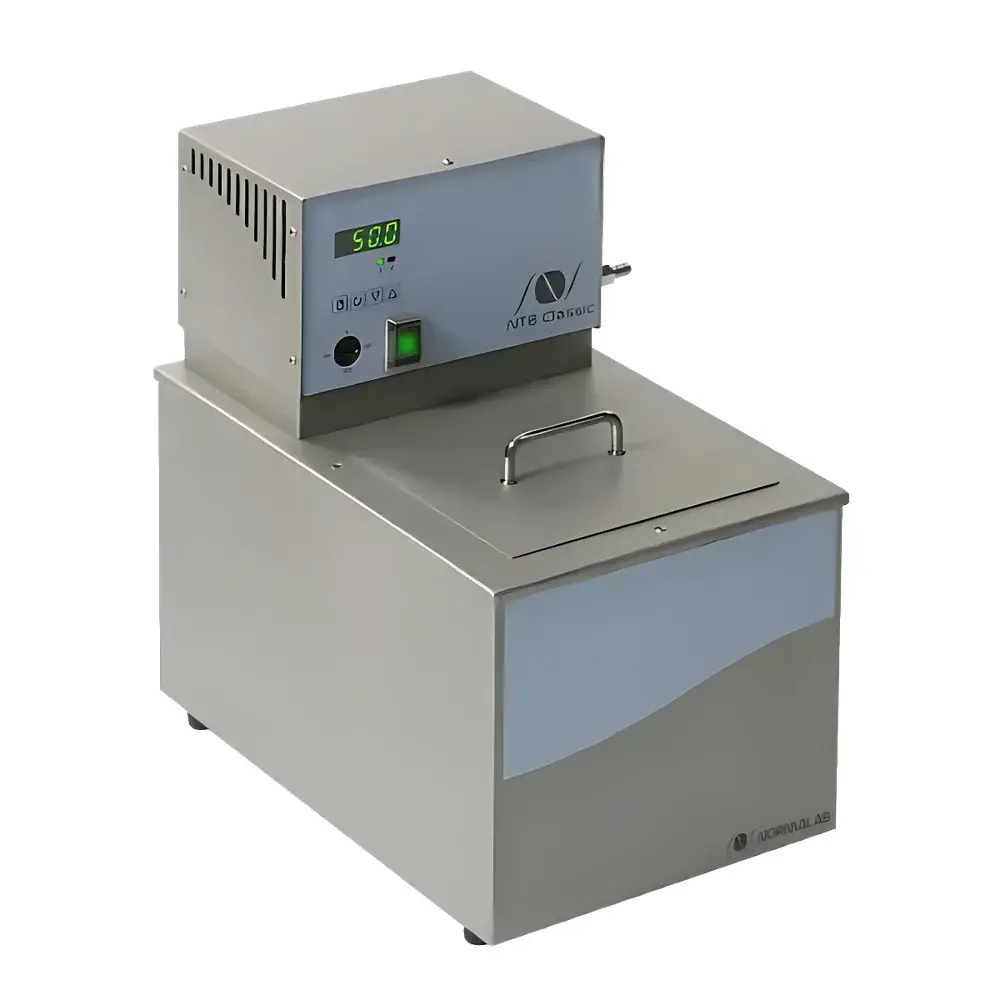
NTB Classic Copper Strip Corrosion Tester by NORMALAB
| Brand | NORMALAB |
|---|---|
| Origin | France |
| Model | NTB Classic |
| Temperature Range | Ambient to 250 °C |
| Temperature Accuracy | ±0.1 °C |
| Temperature Repeatability | ±0.02 °C |
| Temperature Display Resolution | 0.1 °C |
| Controller Precision | 0.01 °C |
| Test Positions | 6–9 |
| Compliance | ASTM D130, ASTM D4048, ISO 2160, IP 154, DIN 51759, NF M 07-015, GB/T 5096, SH/T 0023 |
Overview
The NTB Classic Copper Strip Corrosion Tester is a precision-engineered benchtop instrument designed for quantitative assessment of corrosivity in petroleum products toward copper and silver metals under controlled thermal conditions. Based on the standardized copper strip corrosion test principle—where a polished, dimensionally specified copper strip is immersed in a sample and heated for a defined duration—the instrument enables visual and comparative evaluation of surface discoloration, tarnish, or staining per established rating scales (e.g., ASTM D130’s 1a–4c classification). The method relies on accelerated corrosion kinetics induced by elevated temperature and time, providing a reproducible indicator of active sulfur compounds (e.g., mercaptans, elemental sulfur, sulfides) and other corrosive species present in hydrocarbon-based fuels and lubricants. Its dual-capability design supports both copper strip (ASTM D130, ISO 2160, GB/T 5096) and silver strip (ASTM D4048) testing protocols, making it essential for quality assurance in aviation turbine fuel certification, refinery QC labs, and third-party petroleum testing facilities.
Key Features
- Stable, digitally regulated heating bath with PID-controlled immersion zone, maintaining uniform thermal distribution across all test positions
- High-resolution temperature controller (±0.01 °C setpoint accuracy) and independent digital display (0.1 °C resolution) for traceable thermal validation
- Modular test block accommodating 6–9 individual test tubes—each fitted with precision-machined brass or stainless-steel holders to ensure consistent immersion depth and orientation
- Corrosion-resistant chamber construction using anodized aluminum and PTFE-coated internal surfaces to prevent cross-contamination and thermal degradation
- Integrated safety interlocks including overtemperature cutoff, automatic power-down after cycle completion, and insulated external housing compliant with IEC 61010-1
- Calibration-ready architecture supporting NIST-traceable thermometer verification at multiple points within the operating range (ambient to 250 °C)
Sample Compatibility & Compliance
The NTB Classic is validated for use with a broad spectrum of petroleum-derived materials, including aviation gasoline (AVGAS), jet fuels (Jet A, Jet A-1, JP-5, JP-8), automotive gasoline, naphthas, kerosene, diesel fuels (EN 590, ASTM D975), distillate heating oils, solvent naphthas, and lubricating base oils. It fully supports the sample preparation, immersion geometry, and timing requirements specified in ASTM D130 (copper strip) and ASTM D4048 (silver strip), as well as harmonized international standards including ISO 2160, IP 154, DIN 51759, NF M 07-015, GB/T 5096, and SH/T 0023. All operational parameters—including bath temperature stability, strip dimensions (ASTM E29-compliant tolerances), and exposure duration—are aligned with GLP and ISO/IEC 17025 laboratory accreditation requirements. Documentation packages include factory calibration certificates, compliance matrices, and standard operating procedure (SOP) templates suitable for FDA 21 CFR Part 11–aligned environments where audit trails are mandated.
Software & Data Management
While the NTB Classic operates as a stand-alone hardware platform without embedded software, its thermal control architecture is compatible with external data acquisition systems via analog 4–20 mA or RS-485 Modbus RTU interfaces (optional adapter module available). Users may integrate real-time temperature logging into LIMS or ELN platforms using industry-standard protocols. All test records—including start/end timestamps, setpoint values, observed bath temperatures at 15-min intervals, and operator-assigned corrosion ratings—are manually documented in accordance with ASTM D130 Section 9 and ISO/IEC 17025 clause 7.5. Traceability is reinforced through unique test position labeling, serialized strip identification, and dual-signature logbook entries. For laboratories implementing electronic recordkeeping, NORMALAB provides editable PDF SOPs and Excel-based reporting templates pre-formatted to meet internal QA review and external auditor expectations.
Applications
- Refinery final product release testing for gasoline, diesel, and jet fuel batches prior to pipeline transfer or storage
- Investigation of sulfur scavenger efficiency in hydrotreated feedstocks and post-treatment monitoring
- Compatibility screening of fuel additives, biocomponents (e.g., FAME, HVO), and oxygenates against copper-containing engine components
- Root-cause analysis of field-reported fuel system corrosion incidents involving fuel injectors, pumps, or heat exchangers
- Supporting ASTM D1655 Annex A1 and DEF STAN 91-91 compliance verification for military aviation fuel procurement
- Research-grade evaluation of corrosion inhibition mechanisms in novel lubricant formulations under simulated service conditions
FAQ
What is the maximum allowable sample vapor pressure for ASTM D130 testing on the NTB Classic?
Samples must exhibit a Reid Vapor Pressure (RVP) ≤ 124 kPa (18 psi) as specified in ASTM D130 Section 5.1. Higher-volatility samples require depressurized handling or alternative test methods (e.g., ASTM D525 for oxidation stability).
Can the NTB Classic perform simultaneous copper and silver strip tests?
Yes—provided strips are loaded into separate, chemically inert test tubes and assigned distinct positions. Silver strip testing (ASTM D4048) requires strict exclusion of halogenated solvents and adherence to 50 °C/4 h or 100 °C/2 h exposure profiles.
Is calibration verification required before each test series?
Per ISO/IEC 17025 and ASTM D130 Section 7.2, temperature verification using a calibrated reference thermometer is mandatory prior to initiating any test batch, with documented evidence retained for audit purposes.
How does the NTB Classic ensure repeatability across multiple operators?
Through fixed immersion depth guides, standardized strip polishing protocols (per ASTM D130 Appendix X1), and position-specific thermal profiling—validated during installation qualification (IQ) and operational qualification (OQ) procedures.




