
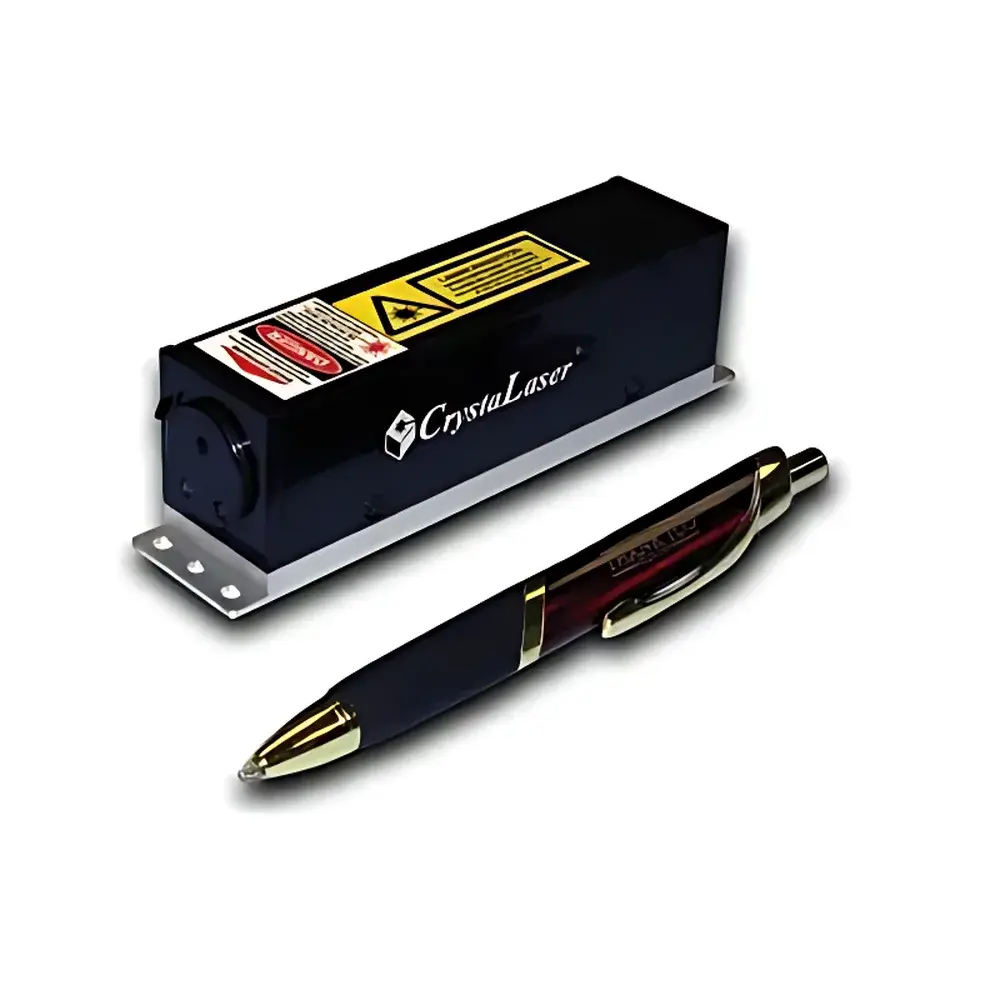
CrystaLaser QL Series Q-Switched Infrared Lasers
| Brand | CrystaLaser |
|---|---|
| Origin | USA |
| Manufacturer Type | Authorized Distributor |
| Product Category | Imported Optical Instrument |
| Model Numbers | QL1064, QL1053, QL1047, QL946, QL1122, QL1313, QL1319, QL1338, QL1342, QL1444 |
| Max. Avg. Power | 2000 mW (model-dependent) |
| Max. Pulse Energy (at 1 kHz) | 0.60 mJ |
| Avg. Power Options | 100–2000 mW (custom higher powers available) |
| Pulse Width | 7–100 ns (typ. 15–30 ns) |
| Repetition Rate | 1–100 kHz (internally adjustable) |
| Transverse Mode | TEM₀₀, M² < 1.2 (typ. < 1.1) |
| Beam Diameter (1/e²) | 0.5 mm |
| Beam Divergence (full angle) | 3–4 mrad |
| Longitudinal Mode | Single longitudinal mode (coherence length option available) |
| Power Stability (rms) | ≤3% after thermal stabilization |
| Beam Pointing Stability | < 0.02 mrad (isothermal conditions) |
| Polarization | Linear, extinction ratio ≥100:1 |
Overview
The CrystaLaser QL Series comprises a family of diode-pumped, actively Q-switched solid-state infrared lasers engineered for high-precision pulsed operation across multiple fundamental wavelengths in the near- to mid-infrared spectrum. Unlike gas-based or fiber-integrated systems, these lasers utilize Nd:YAG, Nd:YLF, and Nd:YVO₄ gain media with electro-optic or acousto-optic Q-switching to deliver nanosecond-scale pulses with exceptional temporal stability and beam quality. The series supports discrete emission lines—including 946 nm, 1047 nm, 1053 nm, 1064 nm, 1122 nm, 1313 nm, 1319 nm, 1338 nm, 1342 nm, and 1444 nm—each optimized for specific material interaction profiles, making them suitable for applications requiring wavelength-selective ablation, time-resolved spectroscopy, or nonlinear frequency conversion.
Key Features
- Actively Q-switched architecture ensuring precise pulse timing control and minimal jitter (< 1 ns RMS)
- TEM₀₀ transverse mode with M² < 1.2 (typically < 1.1), enabling diffraction-limited focusing for high-intensity applications
- Narrow spectral bandwidth ( 1 m)
- Internally adjustable repetition rate from 1 kHz to 100 kHz; full external triggering support from DC to 500 kHz with TTL/CMOS compatibility
- Stable linear polarization (extinction ratio ≥100:1) maintained over full power and repetition rate range
- Integrated thermoelectric cooling and precision temperature stabilization for long-term power stability (≤3% rms after 30-min warm-up)
- Compact OEM-ready housing with standardized 19-mm or 25-mm optical aperture, compatible with industrial laser mounting platforms
Sample Compatibility & Compliance
The QL Series is designed for integration into regulated laboratory and industrial environments. All models comply with IEC 60825-1:2014 Class 4 laser safety requirements when operated within specified parameters. Beam delivery configurations meet ANSI Z136.1 standards for alignment and interlock interface provisions. While not inherently GLP/GMP-certified as standalone instruments, the lasers support audit-ready system integration through optional analog/digital monitoring outputs (pulse count, power monitor, temperature feedback) and RS-232/USB communication for traceable operational logging. Documentation packages include full test reports (power vs. rep-rate, pulse width distribution, beam profile M² maps) aligned with ISO 11146-1/-2 for beam characterization.
Software & Data Management
CrystaLaser provides the QL Control Suite—a cross-platform (Windows/macOS/Linux) application enabling real-time parameter adjustment, pulse train visualization, and automated calibration routines. The software supports SCPI command protocol for seamless integration into LabVIEW, MATLAB, or Python-based automation frameworks. Critical operational data—including pulse energy history, thermal drift logs, and interlock event timestamps—are stored in CSV-compliant structured files with ISO 8601 timestamping. For FDA-regulated workflows, optional firmware upgrade enables 21 CFR Part 11-compliant electronic signatures, audit trails, and user-role access controls when deployed with validated host systems.
Applications
- Laser-induced breakdown spectroscopy (LIBS) requiring stable ns-pulse energy at 1064 nm or 1053 nm for elemental analysis of metals, soils, and ceramics
- Optical parametric oscillator (OPO) pumping where narrow linewidth and high peak power (>1 MW) enable efficient tunable IR generation
- Time-of-flight mass spectrometry (TOF-MS) ion source excitation demanding sub-30 ns pulses with shot-to-shot energy stability <2%
- Micro-machining of polymers and thin-film photovoltaics using 946 nm or 1342 nm radiation for reduced thermal damage zones
- Single-photon counting experiments leveraging long-coherence options for interferometric pump-probe setups
- Calibration of high-speed photodetectors and streak cameras via precisely timed trigger synchronization
FAQ
Can pulse energy be optimized for non-standard repetition rates?
Yes—CrystaLaser offers custom pulse energy tuning for user-specified repetition rates outside standard ranges. This includes optimization of Q-switch drive voltage, cavity alignment, and thermal management profiles.
Is single longitudinal mode operation available for all wavelengths?
SLM operation is standard on 1064 nm and 1053 nm models; it is optionally available on other wavelengths (e.g., 1319 nm, 1342 nm) with extended cavity design and active mode selection electronics.
What cooling method is used, and what are ambient operating limits?
All QL lasers employ thermoelectric (Peltier) cooling with closed-loop temperature regulation. Ambient operating range is 15–30 °C; operation above 30 °C requires forced-air assist or liquid cooling interface (available upon request).
Are OEM mechanical and electrical interfaces documented?
Yes—mechanical drawings (STEP/IGES), pinout schematics, and power supply specifications are provided under NDA for qualified OEM integrators.
Do these lasers support remote diagnostics and firmware updates?
Firmware updates are performed via USB or RS-232; diagnostic telemetry (diode current, crystal temperature, output power monitor signal) is accessible in real time through the QL Control Suite or SCPI interface.





