
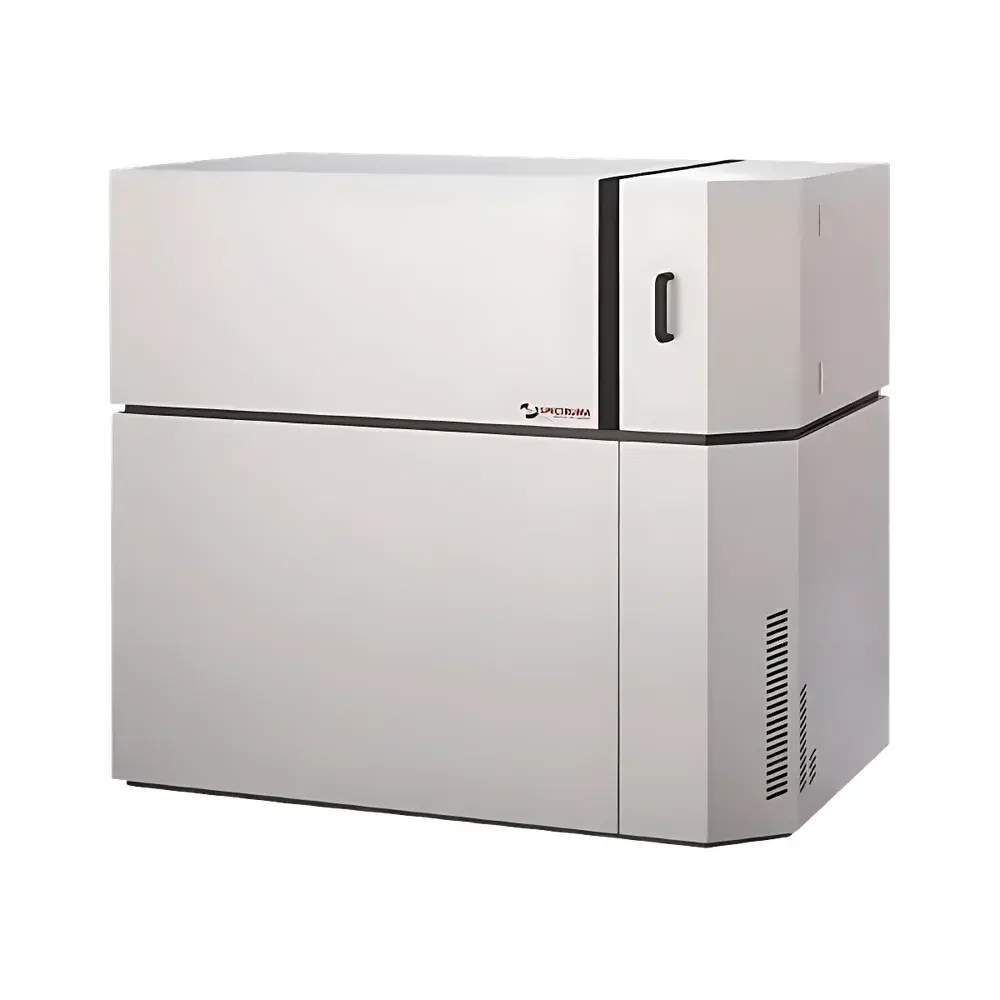
SPECTRUMA GDA 750 / GDA 550 Glow Discharge Optical Emission Spectrometer
| Brand | SPECTRUMA |
|---|---|
| Origin | Germany |
| Model | GDA 750 / GDA 550 |
| Detection Principle | Glow Discharge Optical Emission Spectroscopy (GD-OES) |
| Spectral Range | 190–800 nm (standard PMT system) |
| Spectral Resolution | <20 pm FWHM (PMT) |
| Optical System | Paschen-Runge mount, 750 mm focal length, holographically ruled grating (2400 lines/mm) |
| Max. Analytical Depth | >200 µm |
| Depth Resolution | ≤1 nm |
| Elemental Coverage | H, O, N, Cl, C, and all elements from Li to U |
| Detection Limits | Sub-ppm (matrix-dependent) |
| Sputter Diameter | 1–8 mm (adjustable, same source) |
| DC Source | Up to 1500 V, 250 mA, fully programmable |
| RF Source | Up to 150 W, pulsed mode optional (GDA 750 only) |
| Sample Thickness Range | 50 µm – 45 mm |
| Vacuum System | Dual-stage rotary vane pump (<50 dB), oil-free pump for source chamber |
| Optional Accessories | High-resolution CCD optical system, RF pulse generator, load-lock transfer chamber, 100-position autosampler, monochromator with triple-grating turret |
Overview
The SPECTRUMA GDA 750 and GDA 550 are high-performance glow discharge optical emission spectrometers engineered for quantitative depth profiling and bulk compositional analysis of conductive and non-conductive solid materials. Based on the fundamental principle of Grimm-type glow discharge excitation, these instruments generate a stable low-pressure plasma in an argon atmosphere, inducing controlled sputtering of the sample surface while simultaneously exciting sputtered atoms into emissive states. The emitted optical radiation is dispersed via a high-fidelity Paschen-Runge spectrometer and detected either by photomultiplier tubes (PMTs) or an optional high-resolution CCD array. This configuration enables simultaneous multi-element detection with exceptional sensitivity, depth resolution, and analytical flexibility—critical for applications demanding rigorous compliance with ISO 14707, ASTM E3061, and EN 10260 standards for coated and layered material characterization.
Key Features
- Modular dual-source architecture: Fully programmable DC power supply (up to 1500 V / 250 mA) and optional pulsed RF generator (150 W, GDA 750 only) for direct analysis of insulators (e.g., ceramics, glasses, polymer films, oxides) without metallization.
- Precision depth resolution: Achieves ≤1 nm layer resolution in sputter-depth profiling, validated per ISO/IEC 17025-accredited protocols, with analytical depth exceeding 200 µm in homogeneous metallic matrices.
- Comprehensive elemental coverage: Quantitative determination of light elements—including H, O, N, C, and Cl—enabled by ultra-high vacuum optics (<10⁻³ mbar), oil-free source pumping, and optimized UV transmission path.
- Hybrid optical detection: Standard 63-channel PMT system with pre-aligned exit slits; optionally expandable to 79 channels (via 400 mm extension), or upgraded to a parallel-readout CCD detector (200–800 nm, 0.02 nm FWHM) for true full-spectrum acquisition and post-acquisition spectral reprocessing.
- Universal sample handling: Motorized electrode adjustment (1–8 mm sputter crater diameter), direct Peltier cooling for thermally sensitive samples (e.g., 50 µm stainless steel foils, organic thin films), and adaptable fixtures accommodating irregular, small, or fragile specimens without custom electrodes.
- Robust vacuum integrity: All-stainless-steel optical chamber with dual-stage rotary vane pump (<50 dB noise) and dedicated oil-free pump for the glow discharge chamber—eliminating hydrocarbon contamination critical for accurate C, H, O, S, and P quantification.
Sample Compatibility & Compliance
The GDA 750/GDA 550 supports direct analysis of metals, alloys, carbides, nitrides, electroplated layers, PVD/CVD coatings, anodized films, and—when equipped with RF excitation—non-conductors such as soda-lime glass, alumina ceramics, polyimide films, and sol-gel derived oxide layers. Its design complies with GLP and GMP data integrity requirements: WinGDOES software provides full 21 CFR Part 11–compliant audit trails, electronic signatures, method version control, and secure user role management. Calibration traceability follows NIST SRM guidelines, and depth-scale validation is supported via certified reference depth profiles (e.g., NIST SRM 2136, BAM 1032). Instrument performance verification adheres to ISO 17025 internal quality control procedures, including daily intensity stability checks and quarterly depth-resolution certification using SiO₂/Si multilayer standards.
Software & Data Management
WinGDOES is a Windows-based platform (Windows 10/11 compatible) delivering end-to-end workflow automation—from method setup and calibration to real-time depth profiling visualization and report generation. It features embedded QDP (Quantitative Depth Profiling) algorithms with matrix-matched standardization, multi-point linear/non-linear calibration models, and automated inter-element interference correction. Data reprocessing allows retrospective application of new calibrations or background subtraction routines without re-measurement. Export formats include CSV, XML, ASTM E1343-compliant .gdo files, and PDF reports with customizable templates compliant with internal QA/QC or customer-specific documentation requirements. Language switching during active measurement ensures operational continuity in multinational laboratory environments.
Applications
- Automotive & aerospace: Quantitative depth profiling of Zn/Ni alloy plating on steel substrates, Al-Si diffusion barriers in turbine blades, and TiN hard coatings on cutting tools.
- Electronics & photovoltaics: Composition mapping of Cu(In,Ga)Se₂ (CIGS) absorber layers, interfacial oxygen ingress in ITO/PET flexible electrodes, and dopant distribution in SiC power devices.
- Surface engineering: Thickness and stoichiometry verification of DLC (diamond-like carbon), CrN, and Al₂O₃ PVD coatings; segregation analysis of grain boundary impurities in high-strength steels.
- Battery materials: Solid-electrolyte interphase (SEI) composition on Li-metal anodes, transition metal dissolution gradients in NMC cathodes after cycling.
- Research & development: In situ oxidation kinetics of nanolaminates, hydrogen trapping behavior in high-entropy alloys, and dopant homogeneity assessment in transparent conducting oxides.
FAQ
Can the GDA 750 analyze non-conductive samples without conductive coating?
Yes—when equipped with the optional pulsed RF source, it enables direct, artifact-free analysis of ceramics, glasses, polymers, and oxides without sputter-induced charging or thermal damage.
What is the minimum detectable thickness for ultrathin films?
The system routinely resolves discrete layers down to 50 nm with quantitative accuracy; sub-10 nm detection is feasible under optimized sputter conditions and signal averaging.
Is depth calibration traceable to international standards?
Yes—depth scale calibration uses certified reference materials (e.g., BAM 1032, NIST SRM 2136) and is verified annually against ISO/IEC 17025–accredited depth-profiling interlaboratory comparisons.
How does the CCD option enhance method development?
The CCD enables retrospective spectral interrogation: users can define new analytical lines, correct for spectral overlaps, or add elements post-acquisition—eliminating the need for re-run measurements.
Does the system support automated batch analysis for production QC?
With the optional 100-position autosampler and scheduled method execution, the GDA 750 supports unattended, GLP-compliant throughput of >50 samples per shift, including automatic drift correction and pass/fail flagging against specification limits.




