
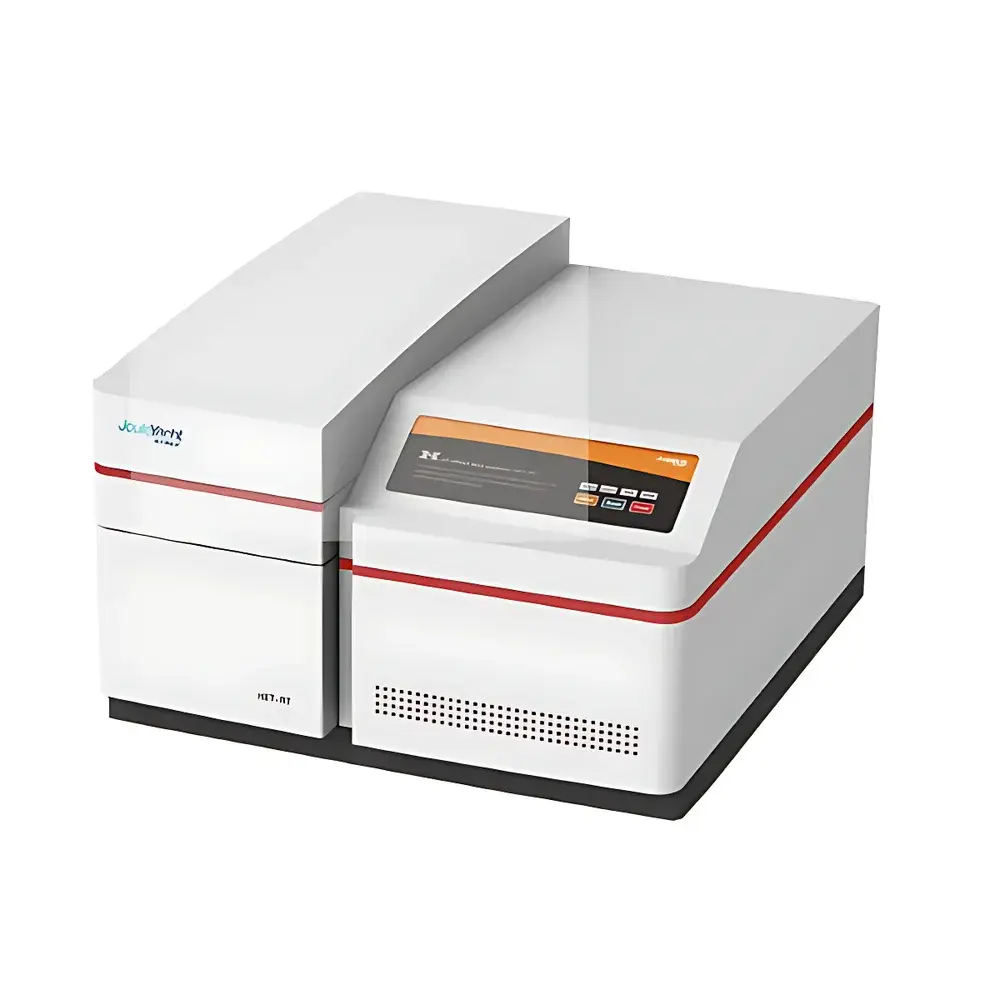
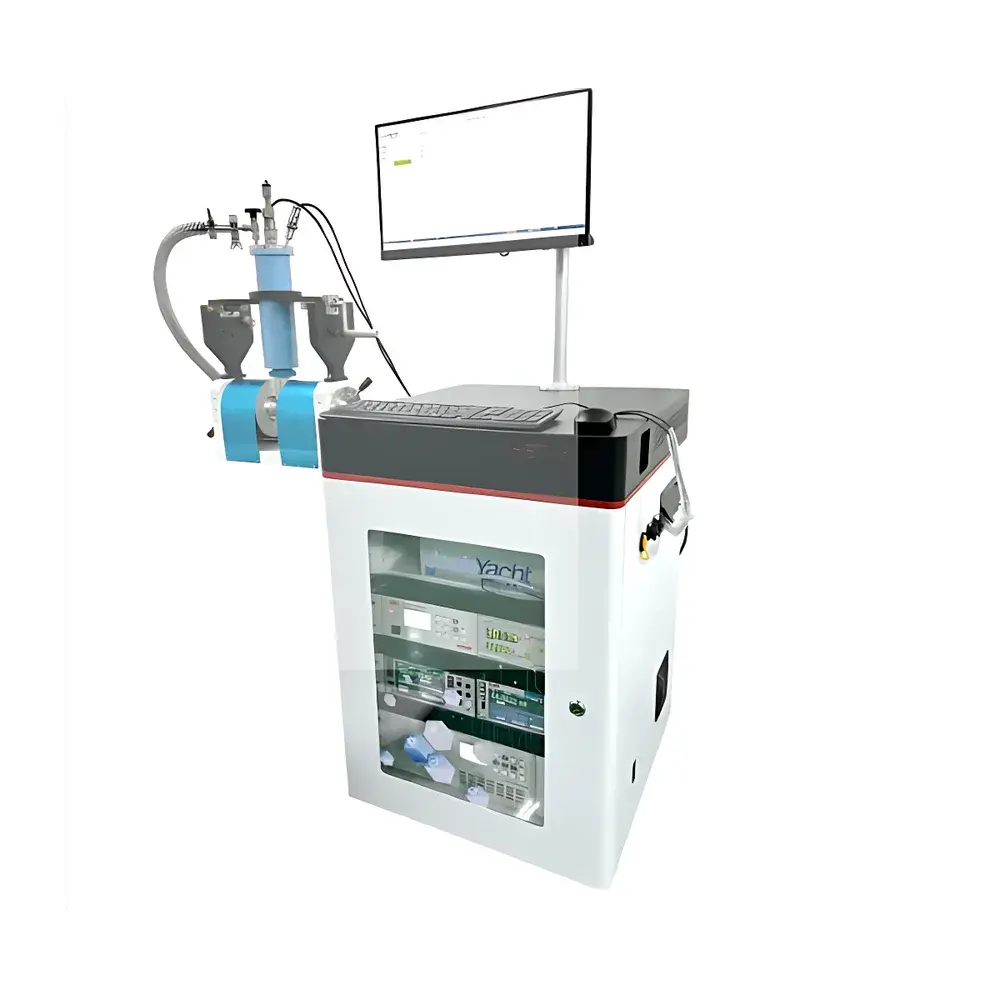
Ayao Instruments HET Variable-Temperature Hall Effect Measurement System
| Brand | Ayao Instruments |
|---|---|
| Origin | Hubei, China |
| Manufacturer Type | Authorized Distributor |
| Origin Category | Domestic (PRC) |
| Model | HET |
| Pricing | Upon Request |
| Instrument Type | Variable-Temperature Hall Effect Tester |
| Measurement Principle | Van der Pauw Method |
| Sample Form | Thin Films & 2D Layers |
| Compatible Materials | Si, ZnO, SiGe, SiC, GaAs, InGaAs, InP, GaN (n-type & p-type) |
| Temperature Range | Cryogenic to 500 K (configurable with optional cryostat or furnace) |
| Magnetic Field Range | ±1.5 T (standard electromagnet), up to ±9 T (with superconducting magnet option) |
| Current Source Accuracy | ±0.05% of reading |
| Voltage Measurement Resolution | 100 nV |
| Data Acquisition Rate | Up to 100 samples/sec per channel |
| Software Compliance | Supports ASTM F76, ISO/IEC 17025 traceability logs, GLP-compliant audit trail (optional) |
Overview
The Ayao Instruments HET Variable-Temperature Hall Effect Measurement System is an engineered platform for quantitative characterization of charge transport properties in semiconductor and conductive thin-film materials. Based on the Van der Pauw geometry and methodology—standardized under ASTM F76 and widely adopted in semiconductor metrology—the system delivers precise, reproducible measurements of Hall coefficient (RH), carrier concentration (n or p), mobility (μ), resistivity (ρ), and conductivity (σ) across a controlled thermal range. Designed for laboratory environments where material physics validation and process development are critical, the HET integrates synchronized current sourcing, magnetic field control, multi-point voltage sensing, and real-time temperature monitoring into a single modular architecture. Its core functionality supports both fundamental research (e.g., band structure analysis, defect-state mapping) and industrial QA/QC workflows requiring traceable, standards-aligned data generation.
Key Features
- Automated dual-polarity current sourcing with programmable reversal intervals, eliminating manual polarity switching errors and enabling symmetric Hall voltage averaging.
- Integrated electromagnet control interface supporting field ramping, dwell, and bidirectional sweep—calibrated to ±0.2% field uniformity over sample area.
- Four-probe, low-noise voltage measurement circuitry with 100 nV resolution and guarded input design to suppress thermal EMF and leakage currents.
- Real-time temperature synchronization: simultaneous acquisition of resistance, Hall voltage, and thermocouple/RTD readings at user-defined setpoints from 4 K to 500 K (dependent on cryostat/furnace configuration).
- Dual-mode operation: fully automated sequence-based measurement routines alongside manual override for exploratory testing and calibration verification.
- Van der Pauw geometry compliance assurance via automatic contact resistance validation and geometric symmetry checks prior to data acquisition.
- Rapid sample mounting fixture compatible with standard 10 × 10 mm to 25 × 25 mm chips; accommodates both evaporated metal contacts and lithographically defined ohmic pads.
Sample Compatibility & Compliance
The HET system is validated for use with epitaxial wafers, sputtered or ALD-deposited thin films, exfoliated 2D materials (e.g., MoS2, graphene), and bulk single crystals prepared in Van der Pauw configuration. It supports n-type and p-type semiconductors—including Si, GaAs, InP, SiC, GaN, ZnO, and SiGe—without hardware modification. All electrical measurements adhere to ASTM F76-22 (“Standard Test Method for Measuring Resistivity and Hall Coefficient of Semiconductor Materials Using the Van der Pauw Configuration”) and align with ISO/IEC 17025 requirements for measurement uncertainty estimation. Optional firmware modules enable 21 CFR Part 11–compliant electronic signatures and audit-trail logging for regulated environments.
Software & Data Management
The proprietary HET Control Suite (v4.2+) provides intuitive workflow-driven operation through a Windows-based GUI. It includes preconfigured test templates for carrier type identification, Arrhenius mobility analysis, and temperature-dependent RH(T) curve fitting. Raw voltage and current data are timestamped, tagged with environmental metadata (temperature, field, time), and stored in HDF5 format for long-term archival and third-party analysis (e.g., Python, MATLAB, Origin). Export options include CSV, XLSX, and image-ready SVG/PNG plots. The software supports automated report generation compliant with internal QA protocols and external review requirements, including traceable calibration certificates and measurement uncertainty budgets.
Applications
- Carrier Type Identification: Determination of majority carrier sign (electrons vs. holes) via Hall coefficient sign analysis—essential for validating doping polarity and identifying compensation effects in heterostructures.
- Quantitative Carrier Concentration Profiling: Extraction of n or p values from RH with temperature-dependent correction for non-parabolic bands and ionization efficiency.
- Mobility Spectroscopy: Separation of scattering mechanisms (ionized impurity, phonon, surface roughness) through μ(T) modeling using Caughey–Thomas or Brooks–Herring formalisms.
- Thermal Activation Energy Estimation: Linear regression of ln(σ) vs. 1/T to determine activation energy of conduction processes in doped or defective layers.
- Process Development Feedback: Correlation of Hall parameters with deposition parameters (e.g., sputter power, anneal ambient) in semiconductor fabrication lines.
FAQ
What sample geometries are supported?
The system requires Van der Pauw–compatible configurations: square or near-square thin films with four ohmic contacts placed at the periphery. Minimum thickness: 10 nm; maximum aspect ratio (L/W): 3:1.
Is cryogenic operation included by default?
No. The base system operates at ambient temperature. Cryogenic capability (4 K–300 K) requires integration with a certified closed-cycle cryostat (optional accessory); high-temperature extension (up to 500 K) uses a resistive furnace module.
Can the HET be integrated into existing lab automation frameworks?
Yes. The system exposes TCP/IP and LabVIEW-compatible DLL APIs for remote command execution, data streaming, and synchronization with other instruments (e.g., probe stations, RF analyzers).
How is measurement uncertainty quantified?
Uncertainty budgets follow GUM (JCGM 100:2008) guidelines and incorporate contributions from current source stability, voltage meter resolution, field homogeneity, temperature sensor drift, and contact geometry deviations—all documented in the calibration certificate.
Does the software support multi-user access control?
Yes. Role-based authentication (admin, operator, reviewer) and session-locked audit trails are available in the GLP-compliant software license tier.






