
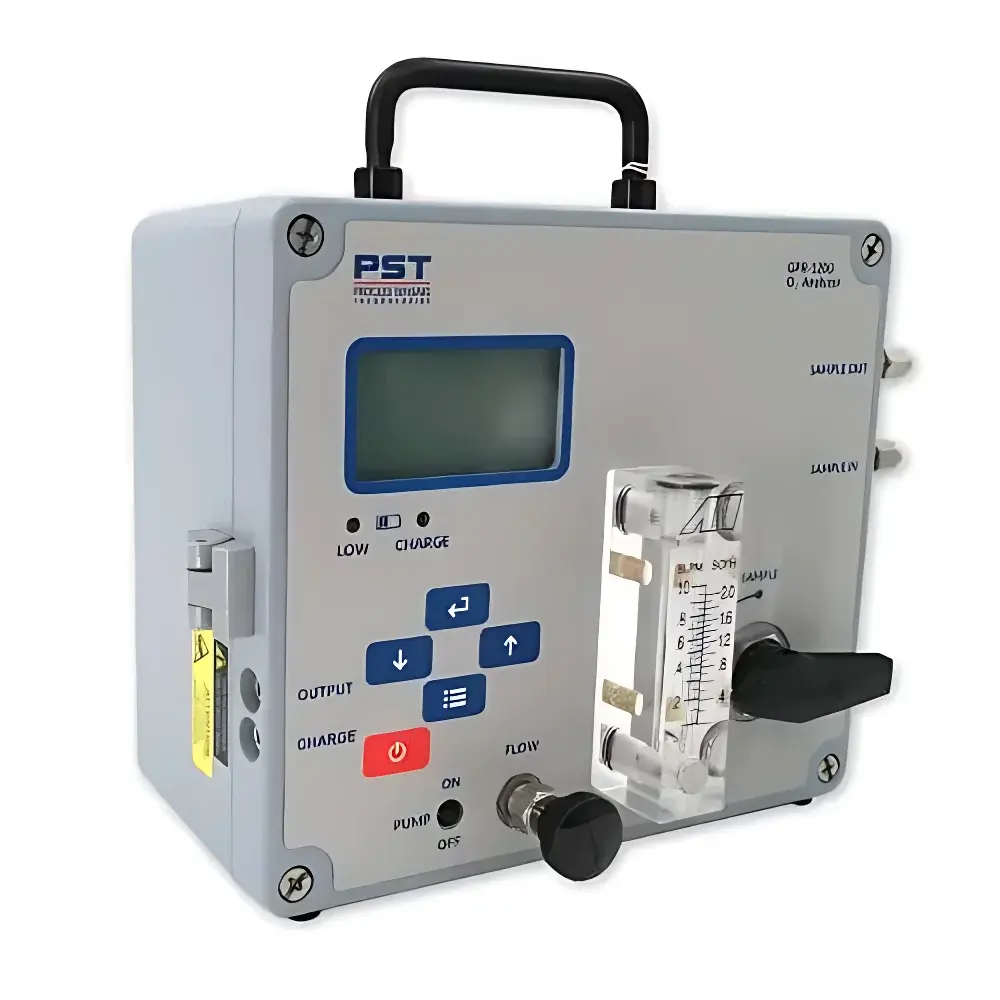
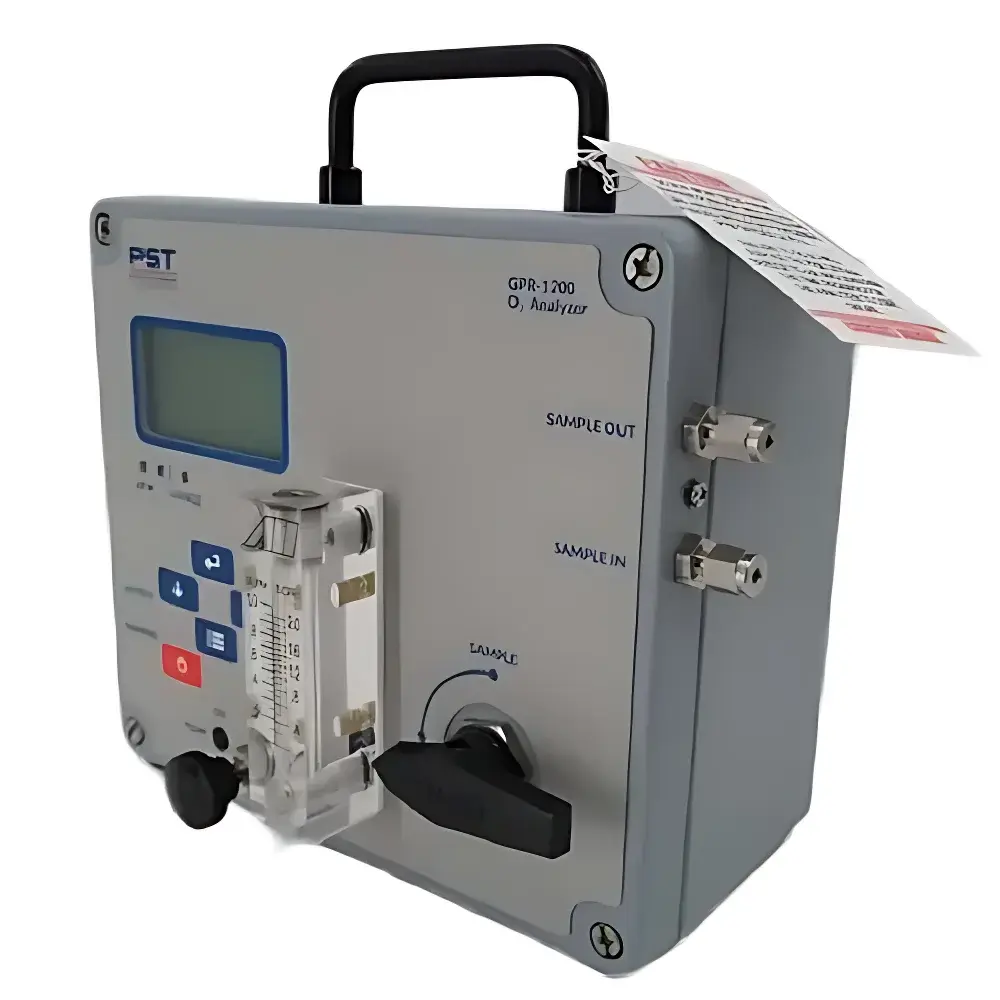
AII GPR-1200 High-Precision Portable Oxygen Analyzer
| Brand | AII |
|---|---|
| Origin | USA |
| Model | GPR-1200 |
| Weight | 5.4 kg (12 lbs) |
| Measurement Range | 0–1 ppm to 0–100% O₂ |
| Accuracy | < 2% of reading or 0.2 ppm (whichever is greater) |
| Response Time (T90) | < 13 s |
| Detection Limit | 0.05 ppm |
| Sensor Lifetime | 24–32 months (at ≤1000 ppm O₂) |
| Battery Life | Up to 30 days (standby), 40 hours (with internal pump active) |
| Operating Temperature | 5–45°C (GPR sensor) |
| Enclosure | Painted aluminum, NEMA 4X rated |
| Gas Inlet | 1/8" compression fitting |
| Pressure Range | 0.34–2 barg (5–30 psig) with vent |
| Output | 0–1 V analog |
| Compliance | ATEX Ex II 2 G Ex ib IIC T4 Gb, Tamb 5°C to +45°C |
Overview
The AII GPR-1200 High-Precision Portable Oxygen Analyzer is an electrochemical gas analyzer engineered for trace and percent-level oxygen quantification in industrial, laboratory, and field-deployed applications. Utilizing proprietary galvanic cell technology—specifically the MS-2 and XLT sensor platforms—the instrument delivers stable, linear, zero-based output across its full dynamic range (0–1 ppm to 0–100% O₂). Unlike conventional amperometric sensors requiring frequent zero/span adjustments, the GPR-1200’s galvanic design ensures intrinsic zero stability and <1% full-scale linearity, enabling reliable single-point calibration at installation and minimal drift over extended operation. Its measurement principle relies on diffusion-controlled oxygen reduction at a noble metal cathode within a sealed, temperature-compensated electrolyte cell. The absence of external bias voltage eliminates polarization artifacts and extends sensor longevity—particularly critical in ultra-low-oxygen environments such as inert gas blanketing, semiconductor purge validation, and pharmaceutical nitrogen systems.
Key Features
- True zero-output baseline: Sensor signal reads 0 nA in oxygen-free atmospheres—eliminating offset drift and simplifying calibration protocol.
- XLT sensor option: Formulated with acid-resistant electrolyte for stable operation in CO₂-rich backgrounds (>0.5% CO₂), extending usability into fermentation headspace, beverage carbonation, and modified-atmosphere packaging (MAP) verification.
- Integrated four-way sampling valve: Enables rapid, closed-loop sample capture—minimizing sensor exposure to ambient air and preserving service life during mobile surveying.
- Robust NEMA 4X enclosure: Die-cast aluminum housing with IP66-rated sealing, suitable for washdown environments and outdoor deployment under variable thermal and humidity conditions.
- Intelligent power management: Rechargeable lead-acid battery supports 30 days of intermittent use or 40 hours of continuous pumping—validated per IEC 62368-1 for portable instrumentation safety.
- Real-time environmental compensation: Onboard barometric pressure and temperature sensors correct readings per ISO 8573-1 Annex B methodology, ensuring metrological traceability across elevation gradients.
Sample Compatibility & Compliance
The GPR-1200 is validated for direct analysis of non-corrosive, non-condensing process gases including nitrogen, argon, helium, CO₂, and medical-grade oxygen. It is not intended for use with halogenated compounds, hydrogen sulfide, or solvent vapors that may poison the electrolyte. All sensor variants comply with ASTM D6866-22 (oxygen purity testing in inert gases) and meet the functional requirements of USP for residual oxygen monitoring in sterile barrier systems. The unit carries ATEX certification (Ex II 2 G Ex ib IIC T4 Gb) for safe operation in Zone 1 hazardous locations where flammable gas mixtures may be present. Its analog 0–1 V output is compatible with PLCs and SCADA systems configured for 4–20 mA or 0–10 V inputs via standard signal conditioning modules. Full audit trail capability—including calibration events, sensor replacement logs, and environmental metadata—is supported when integrated with AII’s optional DataLink software suite under FDA 21 CFR Part 11-compliant configuration.
Software & Data Management
While the GPR-1200 operates autonomously via its front-panel LCD interface, optional connectivity enables structured data acquisition. The USB-C port supports firmware updates and raw sensor output streaming at 1 Hz resolution. When paired with AII DataLink v3.2 (Windows-based), users can configure automated calibration schedules, generate GLP-compliant PDF reports with digital signatures, and export timestamped CSV files containing O₂ concentration, temperature, pressure, battery voltage, and sensor status flags. All stored records include cryptographic hash integrity checks to satisfy internal QA audits and external regulatory inspections. No cloud dependency or subscription model is required—data remains fully resident on local hardware unless explicitly exported.
Applications
- Validation of nitrogen and oxygen generator performance per ISO 8573-7 purity classes.
- In-transit verification of cryogenic liquid tankers and ISO containers carrying high-purity gases.
- Top-space O₂ monitoring in bioreactors, stainless-steel fermenters, and wine aging tanks.
- Leak detection in gloveboxes, vacuum chambers, and dry rooms used in photolithography tool maintenance.
- Residual oxygen assessment in pharmaceutical blister packaging and lyophilization cycle endpoints.
- Field commissioning of inert gas fire suppression systems per NFPA 2001 Annex C.
FAQ
What is the recommended calibration frequency?
Calibration is advised every 30 days under normal operating conditions, or after exposure to >1000 ppm O₂ for >1 hour. A two-point calibration (zero and span) is only required if sensor response deviates by >2% from certified reference gas values.
Can the GPR-1200 measure oxygen in 100% CO₂?
Yes—but only when equipped with the XLT sensor variant, which maintains electrochemical stability in acidic gas matrices down to –10°C.
Is the internal pump mandatory for all measurements?
No. Passive diffusion sampling is sufficient for static or low-flow applications. The optional internal pump (flow rate: 0.5–1.0 NL/min) is recommended for pressurized lines, long sample hoses (>3 m), or when rapid T90 response is critical.
How is sensor lifetime defined and verified?
Lifetime is specified as 24–32 months under continuous exposure to ≤1000 ppm O₂ at 25°C and 1 atm. Actual service life is tracked via built-in sensor health diagnostics accessible through the menu interface—monitoring baseline current decay and electrolyte resistance trends.
Does the GPR-1200 support Modbus or HART communication protocols?
No. It provides only analog 0–1 V output and USB-C serial emulation. For digital integration, third-party analog-to-Modbus converters meeting IEC 61000-4 immunity standards are recommended.







