
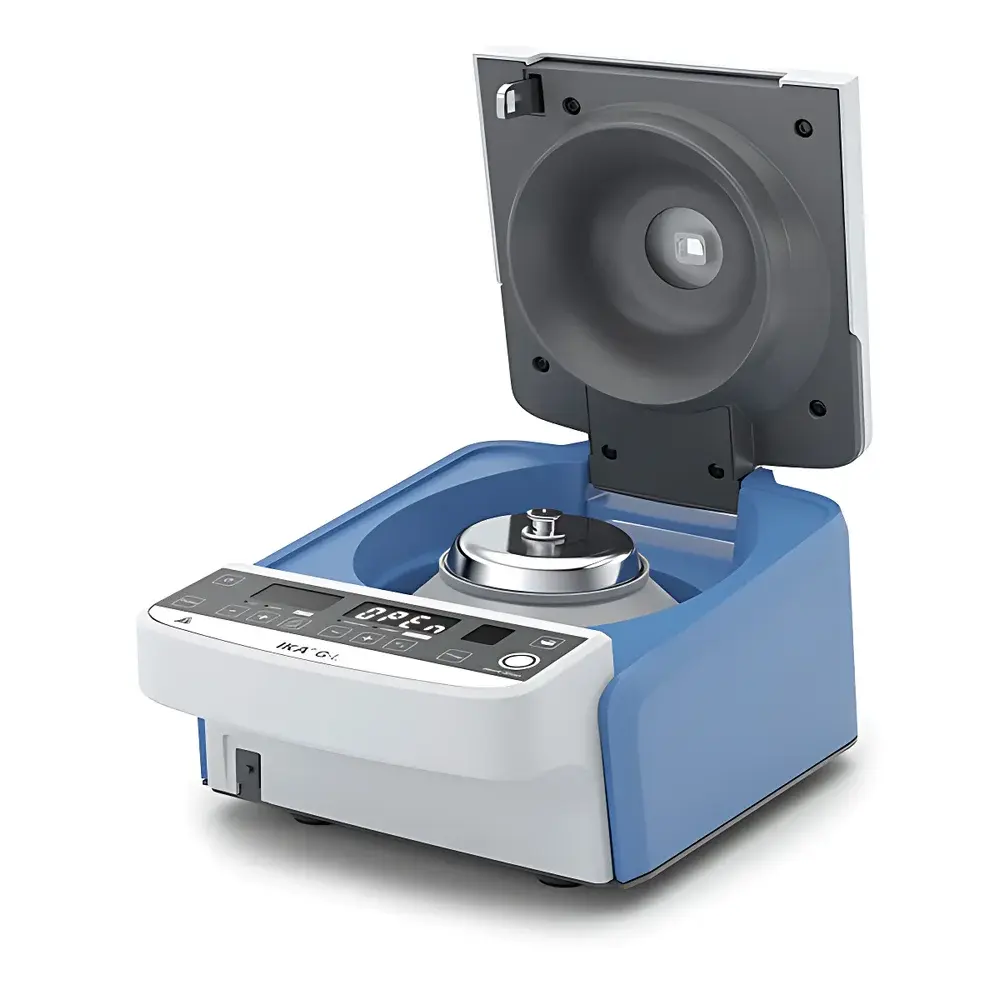
IKA G-L High-Speed Benchtop Centrifuge
| Brand | IKA |
|---|---|
| Origin | Germany |
| Manufacturer | IKA-Werke GmbH & Co. KG |
| Type | Benchtop Centrifuge |
| Speed Range | 800 – 15,700 rpm |
| Max RCF | 16,500 × g |
| Max Capacity | 12 × 1.5/2.0 mL tubes |
| Rotor Compatibility | Fixed-angle rotor (autoclavable at 121 °C, 2 bar) |
| Dimensions (W×D×H) | 200 × 140 × 280 mm |
| Weight | 3.9 kg |
| Power Supply | 220–230 V / 115 V / 100 V, 50/60 Hz |
| Input Power | 92 W (operational), 18 W (standby) |
| Protection Class | IP20 (DIN EN 60529) |
| Operating Environment | +5 to +40 °C, ≤80% RH |
| Safety Features | Lid interlock, imbalance detection, rapid brake, automatic lid opening |
| Display | LED, 7-segment |
| Control Interface | Membrane keypad with RPM/RCF toggle |
| USB Port | Yes |
| Timer | Yes |
| Rotor Auto-Recognition | No |
| Balance Monitoring | Yes |
Overview
The IKA G-L is a compact, high-speed benchtop centrifuge engineered for precision and reliability in routine laboratory separation workflows. Designed and manufactured in Staufen, Germany by IKA-Werke GmbH & Co. KG — a globally recognized leader in laboratory instrumentation — the G-L operates on the principle of sedimentation under controlled rotational force (RCF), enabling efficient separation of biomolecules, cellular components, and particulates from small-volume liquid samples. With a maximum speed of 15,700 rpm and an RCF of up to 16,500 × g, it delivers performance suitable for molecular biology applications including DNA/RNA pellet recovery, PCR product purification, protein precipitation, and microfiltration preparation. Its fixed-angle rotor configuration supports standardized 1.5 mL and 2.0 mL microcentrifuge tubes as well as 8-strip PCR tubes, making it especially suited for high-throughput sample processing in research labs, QC environments, and teaching facilities where space, safety, and reproducibility are critical.
Key Features
- Lid Interlock Safety System: Motor activation is physically inhibited until the metal lid is fully closed and locked — preventing accidental operation and ensuring operator compliance with ISO 13485 and IEC 61010-1 safety standards.
- Autoclavable Rotor Assembly: The aluminum rotor and tube adapters are validated for sterilization at 121 °C and 2 bar (15 min), supporting GLP-compliant workflows requiring bio-contamination control.
- RPM/RCF Dual-Mode Display: Real-time switching between rotational speed (rpm) and relative centrifugal force (× g) via dedicated membrane key, facilitating method transfer across instruments and adherence to protocol-specified g-force requirements (e.g., USP & ASTM methods).
- Imbalance Detection & Rapid Braking: Integrated non-contact sensor continuously monitors mass distribution; if imbalance exceeds tolerance, the unit halts rotation within seconds and displays error code — minimizing mechanical stress and preserving rotor integrity.
- Intuitive LED Interface: Seven-segment display with clear parameter feedback, membrane-based navigation, and programmable timer support streamlined setup without software dependency.
- USB Connectivity: Enables firmware updates and future integration with lab informatics systems compliant with FDA 21 CFR Part 11 audit trail requirements (when paired with compatible IKA software platforms).
Sample Compatibility & Compliance
The G-L accommodates standard conical-bottom microcentrifuge tubes (1.5 mL and 2.0 mL) and 8-well PCR strips, with a maximum load density of 1.2 kg/dm³. Its rotor geometry ensures uniform angular acceleration and minimal sample shear — critical for preserving nucleic acid integrity during pelleting. The device conforms to DIN EN 60529 (IP20 ingress protection), IEC 61010-1 (safety of electrical equipment), and EU Directive 2014/30/EU (EMC). While not certified for clinical diagnostics under IVDR, its design aligns with general laboratory quality system expectations per ISO/IEC 17025 and GMP Annex 11 for instrument qualification (IQ/OQ/PQ).
Software & Data Management
Although the G-L operates as a standalone instrument without embedded data logging, its USB port supports optional firmware upgrades and compatibility with IKA’s Labworldsoft® ecosystem (v5.0+). When connected to a validated PC workstation, users may document run parameters, export timestamped operation logs, and generate electronic records traceable to individual operators — fulfilling basic ALCOA+ (Attributable, Legible, Contemporaneous, Original, Accurate) principles required in regulated environments. All settings — speed, time, acceleration/deceleration profiles — are retained after power cycling, reducing reconfiguration errors.
Applications
- Molecular biology: Pellet isolation of plasmid DNA, genomic DNA, RNA, and synthetic oligonucleotides.
- Proteomics: Precipitation and concentration of low-abundance proteins prior to SDS-PAGE or LC-MS analysis.
- Clinical research: Clarification of serum, plasma, or CSF supernatants for ELISA or multiplex immunoassays.
- Cell culture: Harvesting adherent or suspension cells in small-scale transfection or CRISPR screening workflows.
- Quality control: Routine verification of reagent homogeneity, particle dispersion stability, and filter integrity testing.
FAQ
Is the G-L suitable for continuous operation?
No — it is designed for intermittent use with recommended duty cycles of ≤15 minutes ON followed by ≥5 minutes OFF to maintain thermal stability and motor longevity.
Can I use non-IKA rotors or adapters?
No — only IKA-certified rotors and accessories are approved for use; third-party components void warranty and compromise safety certification.
Does the G-L meet FDA 21 CFR Part 11 requirements out-of-the-box?
Not independently — full Part 11 compliance requires integration with validated software, electronic signatures, and audit-trail-enabled infrastructure, which must be implemented at the institutional level.
What maintenance is required?
Routine cleaning of the chamber and rotor with 70% ethanol; annual calibration of speed and timer accuracy by an IKA-authorized service center is recommended for ISO 17025-aligned labs.
Is the rotor balanced automatically during acceleration?
No — manual balancing is required prior to each run; however, the built-in imbalance sensor provides immediate shutdown if deviation exceeds ±0.5 g across opposing positions.



